
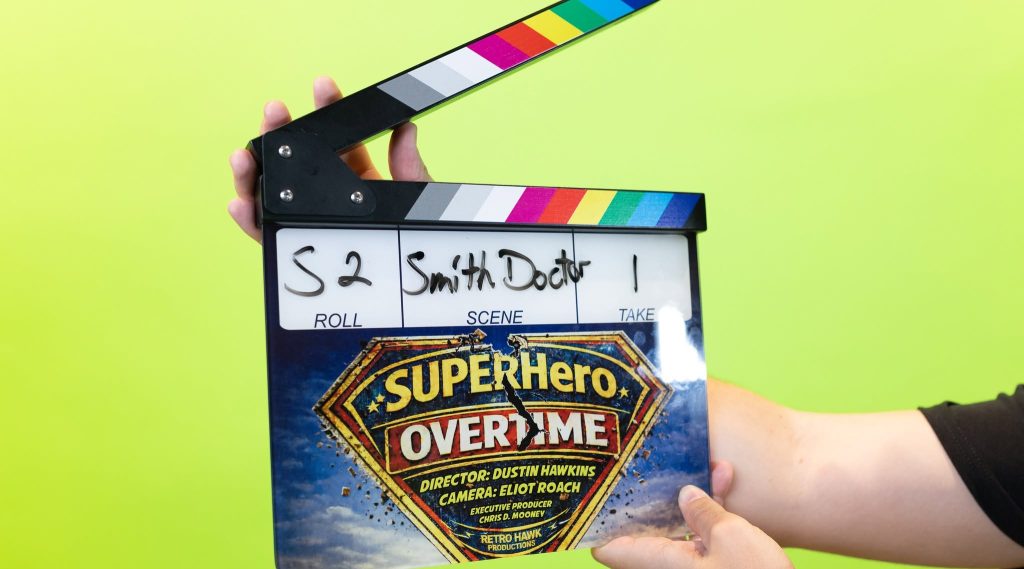
A film about an overworked superhero might sound like another entry in the ever-growing comic book genre, dominated by Marvel and DC. But Superhero Overtime, a locally filmed short shot primarily in Boonville, takes a decidedly different approach. There are no sprawling battle scenes or city-destroying villains at the center of the story. Instead, writer and director Dustin Hawkins explores the far more realistic struggles with burnout, isolation, and the belief that asking for help is somehow a sign of weakness.
Filmed in mid-April 2026, Superhero Overtime reimagines superheroism as a profession: one with long hours, personal sacrifices, and responsibilities that don’t disappear when the cape comes off. The inspiration, interestingly, came from Monsters, Inc. and its vision of fantastical work treated as ordinary labor.
“People don’t picture Superman stopping for a Diet Coke after work,” Hawkins said, laughing. “You think of him rescuing people from burning buildings.”
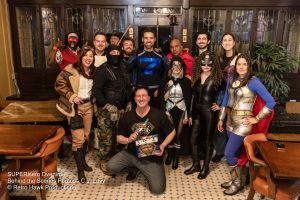
The film follows Zip (played by Kevin Caliber), a celebrated hero who begins taking every rescue call himself. Part of it is his ego — he enjoys the recognition that comes with being the city’s favorite hero — but a larger part stems from a conviction that if he doesn’t answer the call, no one else will. As other heroes (portrayed by Keith Nussbaum, Rachel Klewicki, Wyatt Weed, Firas Al Shakarchi, Tristan Wilder Hallett, and Catera Combs) find themselves sidelined and increasingly disconnected from their purpose, Zip pushes himself harder and harder, convinced that self-sacrifice is just part of the job.
That grounding in everyday life gives Superhero Overtime its emotional core. Underneath the colorful costumes and superhuman premise lies a story about learning that even the best heroes sometimes need help, and that communities function best when responsibility is shared rather than borne alone.
It’s a lesson that extends past the film itself and into the realities of independent filmmaking.
It Takes a Village to Make a Movie
Independent filmmaking is rarely the work of one person. Even the script of this particular production was a collaboration between Hawkins and his co-writer, Kira Lee Harris.
“With almost all of my films lately, I’ll have a co-writer,” says Hawkins. “Basically, someone to keep me in check. Help keep me real. I’m very, very big in narrative stuff and fantasy, and sometimes I tend to go too far one direction or the other, and my co-writer helps keep things in check.”
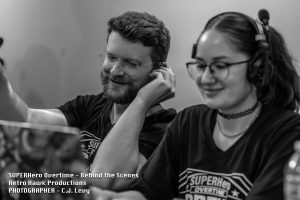
By the end of production, roughly 50 to 60 cast and crew members — some traveling from out of state — had contributed to the project, including students and recent graduates from the University of Missouri, Stephens College, and Moberly Area Community College. Among them was assistant director Emma Gomez, a recent Mizzou graduate who stepped into the role for the first time on Hawkins’ set.
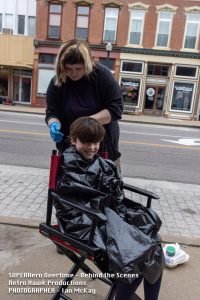
Students observed shoots, assisted on set, and gained firsthand experience with everything from lighting setups to production logistics — opportunities that can be difficult to find outside major film hubs, especially for first-timers.
Those experiences and connections were made possible in large part through support from Vidwest Studios, Columbia’s local media center, which provides affordable equipment, space rentals, and education to aspiring creators.
For many independent filmmakers, access to professional equipment represents one of the biggest barriers to creating work. A single production can require upward of tens of thousands of dollars in cameras, lighting, audio gear, and production tools. And Superhero Overtime was no exception. According to Hawkins, the production relied on roughly $40,000 worth of equipment, with a significant portion provided through Vidwest.
“There’s no way most independent filmmakers could afford that equipment on their own,” he said. “Without Vidwest, a lot of these projects wouldn’t happen. Vidwest is literally Columbia’s filmmaking family.”
Fighting for Creative Infrastructure
Hawkins’ film is currently in post-production, while the future of Vidwest remains a little more up in the air. The nonprofit media organization was notified in June 2025 that its city funding agreement — which had provided $35,000 annually — would expire in August 2026. Since then, Vidwest representatives and supporters have regularly appeared before the Columbia City Council to advocate for restoration of the city’s investment in the organization and the creators it serves.
“When there’s a budget shortfall like the city is currently experiencing, the squeaky wheel is the one that gets the grease. And there are a lot of squeaky wheels,” says Matt Schacht, co-founder and studio manager of Vidwest. “Community media has a particular challenge because of its artistic elements, which can be viewed as nonessential. For city leaders who have not experienced Vidwest’s services or used the space, they may underestimate the value that a safe and welcoming community space can mean for people’s connection to Columbia.”
Schacht encourages everyone who feels moved by Vidwest’s mission to consider voicing their concerns at City Council meetings and budget town halls.
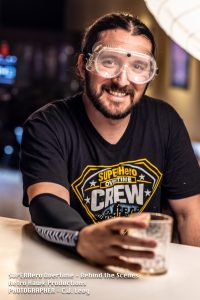
Among those who have already stepped forward is Colin Skinner, a Columbia local, boom operator on Hawkins’ Superhero Overtime, and Vidwest member, who delivered his testimony to council members on May 18.
“Before [finding] Vidwest, I was always telling my friends about creative ideas, but it stopped there — always just concepts with no pipeline to reality,” said Skinner. “No way to actualize this creative part of me. Then a friend told me about Vidwest. … I’ve been part of organizations before, but none that fit my personality and dreams so precisely. I had that feeling of belonging, where I could say, ‘This is where I’m meant to be.’”
Skinner recently made his directorial debut with a short film he wrote, titled Smartphone of Power. Thanks to connections made at Vidwest, he was lent an anamorphic camera lens valued at $10,000 and given access to a RED camera, which typically costs at least $12,000 for a production-ready kit. Additionally, Vidwest donated approximately $2,000 worth of equipment for the project, which was filmed on July 11.
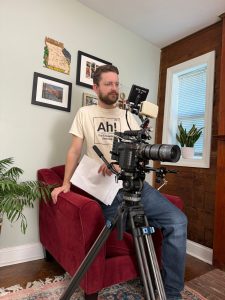
Beyond providing access to affordable equipment, Vidwest offers classes, such as foley and photography, as well as collaborative spaces for filming, audio production, and other creative work that enable filmmakers, students, and hobbyists to develop technical skills and build professional connections without leaving mid-Missouri.
“[Vidwest] is Willy Wonka’s factory,” says Van Windsor, an associate producer on Superhero Overtime, producer/grip/gaffer on Smartphone of Power, and studio manager-in-training at Vidwest. “Strange and a little rough-looking on the outside, but on the inside, it’s a magical wonderland of imagination and creativity that offers limitless opportunities for people to express themselves in a safe and nurturing environment.”
Members aren’t just from Columbia, either. According to Hawkins, they also come from places such as St. Louis, Kansas City, and smaller surrounding towns, regularly traveling to Columbia specifically because those resources exist here.
Everyday Superheroes
A lot of the work that makes local art possible happens behind the scenes. Audiences see the finished film, but they don’t see the borrowed camera lens, the low-cost workshops, or the conversations that turn a group of strangers into lifelong collaborators. For many aspiring filmmakers, organizations like Vidwest provide the tools, connections, and encouragement needed to take an idea from a concept to a finished project.
Films like Superhero Overtime and Smartphone of Power are examples of what can grow when creators have access to the right tools and a tribe behind them. It’s also a reminder that local arts scenes aren’t built by coincidence or sustained by accident, but rather, developed through shared equipment, mentorship, education, and communities willing to invest in giving creators a place to learn, experiment, and make things together.
In Hawkins’ film, Zip learns that trying to carry the weight of an entire city by himself leaves him exhausted and alone. The same is true of creative cohorts. No filmmaker builds a career alone, and no arts ecosystem sustains itself without support.
For more information about Hawkins’ film, visit the Superhero Overtime Facebook page. Those interested in advocating for community investment in local filmmaking and media education can contact Vidwest at [email protected].