
Part 1: HHS is born and comes to grapple with its original sin.
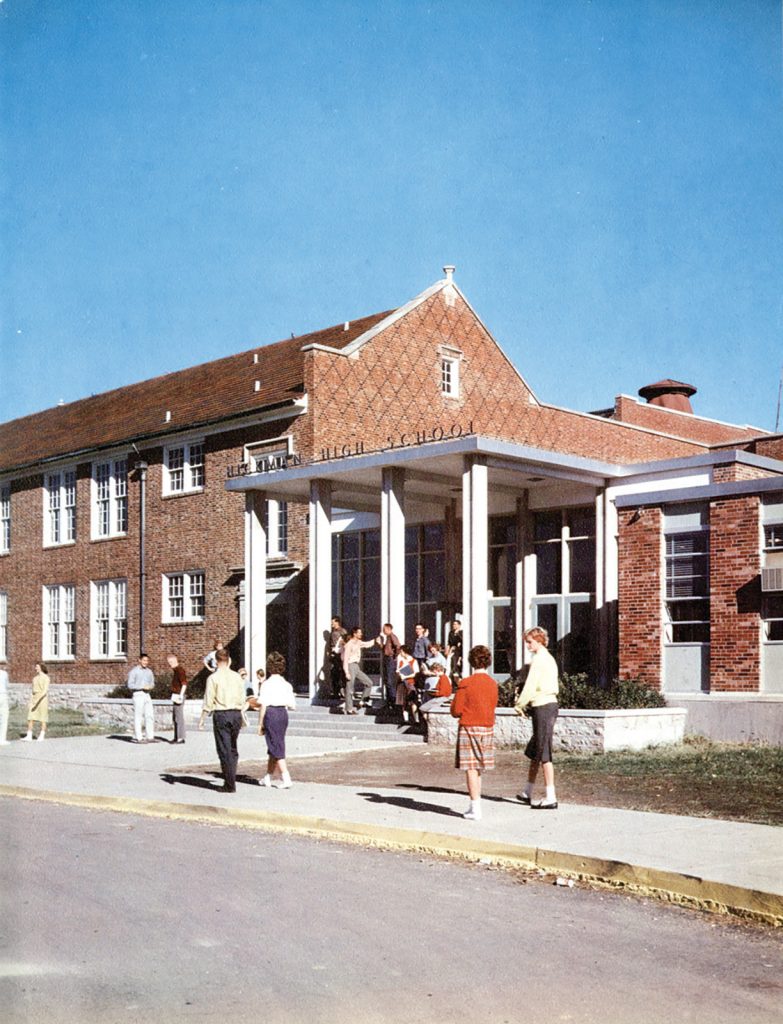
Next year, Hickman High School will graduate its 100th set of Kewpies. This is also a period of transition for Columbia’s grandest, oldest public high. Many veteran teachers retired in the wake of COVID-19, and many more are getting close to pension age. There’s been shake-up at the top: One year after Jeff Klein became the new district superintendent, Virginia Tate will be coming from suburban Rock Bridge High to take the reins as principal for the 2026-27 school year. Six years after lockdown, HHS is just now coming out of the post-pandemic malaise: Many teachers say that the last school year was the first of the twenties that “felt normal.”
Today’s faculty are also working through a whole host of modern problems: how to make their TikTok-addled pupils pay attention in class, how to tell if that student essay was AI-generated, and how to enforce the state’s strict new phone ban. The grown-ups are also reeling from the news that Hickman’s been placed on a state watchlist for subpar standardized scores among students with Individualized Education Programs. They know they have two short years to “demonstrate improvement” before the state (in the worst-case scenario) takes over lesson planning and tells Hickman’s proudly independent teachers how to run their classrooms.
And they know that Hickman has a proud academic legacy to defend. With a century of churning out university matriculants, scholarship winners, and Presidential Scholars behind it, many teachers regard academic excellence as a core school tradition. “Tradition, Integrity, Diversity, and Excellence are what we have considered four pillars of Hickman High School,” says biology teacher Noelle Gilzow, “and they’re hard to separate from each other. … There’s a tremendous amount of historical pride.”
This academic prowess has long been complemented by a top-notch arts program. The school boasts a theater program that puts on five shows per year, four symphony bands, two jazz bands, a 200-student marching band that draws more people to the games than the football team. And though Kewpie athletic prowess has waxed and waned over the years, right now the wrestling and track teams are racking up the wins. As Ronald Reagan mused during his 1987 visit, “From the look of the trophy cases in the hall, one time or another, the Kewpies have been champs in just about everything.”
If the faculty is feeling antsy about its test scores, they would do well to remember that that is not the first challenge that their school has faced. And if Hickman’s students (as its teachers like to remind you) are a microcosm of Columbia, then its history is a mirror of the city’s. Over its first century, Hickman has borne witness to some of the greatest challenges (depressions, wars, pandemics) American society has faced. During the civil rights era of the 1950s and ’ 60s, Hickman was one of the central places where Columbia worked through the necessary struggle of desegregation. With a multiethnic student population that includes professors’ brats and farm kids, wealthy families and poor ones, liberals and conservatives, part of the daily mission of the Hickman teacher is getting their pupils to look past their differences and learn from each other as fellow scholars and citizens.
Becoming Kewpie Kingdom: HHS Through the Decades
Hickman may be the oldest of Columbia’s current public high schools, but it’s not its first. That distinction is shared by Jefferson and Douglass schools, which began offering some sort of secondary education (for white and black kids, respectively) in the 1880s. Nor is it Columbia’s first purpose-built high school, which would have been a new building on the Jefferson site in 1900. Even the famous Kewpie mascot predates Hickman. While the origins of the Hickman Kewpie are shrouded in mystery, one standard story is that school secretary Josephine Hickem would bring her then-trendy Kewpie doll to varsity games as a good luck charm in the 1910s. When the Columbia High basketball team won state in 1914, someone drew a Kewpie on the cover of that year’s Cresset to commemorate the victory. The naked baby mascot has stuck around ever since.
By the 1920s, Columbia had grown too large, too fast to accommodate all of its white high school students in its then-current edifice. In 1925, the school board announced its intention to build a new, bigger-and-better school and found a massive site for it: 40 largely undeveloped acres that had once been the estate of prominent early Columbia politician David Henry Hickman. Because the title to the land was under dispute, the site was also a steal. The school district could scoop up the tract for cheap, use its eminent domain powers to clear the title, and have plenty of land for a school, athletic fields, and — now that automobiles were a concern — parking. The city’s leading citizens also hoped that a new school, located right on the newly minted U.S. 40, would help spur development north of town.
The voters approved the bond issue, and two years later, Hickman High School opened its doors to students on September 19, 1927. With a 1,204-seat auditorium, a gymnasium that could be converted into two, and the best lab equipment in the school district, Principal Saidee Stean regarded the new school as a huge improvement. Stean told the Missourian that, while the old high school’s curriculum had been “strictly of a college preparatory nature,” the new school would offer vocational education, home economics, and other subjects that might appeal to the non-college-bound student.
Two years later, the stock market crashed, the country plunged into the Great Depression, and vocational education took on an even greater importance at the school. Fearing that Columbia’s youngsters were “hopelessly lost in an economic, social, and moral forest,” history teacher Fred Dixon launched Hickman’s first guidance program in the mid-1930s. Recognizing that different students had different needs, Dixon hoped that the guidance program would provide the individual support and career coaching (including on-the-job training at local businesses) that students would need to thrive in troubled times.
Extracurricularly, the thirties also saw a massive expansion of the school’s music program under C.M. Stookey, the creation of an award-winning Verse Speaking Choir by speech teacher Helen Williams, and many new activity clubs that were allowed to meet during the school day. Athletically, the Kewpie football, basketball, and wrestling teams were practically undefeated in the decade. Jobs may have been in short supply, but Hickman found plenty for its students to do.
When the United States entered World War II, Hickman played its part: Kewpies collected scrap metal, bought war bonds and savings stamps, planted victory gardens, and knitted sweaters and afghans for troops overseas. The school also began offering courses in aeronautics, international relations, and nursing. And with a need for more skilled labor to work defense factories in Kansas City and St. Louis, the school district tapped history teacher Delbert Dunkin to run a manpower training program for 17-and-overs that would teach such skills as machine tool operation and slide-rule proficiency.
The war stirred Kewpies’ artistic sensibilities as well. In December 1943, the Verse Speaking Choir held an operatic Trial of Hitler, in which students playing such characters as France, Czechoslovakia, Uncle Sam, Lady Liberty, and the Spirit of Religion all condemned the Nazi dictator for attempting to destroy humanity’s freedom. The 110-student production was preceded by a memorial service for the Hickman alumni who had thus far lost their lives in the fight against fascism. (By war’s end, that number would reach 36 servicemembers. They are honored today by the American Legion flagpole that stands in front of the school’s north entrance.)
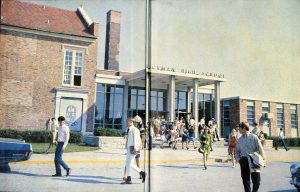
In the postwar years, Hickman was ground zero for a major transformation of Columbia’s public education system: the end of racial segregation. While the school now takes great pride in its diversity, we must remember that Hickman was originally built for white Columbians only. Between the 1880s and 1954, all public primary and secondary education provided to black Columbians took place at Douglass School.
That changed on paper shortly after the Supreme Court outlawed school segregation in Brown v. Board of Education on May 17, 1954. The school board met on July 6, and upon the recommendation of Superintendent Neil Aslin, formally ended segregation in Columbia Public Schools. At the elementary level, Douglass became a zoned neighborhood school, and Black high school students could now enroll in Douglass or Hickman as they pleased. Save for the Ridgeway Elementary PTA, which threatened to cancel the annual chili supper in protest (it didn’t), Columbia was spared the sort of organized white intransigence that plagued school integration in the deeper South. Aslin and the school district honchos patted themselves on the back for a job well done.
Alas, desegregation does not equal integration, and the real integration of Hickman was very slow to come. Though Hickman was stronger academically (years of budgetary neglect had left Douglass with fewer teachers, textbooks, microscopes, etc.), Douglass was the central social hub of Columbia’s black community, and most black parents didn’t want to send their kids to get picked on by white students down the road. As a result, Hickman still had only six black students in 1958.
Some of those kids, like John Kelly (’60), had been urged to enroll by local NAACP leaders who thought they could handle the pressure. Once Kelly arrived at Hickman, he was surprised to see that the biology classroom had one microscope per student rather than the three-for-the-building deal that Douglass had. “When you look at a system that’s trying to keep a specific segment of the population underfoot,” Kelly reckons now, “then that’s the way to do it. You deny people the opportunity to learn and have experiences. … That’s how you keep people having no aspirations.”
Eager to speed up the pace of desegregation, the school district’s solution was to methodically wind down operations at Douglass and force black kids to attend Hickman. First, in 1957, it sold the athletic field to the Housing Authority in the name of urban renewal. Then, in the 1959-60 school year, it canceled the advanced academic courses in Douglass, making Hickman the only real option for college-bound black students. Finally, it canceled all high school classes at Douglass in 1960 and dispersed its faculty among the rest of the school district. Out of the former Douglass High School faculty, only Vice Principal Eliot Battle and English teacher Ruth Wiggins made the move to Hickman.[1] The reverse option (zoning white kids for Douglass) was not something the school district seriously considered.
In Part 2, hear how HHS navigated the turbulent 1960s “the Kewpie way” to become the multicultural academic and extracurricular powerhouse it is today.