
HISTORIC PRESERVATION doesn’t just preserve aging structures in Columbia — it also creates and sustains jobs.
More than 947 total direct and indirect jobs were created over the past 10 years, with about 120 jobs sustained per year, according to an economic impact report released in September by the Historic Preservation Commission. Jobs directly impacted by historic preservation include construction, architecture, financial services and legal disciplines.
Brian Treece, chairman of the Historic Preservation Commission says the study cost $20,000. About a sixth of the total cost was granted by the City of Columbia in the form of employee human hours, which were used to pull city data for the report.
The report studied several aspects of historic preservation, including the impacts of tax credits to businesses engaging in historic preservation, the appreciation of historic property in Columbia and the effects of preservation on sustainability over the past 10 years. Although reports on the economic impact of historic preservation have been made in the past, the Columbia report is the first in Missouri to be done at a local level.
Fueling economic activity
According to the 50-page report, $201 million of economic activity in Columbia can be attributed to historic preservation. For every dollar spent on historic preservation tax credits, $4.40 is generated, which Treece believes to be a pretty conservative number.
Development Strategies, a company based out of St. Louis, was chosen to preform the study because of its prior work in economic impact studies as well as its relationship with the City of Columbia.
“The group had a history in Missouri and with the city,” Treece says. “We wanted the study to be independent, but we also wanted it based out of the Midwest.”
To measure how historic preservation has affected Columbia’s downtown, the study compared property value records of properties throughout Boone County over the past 10 years. Historic properties in downtown appreciated more in comparison to non-historic properties located downtown and throughout Boone County.
But job creation and property appreciation aren’t the only reasons to be interested in preservation. When it comes to sustainability, historic preservation not only saves on the cost of building materials (because those bills were paid years ago), but it also means more dollars can be invested in labor, according to the report. Preservation requires skilled labor, specific materials and trained service professionals to do the necessary work. As a result, the money generated by preserving a historic building is higher.
“This is good, clean, green job creation,” Treece says. “And it creates more jobs than a new construction.”
Keeping what’s best
Over the past 10 years in the City of Columbia, there have been 35 demolitions per year, 26 of which averaged 1,500 square feet and were more than 50 years old. The resulting debris piles up to more than 2,450 tons of waste in Columbia’s landfill, according to the report.
When all is said and done, Treece says he hopes the report will help protect and generate new opportunities and projects for historic preservation.
“What makes Columbia unique is that we have an authenticity and an identity,” Treece says. “People gather in these historic places, and we ought to keep what’s best of Columbia and make it great.”
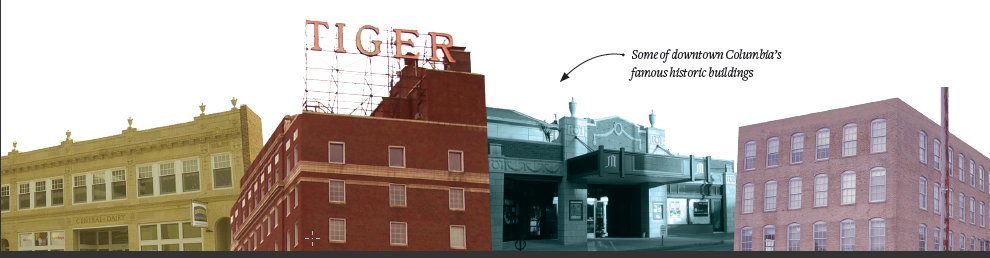
Here are a few of the projects you might know that are receiving state historic tax credits:
Hamilton-Brown Shoe Factory
Tiger Hotel
Ballenger Building
Central Dairy Building
Missouri Theater
Lindsey Jewelry Building
Renie Hardware
McGlasson Distributing Building