
“Few in the nineteenth century doubted that grave dangers lurked behind the foolish hopes of some that young women could achieve success in higher education. As late as 1873, Edward Clarke, writing in Sex in Education, stated that higher education would destroy the ability of women to bear children by overtaxing the female body at a critical stage of its development.”
— Paulina Batterson,
150 Years of Courage, Commitment, and Change
A Radical Beginning
Founded in 1851, Christian Female College — now known as Columbia College — was established with a trailblazing, radical mission: to educate young women in the liberal arts. As the first state-chartered women’s college west of the Mississippi River, CFC was no finishing school. Students engaged deeply with history, science, mathematics, literature (“belles lettres”), instrumental music, and the fine arts. Within a few years, the curriculum stretched even further — into ancient geography, rhetoric, physiology, trigonometry, and constitutional law — with opportunities to study modern languages, music, and art.
In its early days, CFC functioned as a two-year institution and, alongside Stephens College (est. 1833), offered opportunities women could not find at the then male-only University of Missouri. While the institution reflected the limitations of women’s education at the time, it also reflected a growing shift in what women’s education could be. As noted in Paulina Batterson’s 150 Years of Courage, Commitment, and Change, the school was recognized as a pioneer, predating institutions such as Vassar (1865), Wellesley (1875), and Smith (1875). It also operated at “a truly collegiate level, sharing some texts, faculty, and board members with the University of Missouri.”
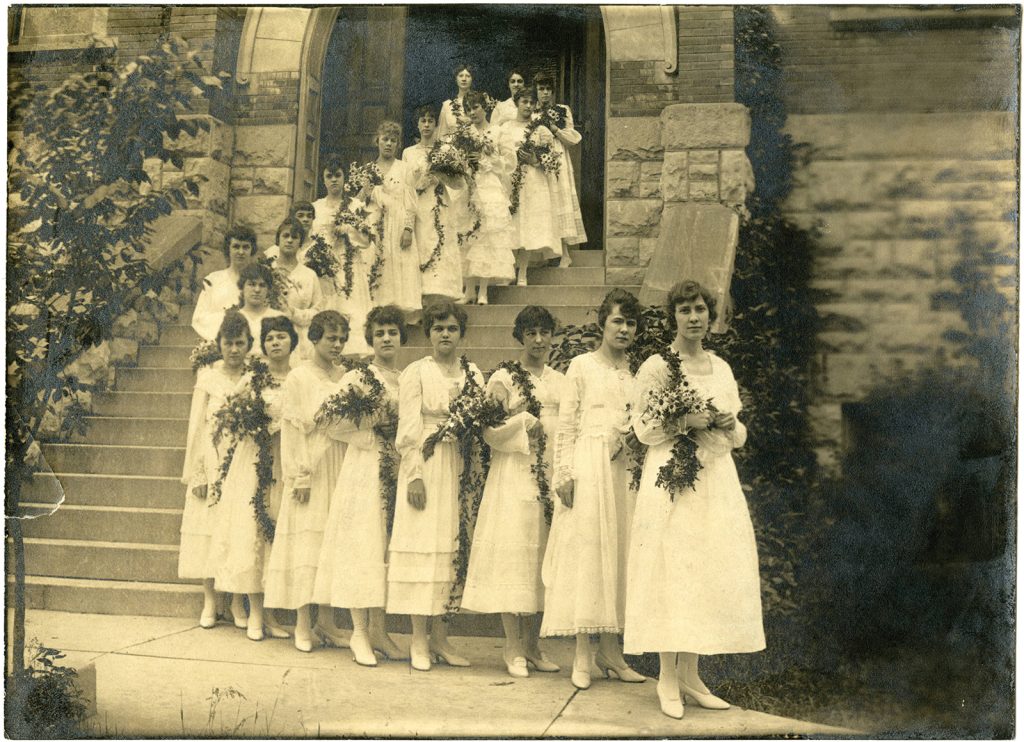
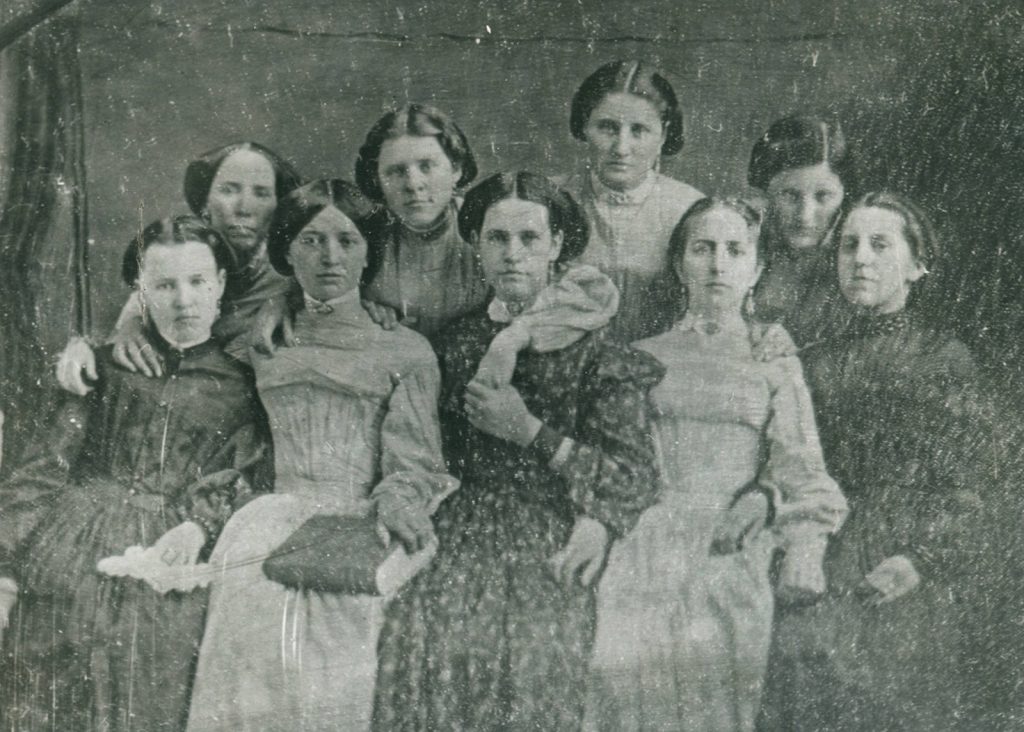
CFC began its first academic year in early April 1851, with a student body of seven aspiring scholars. Six of these students — Sarah Reeds, Adaline Jones, Emma Jameson, Emma Gordon, Martha Shirley, and Sallie Bedford — would eventually make up the first graduating class in 1853.
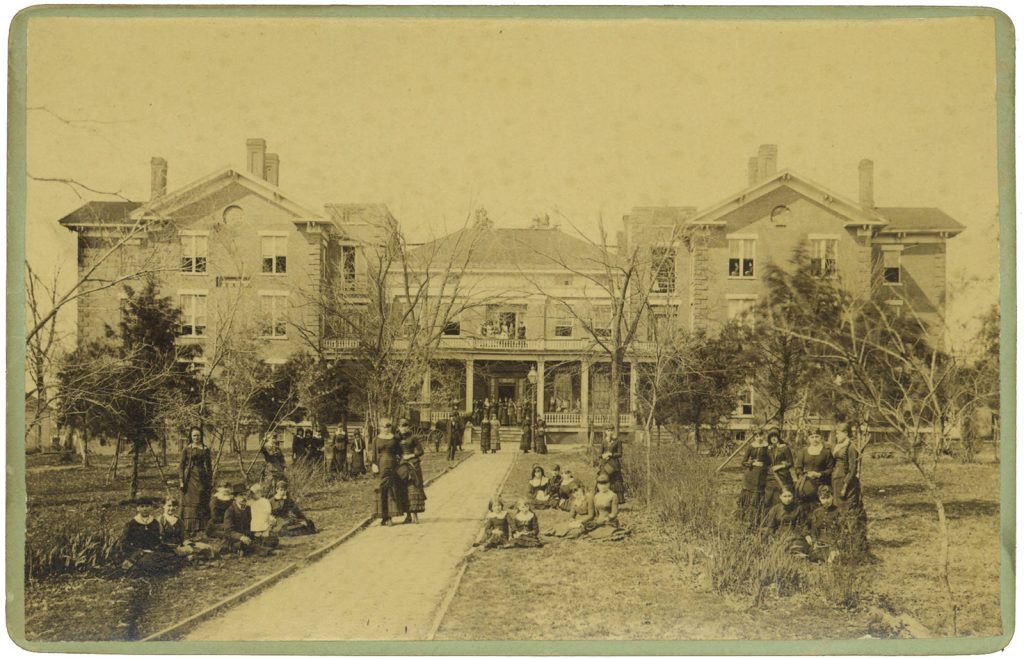
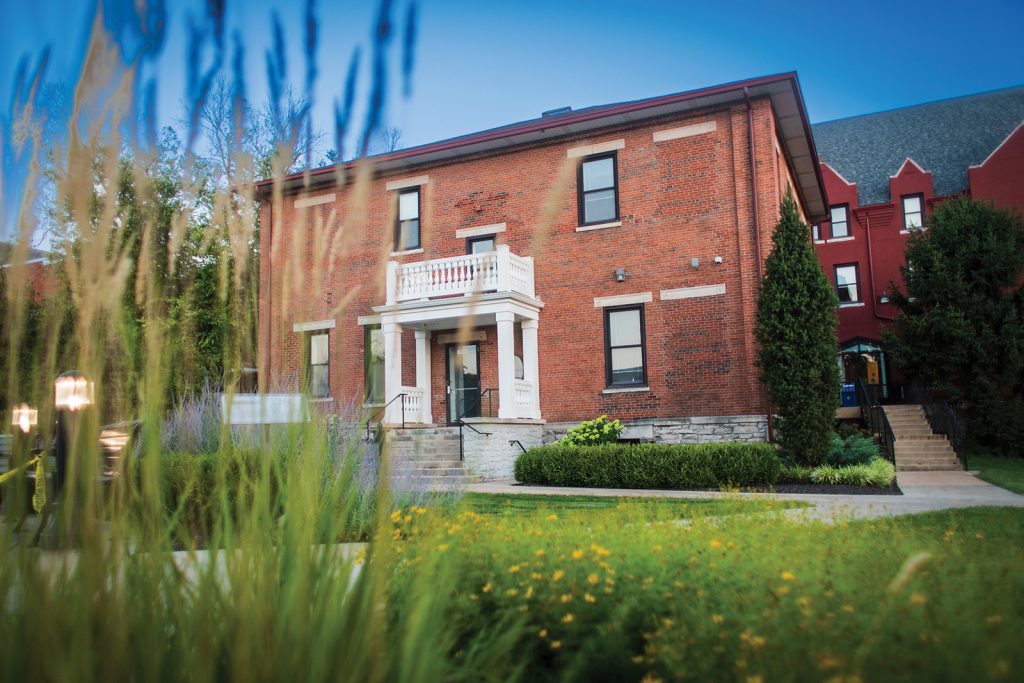
During its first session, classes took place in the snug, one-room Christian Church on Seventh Street and a two-room storehouse, though the college would go on to secure its future that fall by purchasing the 29-acre estate of local physician and civic leader Dr. James H. Bennett. The unfinished house that accompanied this purchase is now recognized as Williams Hall, the oldest collegiate building still used for academic purposes.
Once the structure was completed, it gave CFC’s ambitious vision a more permanent physical home, offering space for both classes and living quarters. Though modest in size — initially featuring just five rooms — it conveyed an undeniably strong message of growth and endurance.
The faculty also proved deeply committed to the college’s success. Several presidents were educators themselves, including the first president, John A. Williams, and later Edgar Lee. Throughout the Civil War, teachers remained dedicated to the college despite facing uncertain pay, and during the Great Depression, they pledged one month’s salary to support the construction of Hughes Hall, which was completed in 1939.
Over the decades, CFC continued to evolve, consistently pushing boundaries and reimagining itself beyond its academic strengths. Physical education, for example, became a priority.
In 1903, President Luella Wilcox St. Clair (later Moss) — the institution’s first female president — helped establish the college’s first competitive basketball team. In A Look Through Rogers Gate: A Pictorial History of Columbia College, author Annie Devoy writes, “Filled with a seemingly endless supply of energy herself, [St. Clair] scoffed at the notion of female frailty.” Games were played against neighboring high schools, accompanied by the spirited cheer: “Boom-a-lack! Chick-a-lack! Who are we? We’re the girls from old C.C.”
St. Clair Moss epitomized the strong female spirit on which the college was founded. Batterson notes, “When Luella Wilcox St. Clair Moss finally retired from the college in 1920, the original Bennett building remained, but a completely new campus had been constructed around it during her three terms as president of what had become a respected junior college.”
In the late 1930s, dance transitioned from a recreational activity into a formal discipline when the college (known simply as “Christian College” since 1929) added seven dance courses to its catalog, officially establishing it as a major. Other significant athletic highlights included the construction of an on-campus lake in 1904 for swimming, boating, and skating; the completion of Dorsey Gym in 1911; the addition of a $25,000 swimming pool in 1919; and the swap from a centaur mascot to Scooter the Cougar in 1984. Over the next several decades, the college would expand its varsity offerings, more recently adding eSports in 2016 and men’s lacrosse and women’s bowling in 2017.
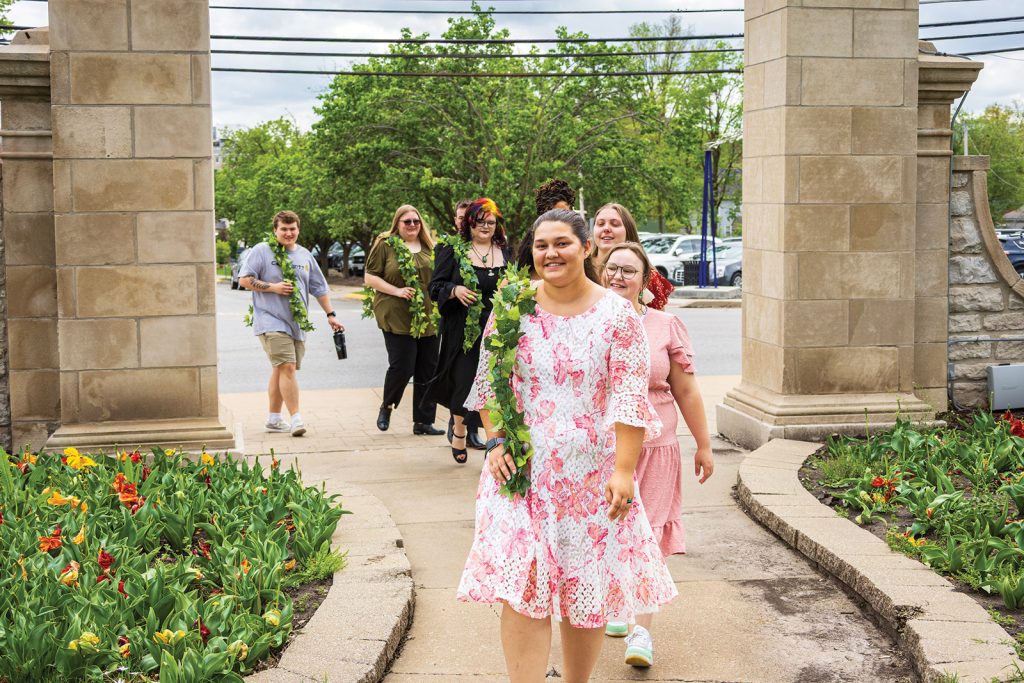
Beyond its sports programs, Christian College valued cultivating connections through long-standing traditions, such as the Ivy Chain ceremony, which began in 1900. The custom involves senior students standing in a circle on the lawn of Bass Commons, draped — as the name suggests — in a chain of ivy leaves to symbolize unity. Until recently, the chain was continuous and linked the students; at the end of the ceremony, each student’s portion of the chain would be cut at both ends, allowing the students to break free into the world while still cherishing their established connection to their alma mater. Although the ritual has since been slightly altered to feature individual pieces of ivy, its symbolic significance remains intact.
Since 1996, the school has also celebrated a holiday lighting tradition, showcasing over 5,000 lights along the gables of the school’s most beautiful historic buildings, such as St. Clair Hall and the Atkins-Holman Student Commons. This event, celebrating its 30th anniversary in 2026, brings together staff, students, alumni, and community members for a joyous night that marks the beginning of the holiday season.
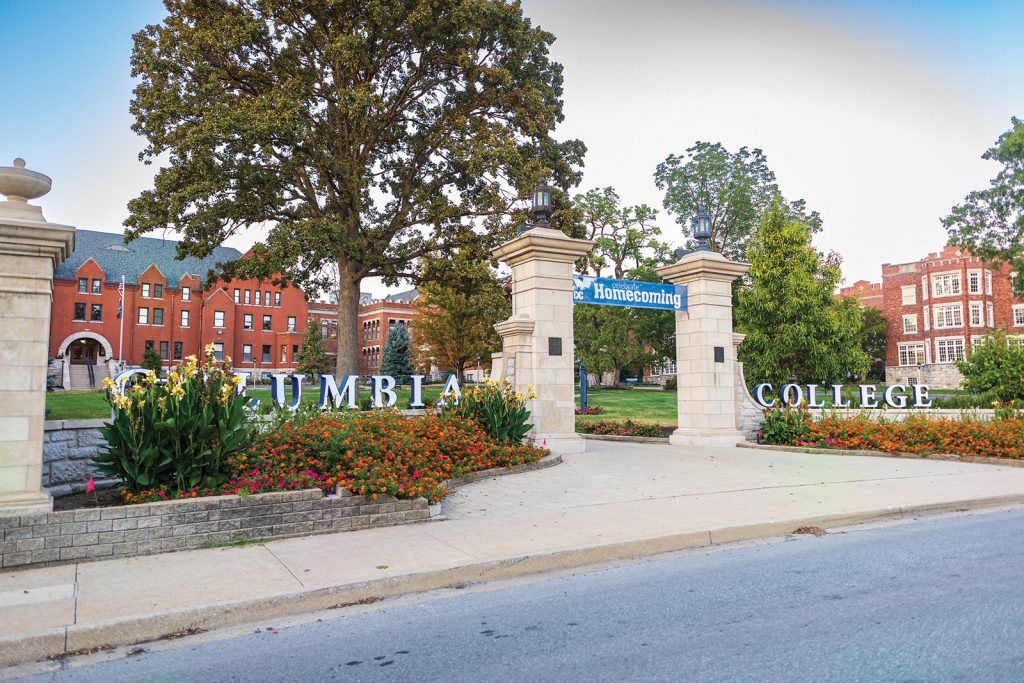
One of the most significant changes in the college’s history, though, occurred on July 1, 1970, when Christian College was renamed Columbia College. The institution also transitioned to a four-year, coeducational model and began welcoming students of color. This decision reflected CC’s commitment to progress and indicated a promising future as it sought to expand its programs and adapt to societal changes.
A Look Into the Crystal Ball
As the school approaches its 175th anniversary, faculty and staff have been reflecting on what it means to be a CC Cougar — and what that identity will look like for future students. The milestone also coincides with the arrival of Toby J. Arquette, who stepped in as the college’s 19th president in March, succeeding David Russell.
“As I think about 175 [years] and then the next 175, it’s a powerful time for the college to reflect on who we’ve been — and to come together to imagine what we want to become,” Arquette says.
That vision will take shape through strategic planning this summer, though Arquette is quick to note it won’t be “run-of-the-mill.” Instead, he sees it as an opportunity to co-author the college’s story alongside the board, faculty, staff, students, and the broader community. The process will also use backward design, starting with where they want students to be, then asking, “How do we get there?”
In looking ahead, Arquette points to the college’s long history of reinvention as its legacy — one he hopes to maintain.
“I see [invention and reinvention] as an enduring theme of my presidency. When Christian College became coeducational, it was an effort to reimagine itself,” he says.
That spirit has continued in other defining moments, from CC’s expansion to military bases in 1973 to its launching of online courses in 2000, among the earliest efforts of their kind. Today, the college serves service members, veterans, and military families online and at more than 20 locations nationwide, including 14 on military installations. It also offers more than 70 online degree programs, reaching approximately 3,200 students each year.
Arquette feels that, in addition to reimagining itself, CC has continued to sustain its mission of serving students’ needs.
“We have roughly 100 various types of degree pathways, which is a testament to the idea that we want to meet students where they’re at, with the different types of educational degrees they want to pursue, from associate’s degrees all the way up to master’s degrees,” Arquette says.
And the new president already has a vision for programs he’d like to see emerge one day — though it will certainly take some time.
“We’re likely going to see doubling down on the business program, growing business beyond where it’s already at now,” he says. “So, expansion into other areas of business — maybe hospitality, maybe AI in the business space, maybe in retail, or insurance.”
He envisions expansion in the healthcare sector as well, particularly to enhance the current nursing program and address workforce demands. Arquette is interested in exploring several potential programs, including physical therapy, occupational therapy, and physician assistant programs. In addition, he aims to establish credentialing for surgical technicians and phlebotomists, as well as advance education opportunities up to a master’s degree in nursing and, potentially, a Doctor of Nursing Practice (DNP) degree. Another area of interest relates to engineering.
“I’m probably going to make the case that we need to create an engineering school in the private space. It could be mechanical, software, or industrial engineering,” says Arquette. “If you think about where we are located in the Midwest, specifically between Kansas City and St. Louis, it makes a lot of sense to take our supply chain program that we have in our business program and tie it into engineering.”
Even amid the excitement of looking ahead, the president, faculty, and staff have a strong desire to preserve Columbia College’s history, including maintaining connections with alumni — its living history.
In January, the school celebrated its Charter Day with an event in Dorsey Gym, featuring a performance by the Jane Froman Singers, a presentation by Distinguished Professor Brad Lookingbill on the institution’s development over nearly two centuries, and, of course, cake. The event drew in around 200 attendees, in person and virtually, and Chief Strategic Communications Officer Sam Fleury adds that a wide range of alumni were in attendance, from the class of 1957 to the class of 2025.
“We also had a birthday party out at The Kitchen and had about 250 attendees there,” says Fleury. “Then we had two events in St. Louis and Kansas City, which had a total of about 200. So, you’re talking about 700 people coming out to celebrate CC’s birthday over two weeks. It was a really powerful display of how much people care about the college and how much they want to see it succeed in the next 175 years.”
In honor of the school’s history and its alumni, CC has opened its own Heritage Center in Missouri Hall, dedicated on April 23. Thanks to a generous contribution from former President Russell and his wife, Lee, the Heritage Center will serve as a museum of the college’s history, featuring permanent displays and a section that rotates semi-annually to keep it fresh.
“It’s going to be a place where students, visitors, staff, and faculty can come in and see some of the highlights of what’s happened over the past 175 years,” says archivist Courtney Gillie. “We’ve got things like Ivy Chain, one of our older traditions; a diploma from the valedictorian of the 1854 class, which still has gold filigree on it; and more modern things. I’ve also commissioned some artwork* that is going to be reminiscent of the panels we have where you can see ladies dressed in their best to come to college. So now, we’ve got some upgraded imagery that will reflect our student body as it’s changed over the years.”
The Heritage Center will also spotlight famous alumni, such as Brigadier General Charles E. McGee — one of the first Tuskegee Airmen, who fought in three wars — and the famous singer-actress Jane Froman, who notably performed for troops during World War II.
The Heritage Center will play an important role in preserving these stories and reflecting something deeper about the college itself. Columbia College, regardless of the changes it has undergone, has always been shaped by the people within it: the students, faculty, staff, and actively engaged alumni. What began with just seven students in a cramped church has grown into a community that extends past its mid-Missouri footprint, connecting learners across the country and online. At every stage, that growth has been driven by a belief in access, opportunity, and possibility. As the college looks ahead, that same conviction remains in each new generation, continuing a legacy that once had to fight to exist.






*Artwork for the Heritage Center was commissioned by Dr. Bethanie Irons, visiting assistant professor of art at Columbia College.
Artist Statement
This series of illustrations draws inspiration from Columbia College and Christian Female College yearbooks and, in later decades, social media, tracing shifts in representation of our student body from the 1950s through the 2020s. These sources, which include posed portraits and candid snapshots, demonstrate how styles and representations have changed over time.
This work began with the existing painted panels from the 1930s and 1940s. The use of flat color, minimal shading, and use of framing was adopted as a visual starting point, creating continuity across decades while allowing each panel to reflect its own historical moment. This restrained approach reduces images to essential shapes and tones, emphasizing silhouettes and composition.
Subtle shifts in posture, styling, cropping, and space echo broader changes in technology, media, and social norms. From the formality of mid-century portraiture to the ease of the 80s and 90s to the rise of technology and change in self-representation in the 2000s, each decade is approached as a distinct visual and cultural illustration of time.
New CC President Embraces Columbia College — and Columbia.
By Jodie Jackson Jr.
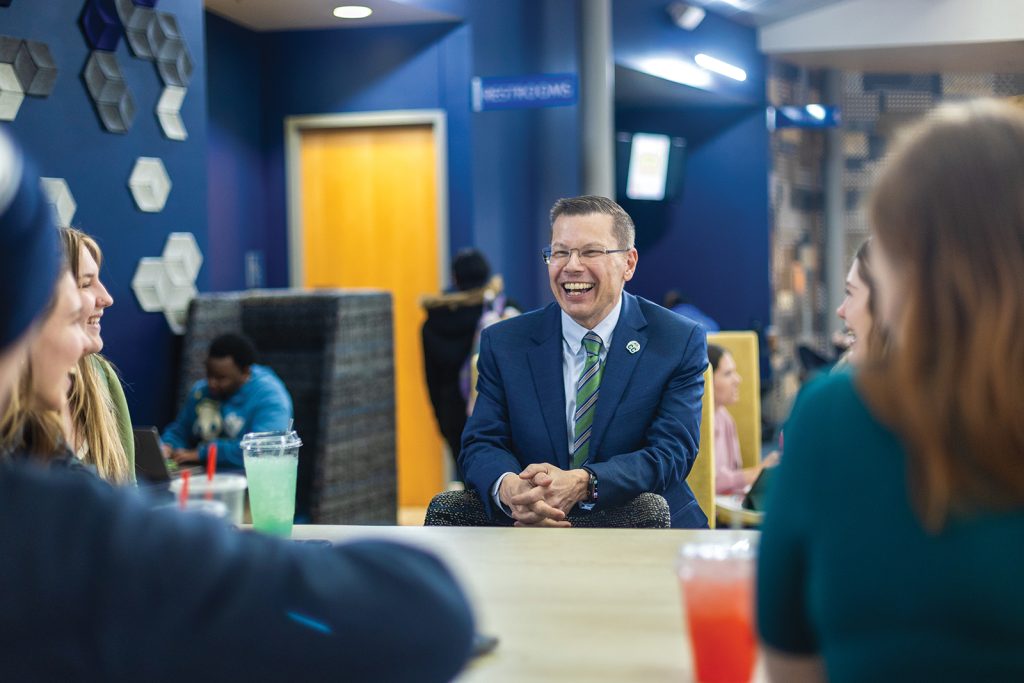
There was barely time for Toby Arquette to catch his breath in the first week on the job as Columbia College’s new president, which he started on March 1. Arquette dedicated time to meeting one-on-one with media outlets, he connected with faculty and staff, and he made the rounds in student commons area, making his presence known.
“That was my first order of business – randomly introducing myself to students,” he said. “That was really fun.” And then it was on to the next meet-and-greet or media interview.
“I’m a little bit of an energizer bunny,” he told COMO Magazine. “It’s been a whirlwind.”
As he settled into the position as the successor to David Russell, Arquette expressed his quick attachment to not just Columbia College, but the city of Columbia.
“Columbia is just really a fantastic location,” he said. “It’s a lovely college town.” As a cyclist, Arquette was already eager to head to the MKT trail. He added, “It’s just beautiful. The parks to take advantage of, the downtown arts scene, the thriving business scene.”
On the professional side of his experience, Arquette was equally enamored with the new position and what he views as “limitless possibilities” for the college.
“Who can take for granted being the president of a wonderful college?” he said. “This is a once-in-a-lifetime chance. I have to pinch myself each day.”
Arquette comes from St. Ambrose University in Davenport, Iowa, where he had been vice president for strategic growth, marketing, and digital transformation. At St. Ambrose, he spearheaded development of AI innovation and added data-driven technologies to support academics, according to a news release.
He is enthusiastic about helping the college not only embrace but become a leader in the AI space. Arquette talks about helping the college “reimagine who they are” with the digital information arena helping guide the way. “This is exactly what I want to do,” he said. “I’m built for this.”
The ultimate goal of any strategic plan or approaches must be helping students thrive, he added.
“In the public and the media, there’s a big concern about the value proposition of higher education,” Arquette explained. “For us, that is part of who we want to be. We want to be the college that delivers on those promises.”