
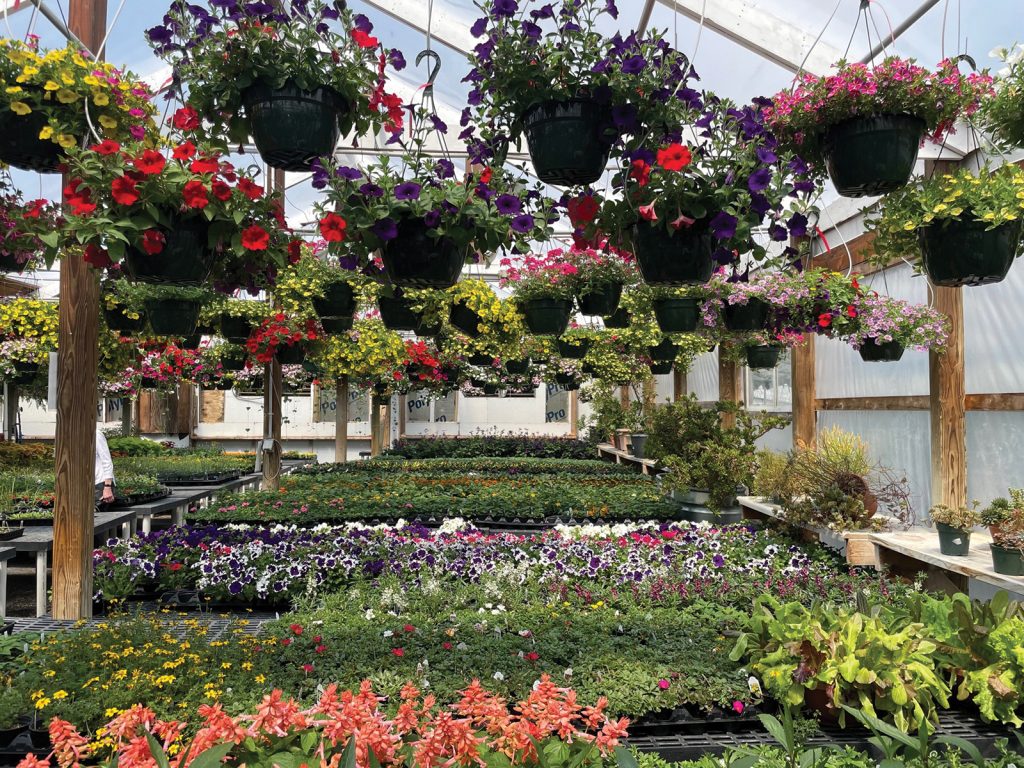
Mid-Missouri has no shortage of nurseries to supply your yard or business with healthy, beautiful plants. But one nursery, CMSE Giving Gardens, a subsidiary of Central Missouri Subcontracting Enterprises, isn’t only growing plants — it’s fostering relationships and independence, too.
“Our primary mission at CMSE is to provide work opportunities to adults with disabilities,” says Bruce Young, executive director of the 501(c)(3) nonprofit. Between the CMSE sheltered workshop and nursery, CMSE employs around 100 disabled adults.
From Contracting to Horticulture
At first, it may seem surprising that Giving Gardens is a subsidiary of a nonprofit that provides contract manufacturing services through a sheltered workshop. The jump from being solely a sheltered workshop to launching Giving Gardens was driven by necessity.
In 2009, CMSE lost a major contract, creating an economic hole the organization needed to fill. “When I got the call, I thought, ‘Oh my god, what are we going to do?’” Young says. The board brainstormed how to make up the funds.
“I just so happened to have a friend in Rotary Club, Bill Regan, who used to run a nursery,” he says. “He gave me the idea to start a retail greenhouse. So, I took the idea to the board, and that’s what we did. We’ve been going strong ever since.” Giving Gardens was founded in 2009 and began operations in 2010.
“Giving Gardens has helped us expand our exposure and help us grow our business. [It] provides work to a number of our folks who really enjoy it — especially those on the autism spectrum — and thrive doing it,” Young says. “The manufacturing area can be loud with some of the equipment, so some people struggle with that but do great in the greenhouse.”
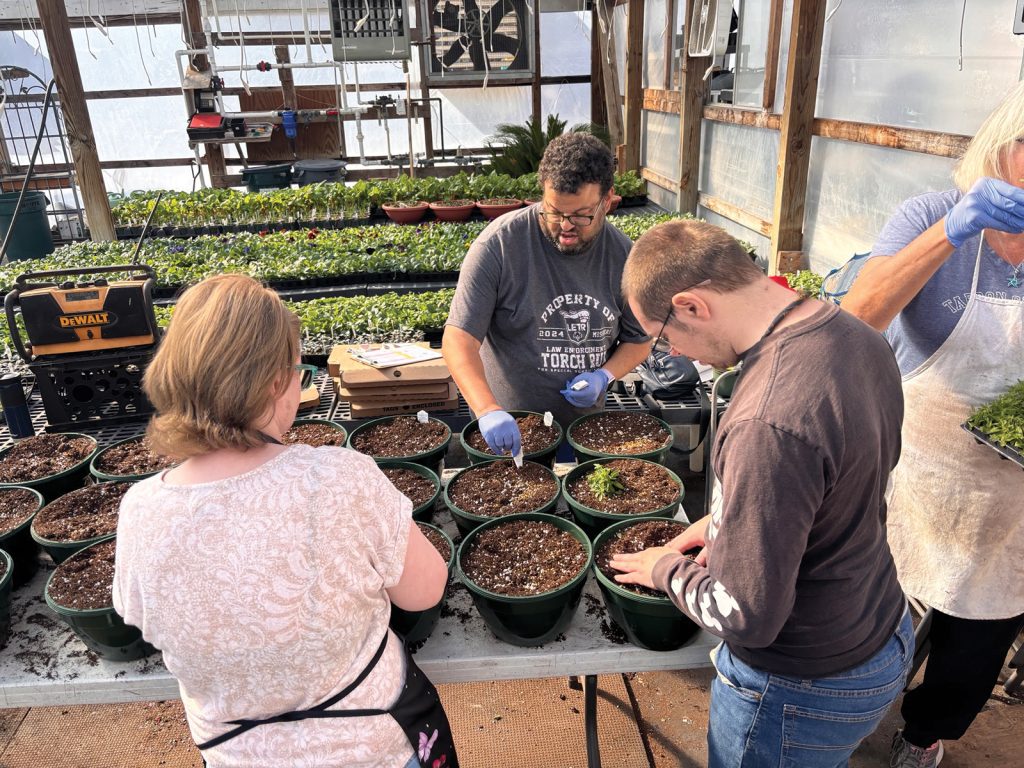
Each year, Giving Gardens employees begin planting in late January and early February, and the greenhouses open to the public on April 1. Young says Giving Gardens employs around 10 people in the greenhouses during the busy growing season, which runs from February to early April. During the selling season, a small number of employees work on watering, manning cash registers, and interacting with the public.
“It’s hard to explain how important the greenhouse work is for our folks, but if you walk through, you can see the self-esteem and dignity they have from working here,” Young says. “The employees who work at Giving Gardens want to show you their work because it’s very important to them.”
The Big Picture
When he started at Giving Gardens, Greenhouse Manager Brian Lee had an extensive background in plant science research but was fairly new to the world of horticulture retail operations.
“I didn’t feel well-qualified, having only been in retail horticulture for two months at Strawberry Hill Farms,” Lee says. “I didn’t have great knowledge of flowering or foliage plants grown for atmosphere and decor around homes and businesses.”
Luckily, a friend tipped him off to an online reference book that catalogued various plants according to their uses and horticultural characteristics, the best settings in which to plant them, and how to care for them. With this guidance, Lee quickly got up to speed.
“After reading it, I went back to Bruce and realized I was his most qualified applicant, which surprised me,” Lee recalls. “I decided I’d give it my best and started in May 2020. I’ve been there almost six years now and turn 68 this year; I’m taking it a year at a time and not really seeking to retire yet.”
“We really lucked out with Brian,” Young says.
As greenhouse manager, Lee works with adults with developmental disabilities on a regular basis. “They are very genuine and approachable once you accept their mannerisms and limitations,” Lee says. “I am blessed to be part of such an operation, but it does have moments of challenge. Every day is an adventure and seldom goes according to my exact plans.”
It seems everyone at CMSE Giving Gardens sees the importance in their work. “The personal benefits of being involved here are the relationships that are being built and the chance to expose others in Columbia to day-to-day realities of some whose lives are significantly different than their own,” Lee observes. “For me, I look at the big picture of life more — what really matters — not just business goals and how to achieve them.”
 How to Help
Want to support CMSE Giving Gardens’ mission of employing adults with developmental disabilities? The best way you can do that is by shopping at the greenhouses. Giving Gardens has a wide selection of plants, including annuals, perennials, Missouri native plants, shrubs, vegetables and fruits (including berry bushes), and herbs. A majority of the plants are grown from seed or plugs on-site. Missouri native plants are supplied by Prairie Hill Farms in Auxvasse.
Some popular plant offerings include annuals such as begonias, dahlias, geraniums, petunias, and snapdragons, as well as perennials like daisies, coneflowers, bee balm, and black-eyed Susans. Giving Gardens also has a tropical plant collection of hibiscus, jasmine, palms, and more.
Central Missouri Subcontracting Enterprises
CMSE’s sheltered workshop first opened in 1969, following the passing of Missouri’s Sheltered Workshop legislation, which aims to provide employment opportunities to adults with developmental disabilities.
CMSE was originally founded as part of Woodhaven Learning Center, with only 15 employees and two paid staff members. It changed its name to Central Missouri Subcontracting Enterprises in 2004.
“Even though we’re a nonprofit, a good portion of our revenue comes from contract work with business partners like Schneider Electric,” Young says. “We have a truck that picks up components and supplies at different companies. Our employees build the items and send them back every day.”
As part of CMSE’s contract manufacturing offerings, employees provide assembly, packaging, sorting, salvage, and more. The nonprofit also offers an on-site work program to provide companies with mobile work crews of between two and eight disabled adults, who are managed by a CMSE supervisor.
Outside of its contract manufacturing work, CMSE offers the Next Step Day Program, which is a habilitation program with recreational and life skills activities for adults with developmental disabilities.