

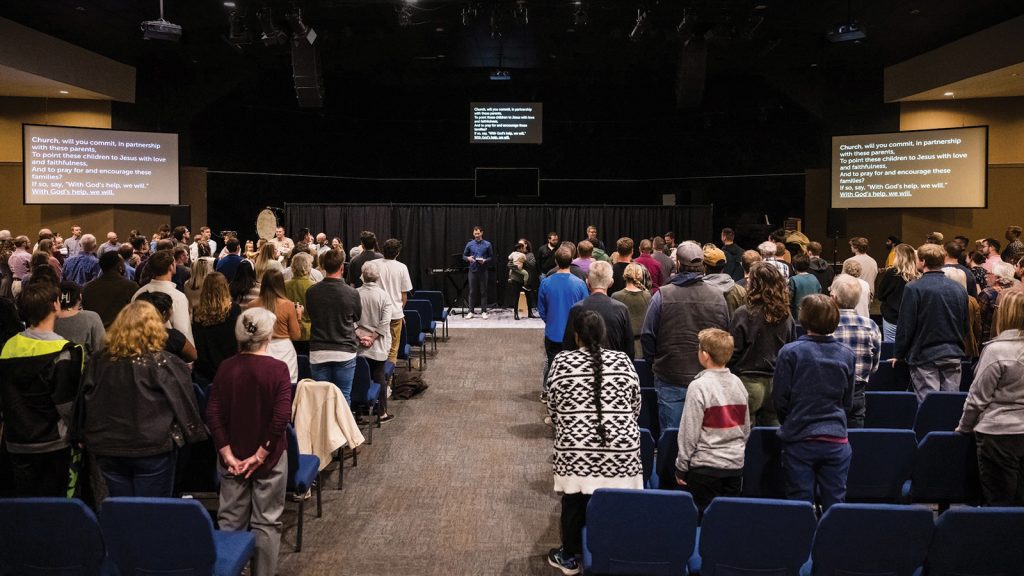
Everyone at some point has pulled up to their destination, only to see the sign of a different business — one often completely unrelated to the one they’re looking for. If you’ve gone to a church service at Trinity Community Church, United Community Cathedral, Redemption’s Hill Church, The King’s Church, or Iglesia Alfa y Omega, you might have had a similar experience.
Except in these cases, all these churches actually operate out of buildings owned by different organizations. Specifically, they operate out of buildings owned by different churches.
 In a move that could be seen as bad business — sharing space with a competing organization — several churches in Columbia are providing space for other congregations to meet. Rather than seeing each other as competitors, these churches choose to partner together in a symbiotic relationship. The hosting church receives a modest lease fee in exchange for sharing its building, and the hosted church is able to access a substantial, convenient space for far less than a traditional lease.
One of the best examples of these partnerships is Christian Fellowship, which has shared its main campus on Chapel Hill with several churches over the past few years. And what kicked off these partnerships wasn’t necessarily financial need, but rather friendship.
Partnerships Forged Through Friendships
“All the partnerships we’ve had with other churches were through friendship and partnership, believing we should work together, not against,” Michael Acock, lead pastor of Christian Fellowship, says. “We’re companions, not competitors. Whatever we can do to help a church that is in transition; we’re willing to keep lease rates reasonable to help them prosper and grow and be able to be fiscally strong and step into the next thing God has for them.”
Acock says the series of partnerships began with a conversation over lunch.
“I’d known Jeremy at Trinity Community Church for around five years and knew the space they’d been in wasn’t conducive to young families,” he says.
“When he pitched the idea of us leasing from them, I was immediately like, ‘Yes,’” recalls Jeremy Linneman, Trinity’s teaching pastor. “I think it was one of the best examples of churches working together, and it’s a huge testament to Mike’s leadership and CF’s hospitality.”
Thanks to Christian Fellowship’s campus size and setup, Trinity was able to function out of the school building, which has a full-size auditorium. “It was an ideal partnership on our end because access to such a great space for a church only a few years old would have been impossible,” Linneman says.
Trinity used Christian Fellowship’s space for a little under four years, from summer 2021 to spring 2025, before moving into its own building. During the church’s time at the CF campus, Trinity’s congregation grew from around 80 people to almost 450. “We had a lot more growth in that season — more than I expected, for sure,” Linneman says.
Passing It On
The building that Trinity moved into following its lease at Christian Fellowship was previously owned by Fairview Church of Christ.
“That church was looking to downsize but didn’t have a new location settled, so they still have been meeting in this building for the last nine months,” Linneman says. “We were the recipients of Christian Fellowship’s generosity, so it made sense to share our building with Fairview Church of Christ, letting them be rent-free. It was a cool full circle thing, where we traded from tenants to landlords and were able to pass it on.”
After Trinity moved out of the shared space on CF’s Chapel Hill campus, Acock offered it to Damian Dean of United Community Cathedral. “Last May, by Mother’s Day, one group had moved out, and it was only two or three weekends before the other group moved in,” Acock says.
United Community Cathedral had a space under construction, which wasn’t completed in time. The goal is for them to move there this fall.
“We’re called to love one another and show that as practically as we can,” Acock says. “Every church for every other church.”
An LLC Inherits a MultiChurch Partnership
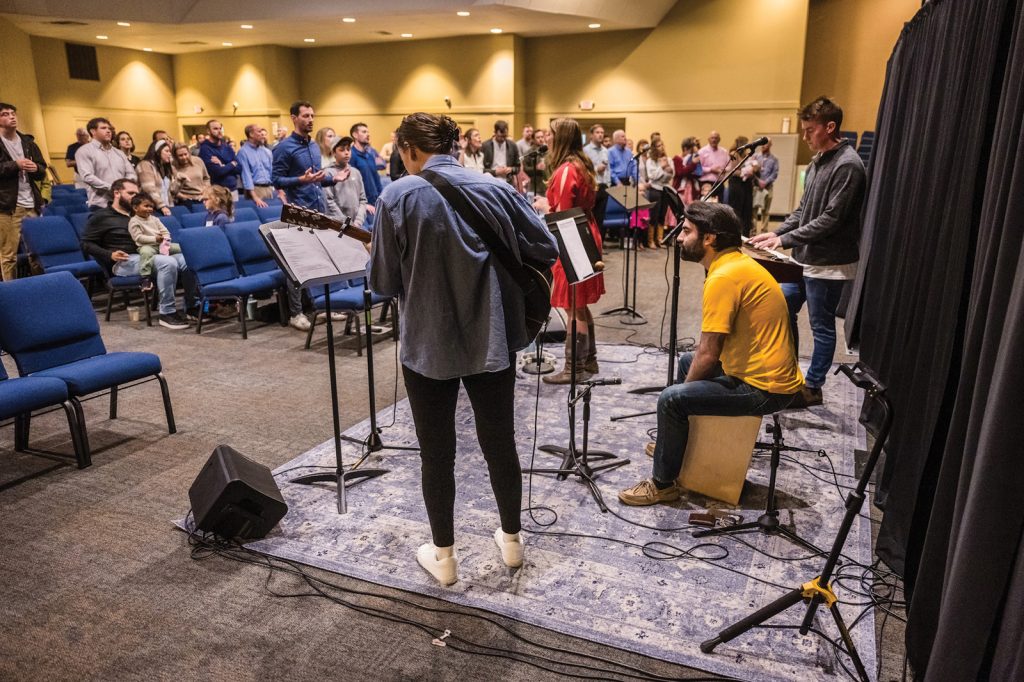
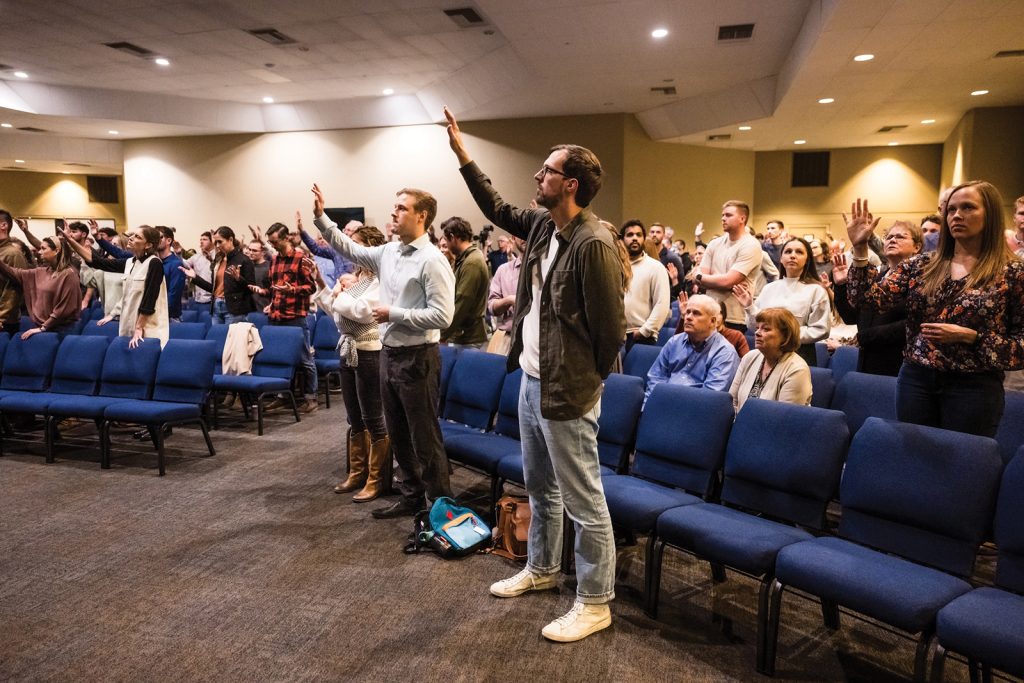
Another church that has long welcomed other congregations into its space is Woodcrest Chapel. Despite the recent sale of Woodcrest’s property to B&D LLC, multiple churches, as well as the Columbia Academy for Learning and Enrichment, still occupy the site. That is mainly due to Woodcrest Chapel, which negotiated the continuity of leases as part of the sale to B&D.
“Our view is finding ways that our faith community can collaborate, whether that’s shared space that creates convenience and less of a financial burden, or other ways to build relationships among churches and finding ways to link arms,” says Masood Heidari, lead pastor of Woodcrest Chapel.
Redemption’s Hill Church has been leasing space from Woodcrest, and now B&D, for three years. Its previous location, the College Park Seventh-Day Adventist Church, had scheduled renovations, so after reaching out to Heidari, the churches determined a lease based on mutual benefits and a sense of community. “It gave us an opportunity to open up our space to a partnership,” Heidari says.
From Necessity to Preference
Unlike Redemption’s Hill, The King’s Church wasn’t yet founded when it became the third church to lease space on the B&D campus. “King’s Church was still in the planning stages, and despite waiting for a space closer to campus, it wasn’t available in time, so they reached out to us,” Heidari says. “So we said, ‘OK, let’s try this.’’’ Because two churches were already in the space, The King’s Church had to pivot to Sunday evening services.
“We didn’t plan to launch Sunday nights but adjusted to that basically off of necessity,” admits Colby Corsaut, pastor of The King’s Church. “But it became a vibe — our people love Sunday nights.”
The King’s Church’s new location will be near the University of Missouri campus, and the congregation hopes to move in by this summer. According to Corsaut, the popular Sunday night service will remain. “We’re moving to a downtown space and are going to have both Sunday morning and night services since so many of our people have learned to love it.”
“What’s fascinating is now that we have this space we’re raising money for downtown, we’re already talking with other church planters and churches about sharing the new space,” he adds. “We know how big of a challenge it can be — it’s really a glass ceiling for growing churches in Columbia.”
Some challenges churches face in Columbia include space restrictions, occupancy limits, outdated buildings, and parking. By sharing spaces, they’re able to at least temporarily get around these issues as they fundraise for the next step.
Maximizing Potential
Another space-sharing partnership in Columbia is that of Open Door Church and Iglesia Alfa y Omega, which both operate out of Open Door’s facility south of town.
“We weren’t using the space to its potential with just one service on Sunday mornings,” Joshua Meranda, lead pastor of Open Door Church, says. Alfa y Omega had outgrown space it was renting from a different church, and while Meranda is unsure who reached out first, Alfa y Omega felt like a great fit to partner with Open Door.
“Functionally, it’s very simple; we kept our morning service as is at 10:30 a.m., and they have their service at 2 p.m.,” he says. “We try our hardest to honor their time so that for all intents and purposes, Open Door Church becomes Iglesia Alfa y Omega from at least 2-5 p.m. every Sunday. We do a few events or initiatives together as sister churches, but otherwise exist independently in the same space.”
As churches continue to shift between growing and downsizing, more space shuffles are sure to occur — and perhaps more collaborations as well.
Heidari says his goal would be to have several churches on one campus that not only share space, but also collaborate to have combined holiday services. “My dream would be to have multiple churches bring all their folks together and worship together without losing our identity, but rather linking arms.”