

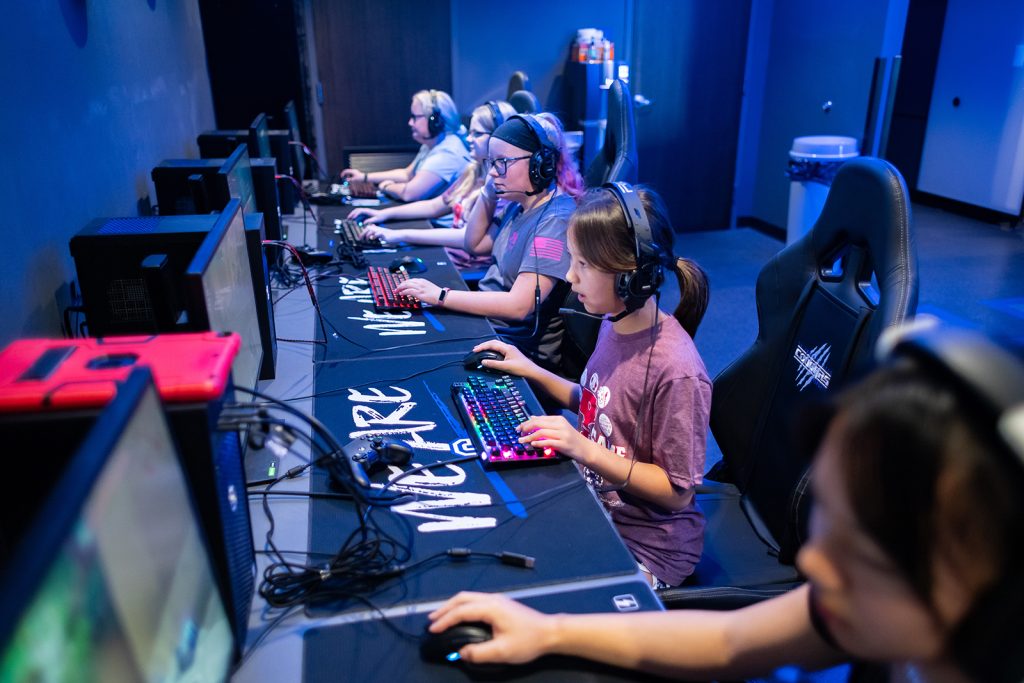
Girls Who Game, which emerged nearly 10 years ago as a response to the absence of women on Columbia College’s coed esports team, is gearing up to reaching more young girls who might feel discouraged from being part of a video game community. And once that barrier is resolved, girls may be more prone to pursue interests in the STEM fields of science, technology, engineering, and mathematics.
“The overall vision is to get to a point where the community itself is inclusive without question, where it’s no longer a special extra thing you have to do to be inclusive,” said Lindsay Zeiter, executive director of COMO Girls Who Game. Zeiter is also the lead online program coordinator and assistant esports coach at Columbia College.
In a nutshell, COMO Girls Who Game is an organization that focuses on getting girl gamers more involved with the industry at a younger age by providing a community to share their interests and learn new skills to help them prepare for professional careers. As the program’s chief storyteller and project manager Katelynn Case puts it, the new gaming community is “a realm of its own where young ladies are encouraged to fully express and indulge in their passion for gaming, STEM, and storytelling, all while learning hard tech skills and vital life skills.”
The idea for COMO Girls Who Game took form in 2017 when Christina Ingoglia, a former English professor at Columbia College, asked the board of trustees why there was a coed esports team at the college when there were no women on it. In response, campus hosted a one-day event where girl gamers were invited experience game design and esports related activities. That was also Zeiter’s “jumping off point,” she explained.
The initial event sparked conversation to create a week-long summer camp. Zeiter took the lead with her current supervisor, Andi Kenuam, who is now a COMO Girls Who Game board member. The organization became independent from Columbia College and was officially approved as a nonprofit organization in July 2025.
Middle school and high school gamers are the target audience.
“Since we are focusing on girls who game, I think that naturally our target audience ends up being girl gamers, but we are happy to have boys attend, too,” Zeiter said, adding that the only way to make changes to the perception of who can be involved “is if everyone is on board with understanding what we are trying to do.”
COMO Girls Who Game fosters a learning environment that is free of discrimination and judgment. It’s a place for gamers of all skill levels to attend and experience new skills, Case said, adding, “In our community, everything is a learning experience, especially our mistakes, and no one is made to feel poorly for what they don’t know or can’t figure out.”
The organization’s main event – the week-long summer camp – offers experience in game design, esports, and even Dungeons and Dragons play.
“The overarching goal of that camp is to be able to cast a pretty wide net so that many types of gamers are going to come and they are going to find something that they enjoy, whether it be the creative side or the competitive side or the story telling side,” Zeiter said.
Throughout the year, COMO Girls Who Game also hosts one-day events in the fall and the spring. The events are also divided between game development and esports activities.
“The goal of those events is to try and help keep our community connected throughout the school year, so they don’t have to wait until the next camp to be able to see each other again,” Zeiter explained. “It’s also to give new members who have never come to one of our events a chance to check us out for free.”
The group also hosts members-only events for people who have already attended other events. These events vary in activities, but one of the previous events invited students to talk to the faculty about programs at the college as well as career opportunities in the gaming industry as a way for students to get a glimpse of the college experience. The organization even participated in this year’s MU Game Jam where it placed third. COMO Girls Who Game attended as a way to get members more involved with other game creation events. After this year’s event, one of the members signed up for other game jams to continue to participate in other events.
“We did it,” Zeiter said. “We did exactly what we wanted to do.”
Last year, COMO Girls Who Game started hosting a second week-long summer camp that was purely focused on the learning game design and development aspects of the organization. The camp is a space for instructors to support the students with learning myriad elements of game design, using game engine systems such as Pico 8 and Godot to teach campers how to develop their own games.
“The hope is to get them comfortable developing small games and get them comfortable with the coding and the art aspect,” said Hunter Deresinski, chief research and content producer for COMO Girls Who Game. “[We’re] recreating the game development studio feel where you’ll have your artists and programmers and designers.” This game development camp puts participants into teams to create a finished product by the end of the week. Deresinski is also a student at Mizzou, pursuing a master’s degree in information science and learning technology – with a video game focus.
“The main reason why Girls Who Game wants to exist is due to the fact that there’s not equal representation within the field,” he said. “To put it into perspective, roughly half of gamers are girls. Within a 2 percent margin across the board are women, but when you look at the esports field and the game development field and all of the fields that actually take that entertainment space and take it somewhere more professionally, it is significantly less represented.”
COMO Girls Who Game wants to help close the gap between men and women in those spaces by introducing kids to STEAM fields and video games at a young age. He said research shows that society often pushes girls out of these interests when they are young. By the time kids get to middle school and high school, interest biases are ingrained unless specific attention is drawn to them, he said.
“We want to make sure that they are aware that it is not only healthy, but it is okay to have those interests when you are young, and to help nurture those interests and turn it into valuable skills without all of the negativity that is generally associated with it,” Deresinski said.
Zeiter echoed that conclusion, adding, “The only way to get past that and keep them interested in this stuff is to make sure that we are a little more intentional about paying attention to that.”
After each event, the organization surveys the participants to see how mindsets have shifted about STEAM fields, as well as their overall enjoyment of the camp. Zeiter said one of the common survey responses was that many of the campers said they did not have other friends to invite to the camp because none of their friends were gamers.
“It really stood out to me how isolating that must feel for them, to be excited about this stuff and really have nobody else in their lives to be able to share it with,” she said. “We are trying to create that community space where they feel like they can be excited about this with other people and not just be in their own isolated silo.”
Case said that experiencing the atmosphere of the community was the most enjoyable aspect of the camp.
“Girls Who Game is a space where everyone is encouraged to apply their strengths and be open to trying new things,” she said. “Over the years we have created a community of amazing young women and men who understand the value of diverse perspectives in STEM and gaming.”
More than 100 girls have attended the events, and the number keeps growing. Many students are returning campers and most are from the local area. However, some have come from New York and other states and communities where they don’t have access to gaming.
“It is exciting to see these individuals growing up, entering college and the workforce, and coming back as volunteers and sharing how GWG prepared them in ways that traditional education did not,” Case said.
For more information on upcoming events and how to be involved, COMO Girls Who Game visit Comogirlswhogame.org, or email questions to [email protected]. The organization also will have a booth at the upcoming Coolfest from noon to 6 p.m. on May 16 in the Arcade District.