
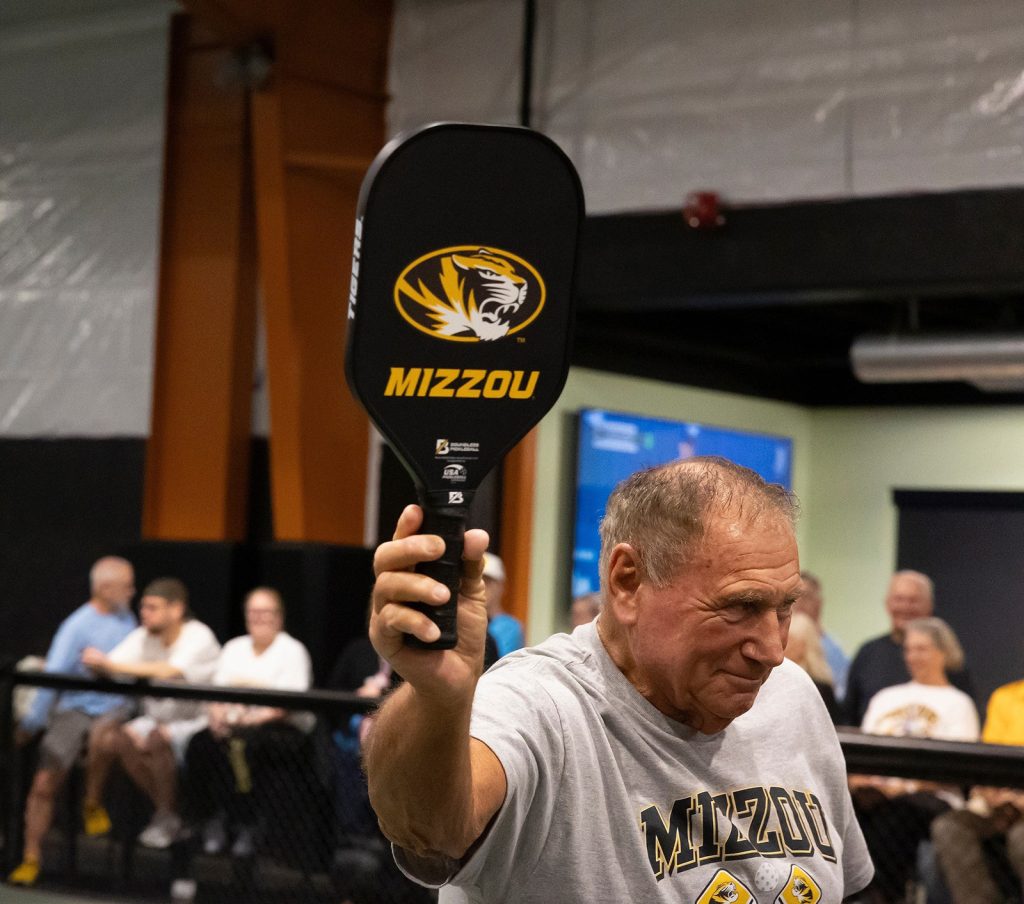
Anyone who plays pickleball has, at some point, been made a fool by someone who could be their grandmother. No disrespect meant — it’s just that you don’t expect your grandmother to aim and fire a projectile at you and then giggle when you get “bagged.” Even so, the intergenerational character of pickleball, the ability to compete with and get to know people of all ages, is one of many players’ favorite things about it.
Historically, pickleball has been known as an older person’s sport, but if you’ve been at the courts regularly over the last few years, you have probably noticed a shift toward the young. On nice evenings, local courts are often full of college-aged players. You can hear some grumbles about this demographic taking over the courts and that the university should build some on campus, but there are likely worse things these “kids” could be doing.
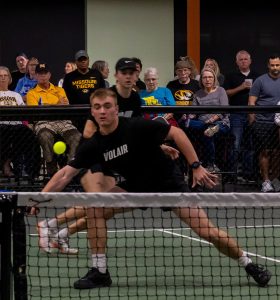 When Caden Davis, president of the University of Missouri Pickleball Club, moved to Columbia, he found the local pickleball courts were a good place to meet people — a healthy alternative to bars or fraternity social life. He also appreciates that pickleball is age-inclusive. “I’ve played 75-year-olds and 13-year-olds and been beaten by both,” he says with a laugh.
Until last summer, the club mostly consisted of a rarely used WhatsApp group to connect members who wanted to play. Under Davis’s leadership, the club has grown into a competitive intercollegiate team. Part of this growth included the addition of coaches, a move that was initiated by Davis and led by the club’s head coach, Steven Hatch. Hatch brought in a group of volunteer coaches and practice partners, including Paul Rubenstein, Cindy Frazier, Ian Reed, Jeff Pope, Rod Peterson, Eduardo Gomez, and Aiden Petterson, because “whether you’re losing or winning, it’s better to do it with others.”
The barrier to entry is low for pickleball, Davis explained. You don’t need a background in racquet sports to enjoy it, and city park courts are free. The Mizzou club’s leaders want to reflect the sport’s inclusivity with three tiers of membership. Students can join for free and be invited to some events. The next level is a paid membership, which provides access to open play and other benefits. The highest level is the competitive team, with the opportunity to travel and equipment for play.
The coaches for the competitive team can offer expert advice on hitting mechanics and situational gameplay, but they are mostly focused on creating opportunities for the team members. When Hatch talks about his goals for the team and his philosophy of coaching, he never mentions high-level performance or winning matches. He challenges himself to get the most out of people. Hatch describes the parallels between sport and life and relationships, saying, “Pickleball is just another conduit for connection and kindness.”
Pickleball, usually played as a doubles sport, has a unique social dynamic. A team of two is a more manageable number than that of many lifelong team sports, such as volleyball or softball. With relatively short games, usually 15-20 minutes, teams can mix up and mix in, with opportunities to get to know a lot of people.
As Hatch explains, the doubles format means you and your partner — often someone you’ve just met — must rely on one another. That reliance carries an emotional component that benefits from a degree of maturity. Navigating those brief partnerships with kindness — toward yourself and your partner — tends to be more effective than venting frustration when things aren’t going well.
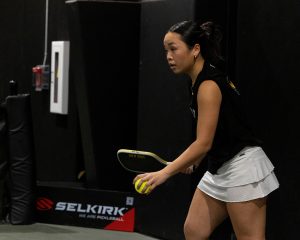 Stephanie Ly joined the club during the push for more competitive players. At the time, she didn’t have big dreams of playing in tournaments, but access to coaches has made that possibility “feel real.” Working with the coaches has made her more disciplined and purpose-driven; higher-level play quickly seemed reachable.
Davis and Ly agree that the coaches and the local pickleball community are “in your corner” in life, not just in pickleball. Hatch and his fiancé, Michelle Williams, held a fundraiser last fall that raised enough money for event registration costs, which can be more than $1,000 for the team. The money was also used to pay court rental fees for events the students hosted here in Columbia.
Hatch’s efforts to connect the team with the community were obvious at their matches against the University of Kansas and the University of Arkansas, both of which were held on the courts at The Kitchen Grill & Games. Davis called it “the best crowd in pickleball,” with an estimated 200 people in attendance at the team’s inaugural event, the September 2025 match against KU.
Even during his years of playing baseball, including in the NCAA, Davis never experienced “crowd pops” like those from the fans lined up around the court to cheer them on. The Mizzou team has traveled to Indianapolis, Illinois, and Springfield, Missouri, for other collegiate events, but the crowds are “nowhere even close” to what they have experienced here at home.
Part of their most recent event was an alumni match, where current team members competed against Mizzou alums. Davis really enjoyed that component and wants to plan more of these games in the future. Hatch says there are a lot of people around who love pickleball and love Mizzou, and alumni events are a great chance to get this crowd together. He also sees that “older folks are an underused resource — you’ve got a whole lot of experience out there, which is another opportunity” for the students to learn from and connect with the community.
The club has also benefitted from its connection to a homegrown professional pickleball player, Dylan Frazier, who is known for his generosity. Frazier, a Mizzou alum, introduced the club to his equipment sponsor, Volair, which has offered “constant support” for the team, according to Davis. The company has donated thousands of dollars worth of paddles, bags, shirts, and other gear for the club, not just the competitive team. Davis says that most collegiate clubs don’t have this kind of opportunity, and it would have never happened without Frazier’s support.
This all elevates the pickleball experience for students, who get the camaraderie and challenge of collegiate sports, only with less pressure and more enjoyment. Davis says he has had “way more fun” playing with Mizzou pickleball than he ever did playing collegiate baseball. In fact, in conversations with Davis, Ly, and Hatch, “fun” is the word that continually pops up. They are having fun while competing and making connections with people in the community and beyond.
As the competitive team gets more exposure, especially at national events, Hatch hopes the university will see the club as a recruiting tool and invest in courts and paid coaching staff. He would be proud to be so successful that he gets replaced by a professional coach.
Davis is planning Mizzou youth pickleball clinics over the summer, with the possibility of sessions for adults as well. The clinics will be led by Mizzou pickleball team members and coaches. He sees this as a way to give back to a community that has supported him: “If I can give other kids that same opportunity, that’s a win. And it’s not just for pickleball, but for development in general.”
For more information on clinics, upcoming matches, alumni events, or ways to donate, visit: https://engage.missouri.edu/mupb/home/