

College art faculty don’t stop being artists when class ends, but the work often has to fit in wherever it can. Creative projects happen after lectures, between grading, on weekends, or during short stretches of free time that are hard to come by once the semester is underway. Alongside teaching, faculty artists are also preparing critiques, mentoring students, and managing the day-to-day responsibilities of academic life. That work rarely leaves room for long, uninterrupted studio hours.
For Bethanie Irons, that reality isn’t abstract. It’s the practical framework of her creative life.
Irons is a visiting assistant professor of art at Columbia College, where she teaches typography, digital media, and corporate identity. Before joining the faculty there, she taught at other institutions in mid-Missouri, including Stephens College, and earned a doctorate in education alongside her work in the studio.
Irons’s days are structured around classes, critiques, and student support, but her artistic pursuits continue alongside that work. Rooted in graphic design, motion, and participatory installations, her art regularly moves beyond the classroom and into public view through exhibitions, festivals, and community-based projects.
“It’s not easy,” Irons says of balancing teaching and making. “Teaching and making art are very much connected.”
Rather than treating instruction and art-making as competing demands, Irons looks for ways they can inform one another. That approach has become especially visible in her recent work with zoetropes, mechanical devices that create the illusion of a moving image when spun. What began as an exploration of movement in her own studio has since become a teaching tool, an exhibition component, and a public installation.
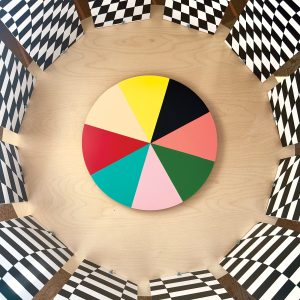
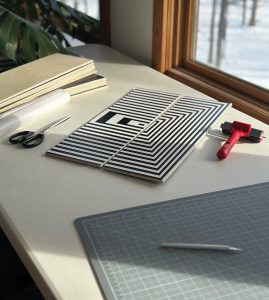
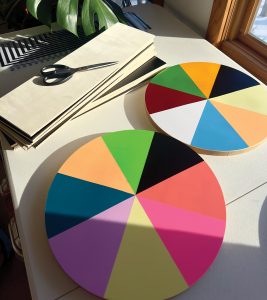
“They’re going to be a part of a lesson that I’ll be doing that is all about stop-motion animation,” she says. “So having stuff that I can sort of do double duty on is really helpful.”
For faculty artists, that kind of overlap can be essential, given how rarely they get to spend unbroken, distraction-free time in the studio during the semester. What matters most, Irons says, is “making time for it consistently and knowing that sometimes it happens in short spurts rather than really long, uninterrupted days.”
When Faculty Work Leaves the Classroom
Earlier this year, Irons’s work was on view at Moberly Area Community College as part of Shape/Play, an exhibition that foregrounded process as much as finished form. The show included digital paintings, videos documenting her design process, and several zoetrope constructions. Some of those pieces also functioned as previews for installations she was developing for the True/False Film Fest, where motion and participation shape how audiences encounter the work.
That evolution, from studio experiment to teaching tool to public artwork, reflects how faculty artists often operate, even when audiences don’t recognize it.
“Students sometimes forget that the faculty in the art department, they are artists,” Irons says. “They actually like this stuff, and they do it in their free time.”
At Columbia College, she says, this visibility matters. All of the art faculty maintain active practices, and that shared momentum shapes both the department culture and the student experience. Faculty exhibitions, conversations about process, and informal sharing through platforms like Instagram help draw attention to that work.
That visibility is supported structurally through the college’s public art programming. Columbia College has two professional galleries on campus, the Sidney Larson Gallery and the Greg Hardwick Gallery. Both host rotating exhibitions throughout the academic year. The galleries regularly feature student work alongside exhibitions by visiting and professional artists. Together, they create consistent opportunities for students and the broader community to encounter work made on and around campus.
Those exhibitions help demystify what it means to sustain life as a working artist. For students, seeing faculty and peers show work publicly reframes art-making as something that exists beyond assignments or degree requirements. For the wider community, it reinforces the idea that teaching and making art are parallel pursuits, not separate ones.
“Our practice as artists,” Irons says, “is an integral part of being a teacher and continuing to learn ourselves.”
Irons holds a Ph.D. in education, and she views empathy as a central part of teaching. That empathy extends to the artistic process itself, which she describes as both demanding and rewarding, particularly in digital and design-based fields where tools and platforms change quickly. It requires “being able to learn alongside them and have empathy for the creative process, which can be a very defeating at times, but also a really triumphant process.”
With limited hours available during the academic year, Irons is selective about the projects she takes on. For her, the deciding factor is less about visibility and more about whether a project offers room to learn.
“Anything that’s going to challenge me is worth my time,” she says.
That mindset has led her toward work that emphasizes experimentation, even when outcomes are uncertain. She values the educational dimension of that process, both for herself and for her students.
“Sometimes I fail, sometimes it doesn’t turn out exactly how I want it to,” she says. “But that adds to the next project.”
Art as a Shared Effort
Outside the classroom, Irons has been involved in a range of community-facing projects and exhibitions connected to True/False, Art in the Park, and other local arts initiatives. What draws her to those spaces is the collective energy behind them.
“There’s so many artists in Columbia who are working to make things happen behind the scenes that don’t often get credit,” she says. “Being around those communities and being a part of them has been a really important thing.”
Irons describes Columbia’s arts scene as notably collaborative, a place where people routinely show up for one another’s work. During a previous True/False installation, she recalls needing help moving a 600-pound sculpture onto a flatbed truck:
“I had 10 people coming out to my house to help do that. There wasn’t any competitiveness there. It was all just people who were working toward a shared goal to uplift the arts in our community.”
For Irons, that sense of shared effort mirrors what happens inside college art departments, where faculty artists often play a quiet but essential role in sustaining local creative ecosystems. In a college town with multiple institutions focused on artistic inquiry, those faculty positions help bring artists to the area, keep them there, and foster a steady diversity work across galleries, festivals, and informal spaces.
As Irons sees it, sustaining that kind of life is less about balance than about finding workable rhythms. Teaching, making, and community involvement overlap, each shaping the other in ways that shift from semester to semester.
“I’m not sure if I would be as active of an artist if I wasn’t teaching and wasn’t around that,” she says. “Being around students who are excited about creating, that inspires me, too.”
That long-term sustainability is reinforced at home. Irons and her husband, photographer Tony Irons, share a creative life that makes the realities of art-making easier to navigate. While they don’t formally collaborate on many projects, the shared understanding of deadlines, experimentation, and artistic momentum shapes how both approach their work.
Having another artist in the household makes space for ideas to evolve without explanation. Creative work becomes a normal part of daily life rather than something that has to be justified or scheduled around other priorities.
For students, that example matters. Faculty artists influence them not only through instruction, Irons says, but by modeling what it looks like to build an artist’s life over time. Through exhibitions, public installations, and community events, the couple demonstrates that art-making is not confined to school years or formal spaces.
In Columbia, where faculty artists quietly shape both classrooms and cultural spaces, that influence could go unnoticed. Yet it shows up in the work itself, in exhibitions that extend beyond campus walls, in installations that invite public participation, and in the steady presence of artists who continue to make even when time is scarce.