

Opportunity is a gift when it comes calling. But for some, opportunity never comes knocking because they have no door. They also don’t have walls, a roof, or windows.
That’s the reality for the hundreds of people in Columbia who have no place to live. The annual Point-in-Time Count in 2024 found 323 sheltered and unsheltered homeless. These are folks in emergency shelters, safe havens, and transitional housing, as well as those living on the street, in their cars, or in other locations unfit for human habitation.
The reasons why people experience homelessness are as numerous as the head count. Their numbers are growing, as are the efforts to care for those who have no place to go.
A Focus on the Issue
In 2021, the city of Columbia issued a request for proposals for a Comprehensive Homeless Services Center Plan designed to address the issue.
The Voluntary Action Center, which provides an array of services to the homeless and near-homeless, also refers clients to several other agencies and organizations. That way, clients know what services are available and who provides them, even if VAC doesn’t.
“Folks typically leave our office with the services they came in for,” said Ed Stansberry, VAC executive director. As noted, however, some of those services are referrals to other providers.
It isn’t always easy for someone who’s homeless to get to a shelter or a hot meal. VAC saw the RFP as a way to formalize provider relationships and bring more services under one roof — or rather, two — to better serve the unhoused population. And that’s how the Opportunity Campus came about.
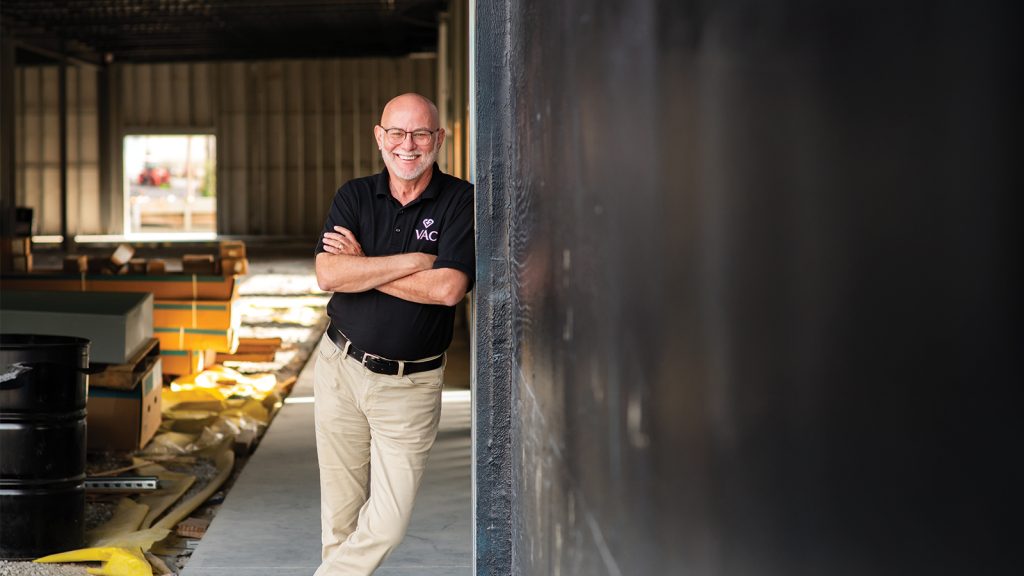
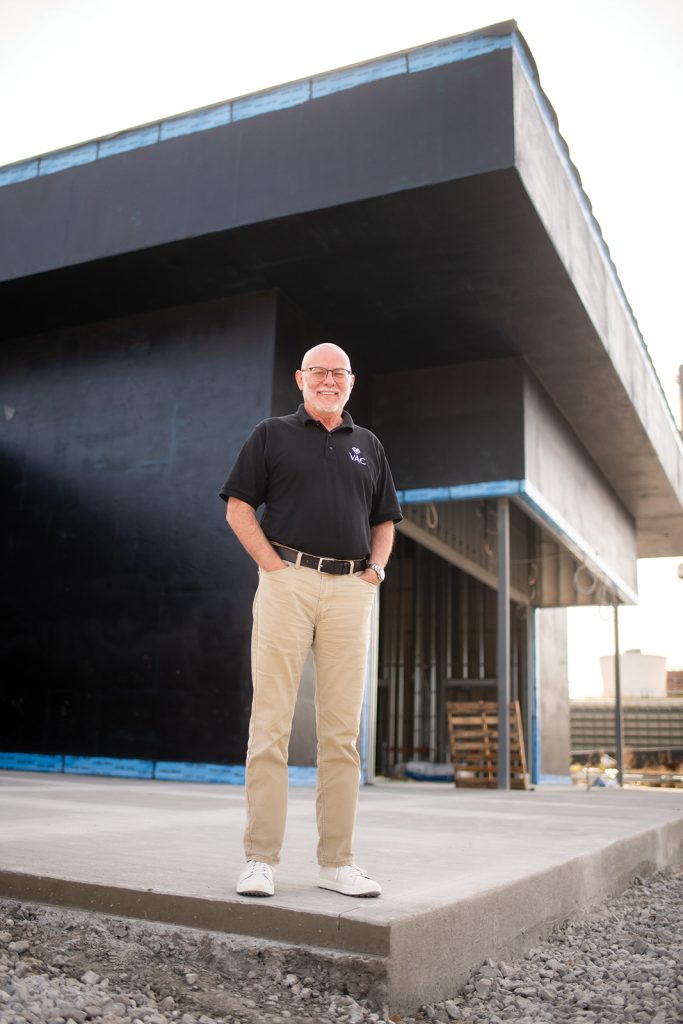
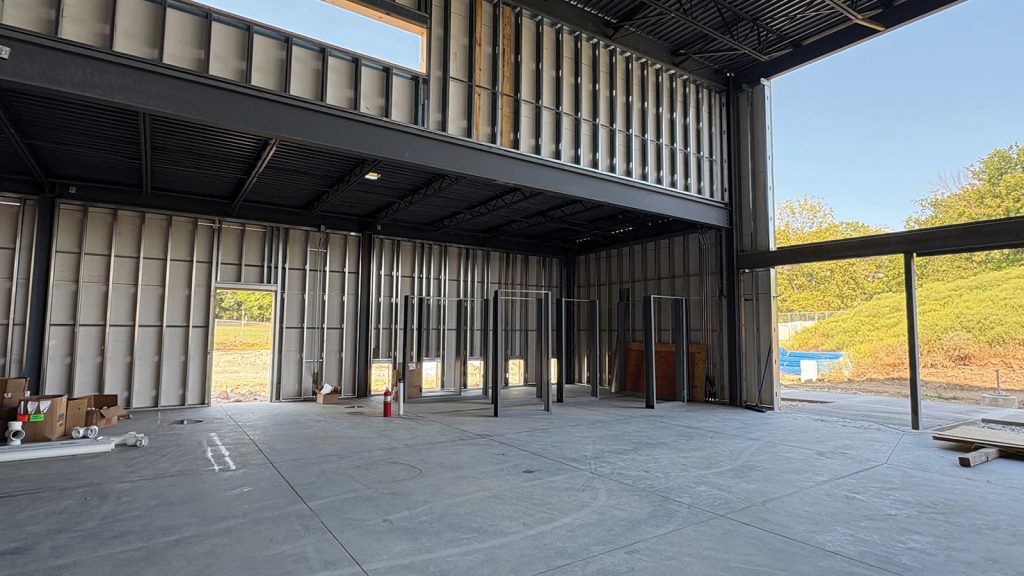
The groundbreaking for the campus took place in 2024. Today, it is taking shape where there was once empty ground on I-70 Business Loop East. The project’s architect and general contractors are hometown companies, PWArchitects, Inc., and Little Dixie Construction.
Stansberry said construction is on track for the Cindy Mustard Resource Center, named in honor of Mustard, VAC’s first executive director and a long-time Columbia volunteer leader. That building, which will house service providers like VAC and the medical clinic, is slated to open in March 2026.
The shelter should open two to three months later, due to a delay in the delivery of steel early on. Stansberry confirmed that naming rights for the Opportunity Campus shelter facility are still up for grabs.
Strength in Numbers
The campus will provide a long-term home for many of the organizations whose mission is to serve the unhoused. For example, Room at the Inn (RATI) has provided overnight shelter services in Columbia for more than fifteen years. But it operated only seasonally and relied on various churches for space to house people. For the past two years, it has operated continuously in the city-owned Ashley Street Center.
RATI routinely fills the ninety-bed facility every night, said John Trapp, RATI’s executive director. The shelter at the Opportunity Campus will have 150 beds served by RATI staff, although the nonprofit will be absorbed by VAC. VAC recently hired Jessica McNear from Rape and Abuse Crisis Service in Jefferson City as shelter director.
“RATI will cease to exist as a separate organization when the OC opens,” Trapp said. “We believe that having the shelter run by VAC will offer benefits of scale, particularly when it comes to employee benefits and attracting and retaining quality staff. RATI brings trained staff and knowledge of the population that we serve to VAC. This will lessen the learning curve and allow VAC to hit the ground running.”
Loaves and Fishes, which used to provide meals at Wilkes Boulevard United Methodist Church, now serves meals at the RATI location. While that eliminated the need to shuttle people between meals and overnight shelter, sharing the current space is tricky. Guests must wait outside while the room is converted from dining to sleeping and back again. The Opportunity Campus has space for both functions — and more — to coexist.
The Resource Center will be the new home for VAC, which owns the campus. Turning Point, another nonprofit serving the unhoused, will also move operations there.
“Turning Point’s mission and role will not change,” said Darren Morton, the organization’s executive director. “We will continue to focus on providing hope and restoring dignity to persons experiencing homelessness. We will simply be renting space at the Opportunity Campus instead of Wilkes Boulevard UMC.”
Other organizations, such as Loaves and Fishes, will also call the campus home, and many more will provide services there.
“We have letters of intent from twelve to fifteen community partners to provide services at the campus,” Stansberry said. “We’ll be transitioning those letters of intent to memoranda of understanding over the next six months or so to really define what that looks like.”
“We are already paying for it with the burden on law enforcement, the judicial system, and unreimbursed medical expenses These are cycles we believe we can interrupt.”
For example, Job Point will provide employment counseling. Central Missouri Humane Society and the Mizzou vet school will help with pets. Central Missouri Community Action will provide services such as life coaching and budgeting skills training. Columbia Center for Urban Agriculture will help develop a community garden.
“We believe that our community’s support for the unhoused works because different agencies collaborate so closely with one another,” Morton said. “These collaborations are essential to our success. But at the same time, we also need to respect each other’s differences, since we each have our own role to play.”
Everything Under Two Roofs
Another key feature of the campus will be the medical clinic, which will be housed in the Resource Center. Clarity Health/Compass Healthcare and Burrell Behavioral Health will be providing mental health, substance abuse, and primary care services. Stansberry said those services will be applying for status as a Federally Qualified Health Center, which means the clinic won’t just serve those struggling with homelessness, but the Columbia community at large.
Meanwhile, the shelter, as a low-barrier facility, will also accommodate its guests’ pets.
“One of the reasons that a lot of people don’t use shelters is because they don’t accept pets,” Stansberry said. “We are currently working with an organization called RedRover and the MU vet school to help educate us on best practices for our guests and their pets.”
The vet school helped VAC obtain a $60,000 grant from RedRover and will be instrumental to staffing veterinary services once the campus opens. There will be an exam room, washing station, runs, and kennels. And pets will be allowed in the shelter with their owners unless they’re disruptive.
Counting the Costs (and Benefits)
Stansberry reported that total construction costs for the Opportunity Campus should be roughly $18.6 million. So far, $15.2 million has been raised from a variety of sources, including American Rescue Plan Act (ARPA) funds from the state of Missouri ($6 million), city of Columbia ($3.133 million), and Boone County Commission ($350,000). Each of these entities has appropriated funding. Neighborhood Assistance Program tax credits, foundation grants, and donations from businesses and individuals have also added to the total.
Stansberry hopes another $3 million will come from some of the $4.7 million grant proposals VAC has submitted and from ongoing donations and three-year pledges made through the Opportunity Campus website. VAC’s goal is to accumulate a $2 million endowment for the facility, the interest of which can be tapped in the event of a lean year of operations.
Given an annual operating budget of $1.2 to $1.5 million for the Opportunity Campus, some question this major investment in the homeless population.
“We are already paying for it with the burden on law enforcement, the judicial system, and unreimbursed medical expenses,” Stansberry said in response to such doubts. “These are cycles we believe we can interrupt.”
While some Columbians fear the campus will attract more homeless people to the area, Stansberry said research tells another story.
“National studies have shown that 70 percent or more of the homeless population is homeless in the community in which they became homeless,” he said. “It is reasonable to say that this is a population with limited resources. In other words, they typically do not own vehicles to drive to the newest homeless center, nor can they afford the cost of transportation.”
Step One of Making Home Happen
The goal of the Opportunity Campus is to “make home happen” for an estimated 10,000 people every year and to expand if the need grows. But it’s only the first step. Naturally, the end of someone’s homelessness is having a home. Whether that’s an affordable rental or home ownership, people will have that door for opportunity to come knocking.
“Homeless shelters are not a solution to homelessness,” Trapp said. “They are a stopgap to lessen the damage done by homelessness.” In Trapp’s view, solving the homelessness problem requires increasing the supply of available housing, especially on the affordable end of the spectrum.
“While getting individuals off the street and into shelter where services can be provided is a step in the right direction, without an adequate housing supply, we are still facing a continued rise in homelessness,” Trapp said. “Increasing services does not increase homelessness. Rather, services are expanding to meet the growing need.”

New Homeless Shelter Receives $60,000 Grant to House Pets
The emergency shelter now under construction at the Opportunity Campus on Business Loop I-70 East will participate in the Campus Companions program, which will help keep pets with homeless individuals staying at and receiving services at the facility.
To make that program a reality, the national nonprofit RedRover has awarded a $60,000 Safe Housing grant to the Voluntary Action Center, which is spearheading construction of the Opportunity Campus project and will take charge of its subsequent operation. A news release from RedRover said the Opportunity Campus expects to serve an estimated seventy-five animals annually.
This funding will enable VAC to:
- Build a 547-square-foot kennel at the shelter to include two rooms with space for pet housing, bathing, and basic medical care
- Furnish the kennel with the appropriate and needed equipment, furniture, and startup supplies
- Provide pet enrichment supplies
- Financially support veterinary care for pets residing at the shelter
Ed Stansberry, VAC executive director, expressed gratitude for the RedRover grant, adding that the Campus Companions program “will greatly benefit from RedRover’s shared knowledge and expertise on kennel best practices.”
Katie Campbell, president and CEO of RedRover, explained, “Pets can be the lifeline for people who are suffering from hardship. Keeping people and their pets under the safety of a shelter can bring hope and relief when not much else can.”
VAC will partner with the University of Missouri College of Veterinary Medicine to implement the Campus Companions program and provide needed veterinary care. The partnership will benefit each organization, as well as the animals in their care, Campbell said.
Dr. Carolyn Henry, professor and director of CVM’s Research Center for Human-Animal Interaction, echoed that conclusion. “At the Mizzou College of Veterinary Medicine, we understand the power of the human-animal bond,” she said, adding that the partnership will give Mizzou veterinary students “real-world experience, meeting people where they are and providing compassionate veterinary care to their pets.”
“By helping people and pets remain safely together, we can preserve that vital connection while strengthening the health and well-being of our community,” Henry noted. And there’s evidence that protecting such connections can enable the unhoused to access the services they need. One study found that 93 percent of men and 96 percent of women said that they would not stay at a homeless shelter if pets were not allowed.
The National Coalition for the Homeless estimates that has many as 3.5 million people experience homelessness each year, and up to 25 percent of them have pets. RedRover’s website and mission statement noted that non-pet-friendly shelters may force people to choose between their pets and supportive services.
Founded in 1987, the Sacramento, California-based RedRover focuses on bringing animals out of crisis and strengthening the human-animal bond through emergency sheltering, disaster relief services, financial assistance, and education. Since 2012, RedRover has awarded 255 grants to shelters in forty-eight states, totaling more than $6 million. In addition, its Safe Housing grants have created the first pet-friendly domestic violence shelters in ten states.