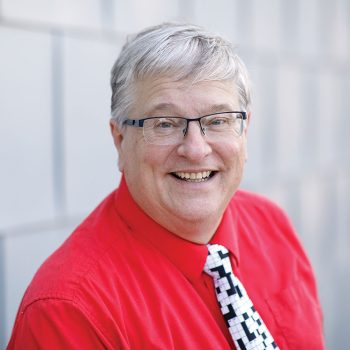
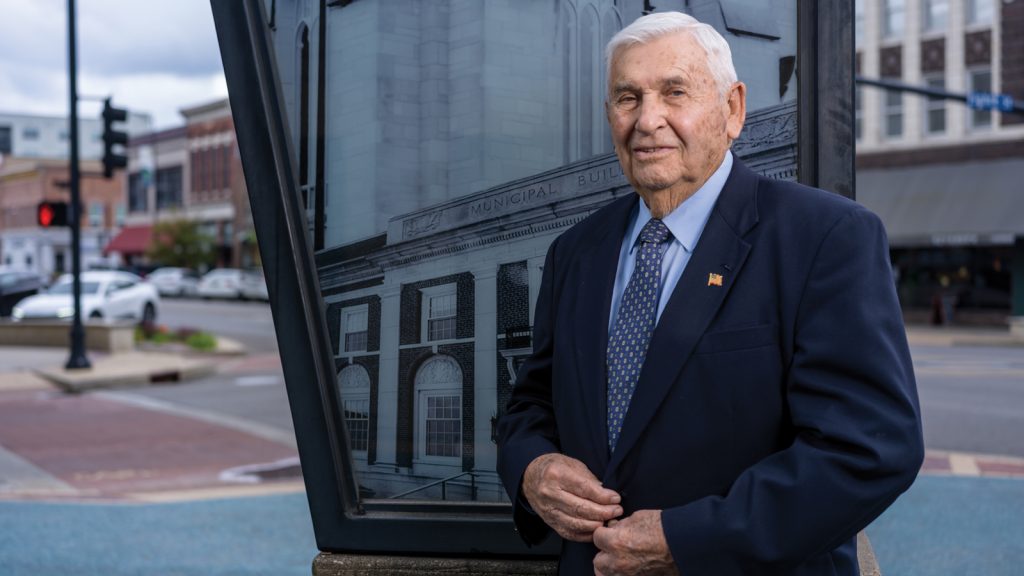
Ray Beck has never shied away from suggesting that there might be a better, more efficient way to do something.
Beck was a junior at the University of Missouri when he attended a field artillery summer camp in 1955 as part of his Army ROTC duties. Following a series of field exercises with his unit, Beck decided to tell a sergeant about some ways the unit could operate more efficiently.
“That got passed up to the guy in charge,” he says, still getting a laugh out of that memory some seventy years later. “So I peeled potatoes for a couple of nights. But I knew how to peel potatoes as a farm boy.”
That experience seemed to foreshadow Beck’s future occupational path as Columbia’s public works director and then city manager, spanning a period of forty-six years from 1960 to 2006. That represents forty-plus years of street projects, sewer improvements, the history of Columbia Regional Airport, the city wetland that provides about 90 percent of the water for Eagle Bluffs Conservation Area, the stormwater utility, licensing new landfills and establishing city garbage and recycling service, and testifying during a landmark, lengthy, and contentious annexation trial. There was also the pulse-pounding, 11th-hour approval of the Discovery Ridge interchange, the approval and phasing in of the MKT Trail, and turning a former sewage plant and sludge drying area into the Martin Luther King Jr. Memorial at Battle Gardens, which is also one of the MKT trailheads.
That’s a headful and mouthful, for sure, but the memories flow freely. Beck might stop himself and say, “Just tell me if I’ve already told you this … ,” but with each new telling, another fact — perhaps a notable name or a moment when a city councilman’s “nay” decision began shifting to an “aye” — emerges from his immense repository of Columbia history.
“I was always trying to find ways to do things more efficiently,” he explained. The farm boy from Miller County, who also had a 23-year military career, is approaching his 93rd birthday in November. A biographical memoir about his life and public service, titled “Fingerprints and Footprints: Ray Beck’s Columbia,” is set for publication early this fall. The foreword is written by Gary Kremer, the retiring executive director of the State Historical Society of Missouri, with the postlude written by Chris Campbell, executive director of the Boone County History & Culture Center. The book was edited by legendary MU journalism professor Don Ranly.
(Full disclosure: This article’s writer, Jodie Jackson Jr., is the book’s co-author.)
The book title is a not-so-subtle reference to Beck’s impact on city government, local infrastructure, and daily life in Columbia. When you turn onto Keene Street toward a medical appointment, turn on the water, flush a toilet, set your trash out at the curb, turn on a light, board a flight at Columbia Regional Airport, or take in some fresh air or recreation at a city park, Beck was involved in making sure those streets, services, and amenities are part of Columbia.
Beck began his work with the city in 1960 with what he anticipated would be a short stay. He’d help fix Columbia’s sewer system, which he’d become familiar with as a University of Missouri student, then as a sanitary engineer with the Missouri Department of Health. His colleagues at the state cautioned Beck to steer clear of Columbia as a career stop, citing the city’s troubled sewer system and internal instability. Beck figured he could whip Columbia’s sewer into shape, then move on to Kansas City or St. Louis, someplace much bigger where he could have an even bigger impact. Someplace where he and his bride, Dee, could build a home and raise a family.
Along the way, Beck passed his professional engineer exam, and he was promoted from sanitary engineer and “acting” public works director to permanent public works director. He oversaw utility and infrastructure improvements — first as public works director and then as city manager — while managing thousands of other projects, attending more than 1,000 regular city council gatherings, and attending 660 planning and zoning meetings. He often personally handled the touchy tasks of purchasing land for projects ranging from street improvements to parks and developing Columbia Regional Airport.
He obviously stayed longer than just a few years.
The Ray Beck legacy did not end with his retirement in 2006. Not long after ending his stint with the city, Beck was approached about serving as a volunteer project manager for building Father Tolton Regional Catholic High School off Discovery Ridge, Columbia’s southernmost interchange. Ray worked with the Missouri Department of Transportation (MoDOT), the University of Missouri, and other entities to get that important intersection in place. While Beck continued his passion for farming and spending time with Dee at RaDe Acres, their farm twelve miles and twenty minutes north of Columbia near Hallsville, the offer to help get a Catholic high school off the ground was tantalizing. Though Dee wasn’t wild about her husband rejoining the ranks of planners, movers, and shakers — he never actually left those ranks, did he? — she agreed to support him and the school-building project.
“So I took on the high school project as a volunteer,” Beck said. “I called them back when I was out on my tractor.”
At his Hallsville area farm, there was some insulation from the goings-on of government, committees, study groups, developers with their plans tucked under an arm (sometimes approaching Ray at the golf course), and pressing decisions about the city’s next moves to modernize streets, sewers, and neighborhoods. His role with the Tolton project, which school officials credit for helping boost a lagging fundraising campaign, was among the accolades listed on multiple nominations for Beck’s inclusion in the Boone County Historical Society’s Hall of Fame.
One of the nominations came from the late Hank Waters, the longtime publisher of the Columbia Daily Tribune.
“For many years, Ray Beck was the gyroscope for local civic management. Not only did he oversee exemplary city administrations year after year, his strong and credible advice kept city councils on track as they made policy,” Waters wrote. “He always knew the proper separation of duties and responsibilities between manager and council. His example has been enormously important to local governance. He is an excellent nominee …”
Beck’s memoir/biography is more topical than chronological, though the most significant machinations that would leave indelible fingerprints on Columbia occurred in the ‘60s and ‘70s. Major touchpoints include the city’s annexation history, the modernization of its sewer and water systems, the updating and enforcement of building codes, bringing the Flat Branch area back to useful life, park development, public transit, solid waste management, the Wabash Railroad, a comprehensive look at who “runs” the city under Columbia’s charter form of government, and the city managers, council members, and mayors Beck worked with.
Beck served with 14 different mayors and under six city managers. He was the city’s public works director from 1961 to 1985, then city manager from 1985 to 2006.
The book also steps into Beck’s personal life, from his love affair with Dee, his formative years in St. Elizabeth, and other family stories.
Beck also details the process of the city buying the burned Daniel Boone Building and renovating and restoring the historic structure to house City Hall. Beck hatched the plan to expand that building to accommodate the city’s growing services, and those final steps were taken after he retired.
Beck’s list of his proudest accomplishments sometimes varies, but the top two achievements are always the same: establishing a policy that required land being developed outside the city limits to be annexed before receiving city water and sewer service and obtaining all the necessary land for Columbia Regional Airport without using the power of eminent domain to wrestle property away from farmers.
If not for the massive 1968 annexation that wasn’t actually official until the Missouri Supreme Court upheld a Boone County Circuit Court landmark decision, the city might look much different today. The area south of Columbia — south of Hinkson Creek, specifically — is now a thriving mix of well-defined neighborhoods and commercial and retail establishments, namely the shopping centers at the intersection of Providence Road and Grindstone Drive. Before that area was part of the city limits, neighborhoods and infrastructure were sorely lacking: substandard housing and housing that was only rarely inspected, poor streets that were expensive to maintain and exacerbated stormwater runoff issues, questionable water supply, and private sewage lagoons.
“Just think what Columbia would be without anything south of Hinkson Creek and the industrial area along Route B in northeast Columbia,” Beck declares. “I don’t know what Columbia would be like if it had all those unimproved streets today. One of the best things I did for the city was to constantly pound annexation before development.”
He also managed to avoid lingering controversies and had a knack for winning over opponents. One case in point was thawing a once-frosty relationship with Jefferson City. Locating a regional airport just outside Columbia did not sit well with Jefferson City officials, who eyed their city’s airport for that status. When Beck retired, Jefferson City officials honored him with a congratulatory resolution.
Jefferson City’s public works director, Ed Rackers, once announced, loudly, “Here comes the Lagoon Tycoon from Boone,” when Beck arrived for a public works conference, referring to the annexations that brought in more than a hundred private sewage lagoons that Columbia then replaced with sewer connections.
“That still gives me a laugh,” Beck says. “I always told him if he caused me trouble, I was going to annex Jeff City, too. But I didn’t know if we wanted to take in all the politicians. … He was still kidding me about it years later.”