
On Fridays, I take a break from watching news at the end of the day and I turn on Diners, Drive-Ins and Dives, popularly known as Triple D. I appreciate the show’s consistent positive energy and suggestions for restaurants and places to visit. I enjoy getting ideas for recipes, and I get a kick out of the sometimes-zany chefs.
I’ve noticed, however, an increasing focus on over-the-top dishes, like a burger with so many odd toppings it’s the size of an 8½ x 11 sheet of paper, or a pizza made from tacos. First, logistics are confusing. How would I take a bite of a sandwich that’s taller than my own head? But more than that, I wonder, why make an intrinsically classic dish into such a gluttonous mess?
I’m wired with an abundance mentality. There’s always room for more. Goodness has no limit. I see potential. But I also think certain foods shouldn’t be messed with much. Considering the trend toward the seemingly limitless “wow factor,” I decided to read a cookbook for some quieter inspiration. I picked up The Art of Simple Food by Alice Waters.
Waters learned her love of simple cooking from her ingredient searches after she opened her restaurant, Chez Panisse. She found that the best food was grown, raised, and harvested nearby and treated simply, explaining, “When you have the best and tastiest ingredients, you can cook very simply, and the food will be extraordinary because it tastes like what it is.”
But for Waters the simplicity doesn’t stop with good local ingredients. Simplicity for her is also found in the act of cooking. I relish the experience of selecting ingredients for dinner and letting them guide the cooking process and eventual meal, so her focus hit home. Waters suggests: “Good cooking is no mystery. You don’t need years of culinary training, or rare and costly foodstuffs, or an encyclopedic knowledge of world cuisines. You need only your own five senses. You need good ingredients, too, of course, but in order to choose and prepare them, you need to experience them fully. It’s the many dimensions of sensual experience that make cooking so satisfying. You never stop learning.”
I may frame that paragraph for our kitchen. I enjoy her statements because I understand them, and it’s nice to read what I experience in someone else’s words.
On a recent Friday, I skipped Triple D, and we attended the opening night of Project Hail Mary instead. When the movie was over, our brains and hearts were full, but it was 8 p.m., and we hadn’t planned dinner.
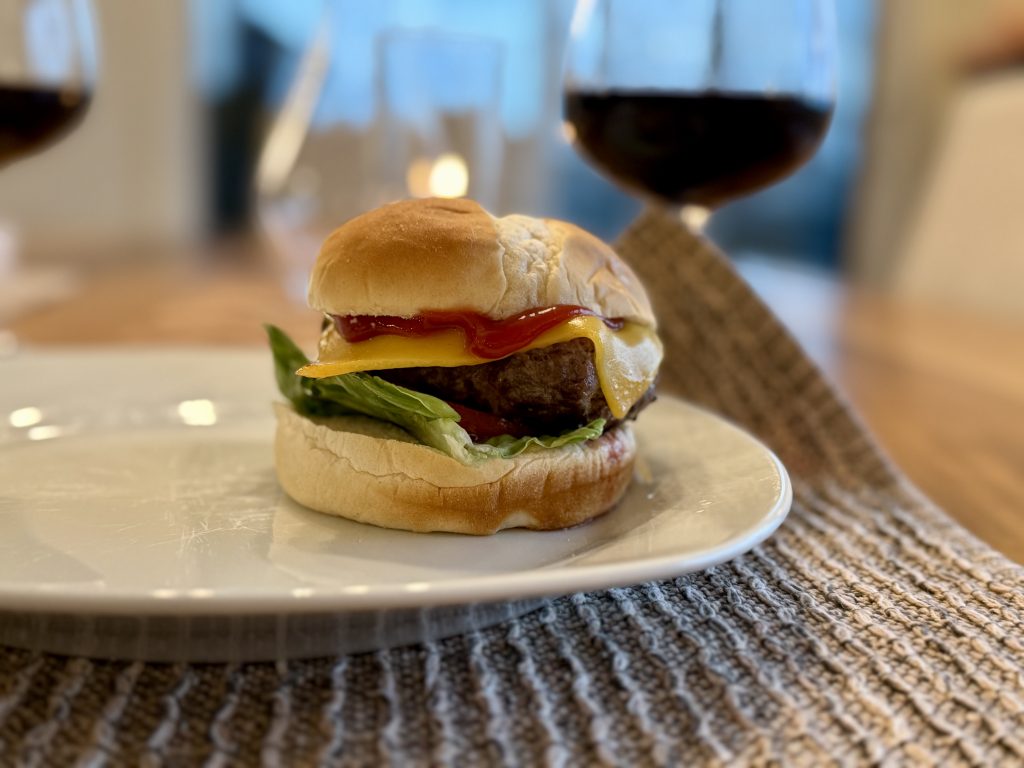
Often, when we need a simple meal, we make cheeseburgers. I love all kinds of cheeseburgers. But Lyle makes a specifically good skillet burger. He forms loose, not-too-thick patties, seasons them with salt and pepper, and cooks them in their own fat to medium rare, topping them with a slice of melted cheese. We enjoy them on soft buns with lettuce, tomato, dill pickles or relish, ketchup and mustard, and sometimes thinly sliced onion. The bite-down on the cheeseburger is an incredibly simple, juicy joy.
Yesterday, we watched an interview with Anthony Bourdain on his ideal cheeseburger. He described a burger like the one Lyle makes and explained that, when making anything — but especially a classic dish like a cheeseburger — he’d ask himself one important question: “Am I making it better?”
Immediately, I recalled the 8½ x 11 Triple D cheeseburger. I cannot fathom that it would come anywhere near a perfectly just-right burger, although I’m sure the spectacle probably paid a few bills after it was featured. I cannot fathom that no one in that kitchen stopped to ask whether all the layers of the eventual burger tower made the cheeseburger better. I cannot fathom that onion rings and a grilled cheese sandwich are burger toppings.
When I think of making a burger, I automatically think of senses. I think of Lyle forming the patties by hand, the smell and sound of the beef fat starting to brown, and all the colors of the condiments and fixings. A classic cheeseburger is the epitome of simple cooking. Use good ingredients. Engage your senses. Make something more than the combination of elements. A good cheeseburger is poetic.
One of my favorite poems describes a simple act of cooking:
Summer Kitchen
— Donald Hall
In June’s high light she stood at the sink
With a glass of wine,
And listened for the bobolink,
And crushed garlic in late sunshine.
I watched her cooking, from my chair.
She pressed her lips
Together, reached for kitchenware,
And tasted sauce from her fingertips.
“It’s ready now. Come on.” she said.
“You light the candle.”
We ate, and talked, and went to bed,
And slept. It was a miracle.
I’m surprised I haven’t yet framed that poem. The poem is glorious in its grounding and in the greater enlightenment with its not-so-simple subject: paying attention, using the senses, appreciating. The poem’s scene is just right as it is. It doesn’t require fine dishes or crystal stemware or talk of expensive, exclusive ingredients to reach its final awakening. As he wrote the poem and selected and framed his ideas and images, I imagine Hall asked himself something like, “Am I making it better?”
This Friday, we may return to the movie theater to see Project Hail Mary again. But if we don’t, and I get sidetracked by some over-the-top Triple D dish, I’ll think of the words of Alice Waters, Anthony Bourdain, and Donald Hall. Instead of getting frustrated with an obnoxious pizza-taco-fusion tortilla-fortified pie, I’ll realize that it’s OK to want something simpler from a pizza. I’ll try to pinpoint the first instance when the question “Am I making it better?” could have been asked, and, when it was answered, made a simply miraculous difference.