Why wait for inspiration to strike when it’s already right in front of you, under you, beside you, or above you? What inspiration is that, you ask? Insects. They’re everywhere. They’re part of Stephen Feilbach’s creative mindset, which is always locked in on the often intricate and sometimes subtle details that give texture, color, and form to the tiniest critters most of us rarely notice.
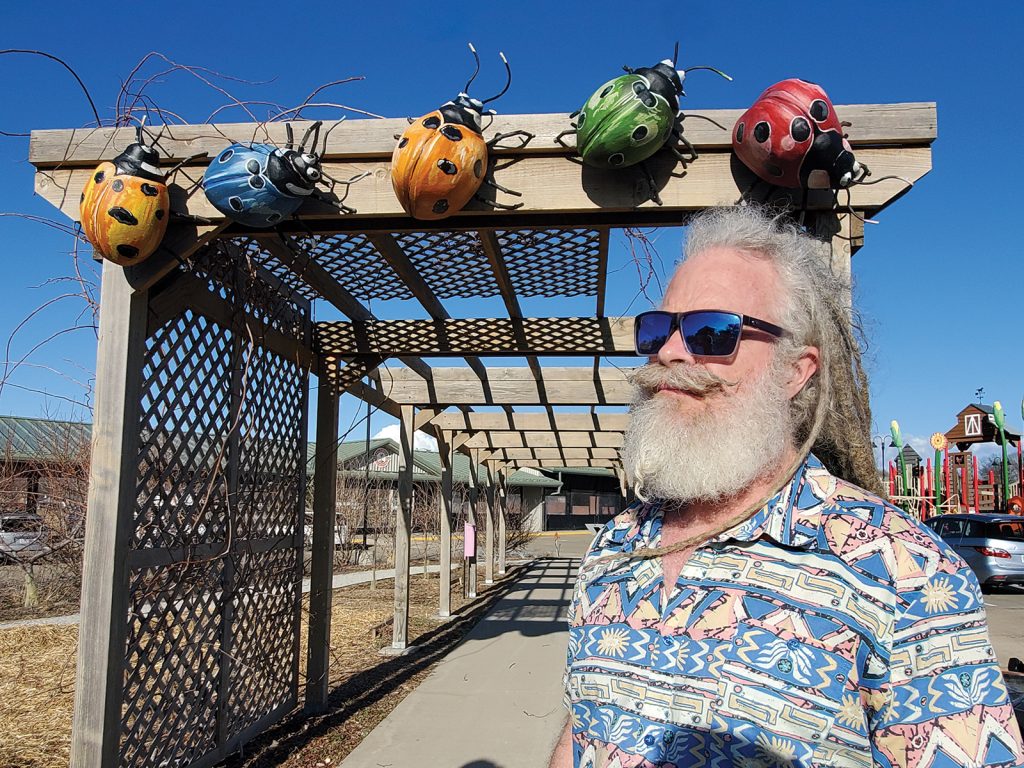
Yes, the artist is a bug guy. And some of his most awe-inspiring works, fashioned from rebar and other industrial materials, adorn the grounds of the Columbia Center for Urban Agriculture’s community garden at Columbia’s Agriculture Park, a 10-acre space in the Clary-Shy Community Park. The larger-than-life bugs include a massive praying mantis, monarch butterfly, ladybugs, and a gigantic bee. The prominent art installations get a lot of looks from the 6,000 or so visitors to Columbia Farmers Market next to CCUA and that organization’s community welcome center, which is nearing the end of construction.
After getting to know more about Feilbach and his artistic process, you’ll want to creep, crawl, hop, or fly around the agriculture park to check out his mighty insects. Get ready to peek into the mind of the artist who proclaims, “Passion looks like crazy to those who don’t have it.”
The thousands of people who gather on Saturdays at Columbia Farmers Market have seen the giant insect sculptures that adorn the Columbia Center for Urban Agriculture building and community garden. That’s your work! What can you tell us about the project?
There are several things about that project that really clicked with me. First off, I love wildlife, and I’ve always been drawn to insects. What amazes me about them is that they’re already abstract — the colors, the patterns. They’re like tiny moving paintings. I like taking those little bugs that usually live 6 inches off the ground and blowing them up into something big and impossible to ignore.
When you make a giant praying mantis or a huge bee, people suddenly get to experience what that world looks like from a different scale. It makes everyone feel like a kid again. There’s curiosity, wonder, and play in it.
Mix that with the fact that I’m a big farmers market person, and placing the work at the Columbia Farmers Market and the Columbia Center for Urban Agriculture just made sense to me. That combination of community, food, nature, and art is rare. It’s been one of the most rewarding projects I’ve done.
You’re also connected to the Tigers on the Prowl fundraiser, and two of your recent creations raised a considerable amount for that cause. Tell us about that.
Last year I was invited by Nic Parks, the director of Tigers on the Prowl, to participate as one of the artists. Right away what stood out to me was how well the entire event was run. The staff are genuinely some of the nicest people I’ve worked with, and the whole thing operates like clockwork. That’s rare.
Artists are often asked to donate work, and you don’t really get much back from the experience. This was the opposite. They take care of the artists: You’re compensated, you’re included, you’re invited into the community. There’s a real sense of appreciation, and that matters. My pieces did very well, and what I learned through that experience was the power of relatability. People show up because they care about the cause, but the tiger — and the connection to the University of Missouri — is something everyone around here immediately connects with. I took an existing logo and made it three-dimensional, and people really responded to that.
That project opened a door I didn’t even know existed. It led to me obtaining a license to make and sell that logo. Now I’m exploring additional logos and licensing opportunities with the university.
You combine industrial-grade materials to bring your creations to life. Why have you chosen those materials?
Years ago, when I didn’t have much more than a couple of tools, I was doing chainsaw wood carvings. I did that for a long time. Custom pieces and smaller works I could sell. But I always wanted to go bigger. Wood only allows that to a certain point. Once you scale up, weight becomes a major issue, and then there’s the ongoing maintenance. Wood that is outdoors needs constant care. I wanted to move away from that.
Over time, I started evolving into using other materials that would let me work larger and last longer. That’s what led me to industrial-grade materials. They’re made to live outside. They’re durable, they’re weather-resistant, and, in some cases, they’re reinforced with internal metal structures so the pieces are rigid and stable. That opened the door to doing work at a scale I’d been aiming for for years.
Are there any particular challenges to working with such materials?
Cost is a big one. Industrial materials are far more expensive than most people realize. The process is also really messy. Really messy. That’s just part of the reality of working this way. That said, I’ve been doing it long enough now that I understand the steps and the workflow. A lot of the problems I ran into early on have been worked out through experience.
At this point, I just dig in, do what needs to be done, and push through the parts that aren’t always enjoyable, because the end result makes it worth it. The outcome is a big, bright sculpture that can live outdoors for many, many years — and that’s always been the goal.
Take us back to the beginning. When did you realize that what you were creating brought joy to you — and others?
One of the biggest things I realized early on is that I’m very dyslexic. I spent most of my school years in the resource room because I don’t process letters the way most people do. My brain works in pictures. Letters are just symbols to me, but visuals make complete sense to me. Because of that, I think I was born creative and naturally open to creative processes and ways of understanding the world.
I was also surrounded by it growing up. My dad had a sign shop, so I was around sign painting all the time. I had an uncle who introduced me to art very early on, so creativity was always present. I drew a lot through junior high and high school — mostly doodling — but it was always there in the background.
In my twenties, I started getting into stone sculpture and worked with that for a few years — mostly for myself. That was when I really began noticing how people reacted to what I was making. About 10 or 15 years ago, after a lot of ups and downs, I decided to fully pursue this path. Over time, I’ve developed a clear direction — a lane of what I do and what I do well.
Seeing people interact with the work is where the joy really hits. I have several sculptures in northwest Arkansas, including one in Eureka Springs Park, and I’ve been told that in the summertime, people line up to crawl all over it and take pictures. People genuinely relate to the work. What makes me smile the most is when I’m nearby and just quietly watching people interact with a piece — not saying anything, just observing. Seeing that connection happen on its own is incredibly rewarding.
Your eye for color and detail is incredible. How did you develop that skill?
Detail is something I believe I was born with. I’m naturally very inquisitive and highly detail-oriented. I see things a lot of people don’t — patterns, textures, small relationships — and I tend to obsess over them. To me, everything is in the detail, and that way of seeing has always been there.
Color is different. I can’t take full credit for that. A huge part of my understanding of color comes from Larry Mansker, who has been a mentor to me for close to 10 years now. Years ago, when I was living in Eureka Springs, I actively went looking for someone who could teach me color because I knew that was a gap in my skill set.
When I told him I wanted to learn how to paint, the first thing he said was, “Get a pencil and paper.” We didn’t paint for a long time. We drew, working through textures, tones, values, and control. That foundation completely changed how I see.
As my work grew larger and moved into sculpture, his influence on color became even more important. He has an eye for color that I still don’t fully possess, and I go back to him constantly for feedback. He sees things that I can’t see yet. I’ll bring work to him just to get his two cents because he’s been doing this longer than I’ve been alive, and professionally longer than most people have. That combination — a natural pull toward detail and years of disciplined guidance in color — is what shaped how I work today.
Who are some of the biggest artistic influences in your life, both back when you were starting and now?
Interestingly, my core influences haven’t really changed over the years. I still go back to the same three: Salvador Dali, Frank Lloyd Wright, and Michelangelo. Each of them approached form, space, and scale in a way that pushed beyond convention, and that’s always resonated with me. I’ll also add Larry, who has been both a mentor and a friend. He’s a master painter. Watching how he thinks through color, composition, and discipline has had a real impact on me over time.
Beyond specific artists, I look to nature more than anything. I study the things I’m working on — insects, animals, forms — and then I look closely at what already exists in the world. There’s an intelligence and creativity built into nature that’s impossible to ignore. You could even call it a higher power because everything around us is a creation of something larger. That ongoing observation continues to influence my work as much as any artist has.
What are some of the public art projects in Columbia that capture your attention the most?
I’ve always been a fan of abstract art. One of my favorite pieces in town is the abstract sculpture near Stephens Lake Park, out by the hospital area. It’s strong, well-placed, and it holds us over time. I’m also drawn to several of the more realistic murals around Columbia — pieces where you can immediately recognize the subject and connect to it.
What I’ve noticed over the years, though, is that abstract public art doesn’t always invite interaction in the way representational work does. A realistic piece — something like a giant tortoise or a Bigfoot — tends to pull people in. Kids climb on it, people take photos with it, and there’s a more playful, childlike response. That kind of interaction matters to me. My hope is to make a bigger impression on public art in Columbia by contributing more of that interactive, approachable work.
Abstract art is something I truly love, but I’ve also seen how difficult it can be for abstract pieces to engage the broader public in shared spaces. Finding that balance — respecting abstraction while creating work people physically and emotionally interact with — is where I see a real opportunity locally.
Tell us about projects you’ve done in other communities.
I’ve had the chance to work in a variety of communities beyond Columbia. In northwest Arkansas, for example, I have several pieces, including one just a stone’s throw from Crystal Bridges Museum of American Art in Bentonville. I’ve also done projects in Bella Vista and multiple works in Eureka Springs.
I even had the opportunity to participate in Art Basel Miami some years ago, collaborating on a project that’s still installed there. Beyond that, I’ve done private commissions in Texas and a few other pieces in Branson. I also had a wood piece in Davenport, though it may not still exist.
Each community has its own character and audience, and I’ve learned a lot about how people interact with my work in different places. It’s always inspiring to see how the same piece can evoke different responses depending on where it lives.
How do you split time between Eureka Springs and Columbia?
In a lot of ways, it’s a “go back to where you started” story. Decades ago, when I was living in mid-Missouri, I first got involved in Columbia’s art community. After that, I felt like I needed to get out and see other places — Davenport, Iowa; Kansas City; St. Louis — and I was literally traveling around with a chainsaw, trying to figure out where I fit.
That journey eventually landed me in Eureka Springs. One of the town’s long-standing ideas is that it’s “where the misfits fit,” and that rang true for me. It’s not just an artist community — the whole town is quirky, creative, and open. I made a big splash there and spent many years living and working in Eureka Springs. That time was formative. It’s where I met Larry, who helped me grow not just as an artist, but also in understanding the business side of art. I have served on the Mayor’s Arts Council there for years, continue to do work for people in the area, and have pieces scattered throughout northwest Arkansas.
Over time, I started bouncing back and forth between Eureka Springs and Columbia, and I eventually found myself spending more time in Columbia. Eureka Springs is a smaller art market. It has incredible visitors who appreciate art, but Columbia offers more room for growth. It’s a larger area with bigger opportunities, and at this stage of my career, I want to work on a larger scale and take on bigger projects.
I still visit Eureka Springs regularly and always will. I consider myself “local” there just as much as I do in Columbia. Eureka Springs is one of those places where, if you ever truly fit in, it stays part of you. I’m grateful for places that allow me to become part of their art community — that kind of belonging matters to me. And if another place ever feels like that, I’d be open to becoming part of it, too.
What is something you like about Columbia other than its vibrant art scene?
I really like the university and the passion people have for their team. One of my sayings is, “Passion looks like crazy to those who don’t have it.” I enjoy seeing that energy and commitment. It’s contagious and adds a unique character to the city.
What did you say about creating with the mind or eye of a child? That thought makes us smile!
I think most artisans and creatives are naturally childlike — always curious, easily excited, and drawn to things just outside the norm. I try to create work that taps into that same sense of wonder. You can’t sit on a giant frog, turtle, or Bigfoot and not smile like a 5-year-old. For me, my pieces are about helping people reconnect with that inner child.
Many people have lost touch with that part of themselves. But I never lost mine — for better or for worse. Seeing people interact with my sculptures and genuinely smile or laugh is incredibly rewarding. It’s not a fake smile. It’s real. That ability to make someone think differently, feel differently, or just experience pure joy through my work is humbling and one of the most satisfying parts of what I do.
What is your muse? How much do you rely on inspiration to strike?
My muse is life itself — especially nature. My mind never stops generating ideas. I’ll never live long enough to create everything I want to, let alone all the projects I haven’t even started. Inspiration is constant for me.
To me, waiting for inspiration is sometimes just an excuse not to work. Over the years, I’ve developed the discipline to see what a piece needs, let that spark my ideas, and then get it done. The work itself become the vessel for inspiration, and everyone else gets to see what inspired me. I don’t wait for a moment of magic. I create it.
What do you do for fun — besides creating art?
I enjoy vegetable gardening. There’s something rewarding about growing things and watching them come to life. I also really enjoy helping other people who are trying to grow a business. Over the years, so many people helped me along the way, and they always said, “You don’t owe me anything; just help somebody else.”
I try to do that now by asking, “What are you trying to accomplish? What are you trying to do?” Business, marketing, and advertising are fascinating to me. I enjoy the strategy and creativity behind it, and I like seeing people figure out their path.
If you weren’t creating art for a living, what would you be doing?
I’d be helping businesses with marketing and advertising. I even enjoy cold calling, which didn’t come naturally to me; I had to force myself to do it. But in my experience, artists who sit around waiting for representation or for someone else to make their dream happen rarely see it come true.
I’ve always believed that if you want something, you have to get off the couch and make it happen. That mindset drives both my art and my approach to business.
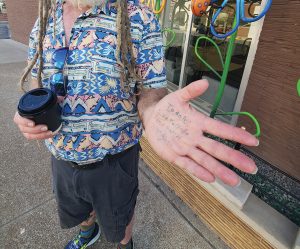
To Do List:
Live to create, find yourself, never give up