

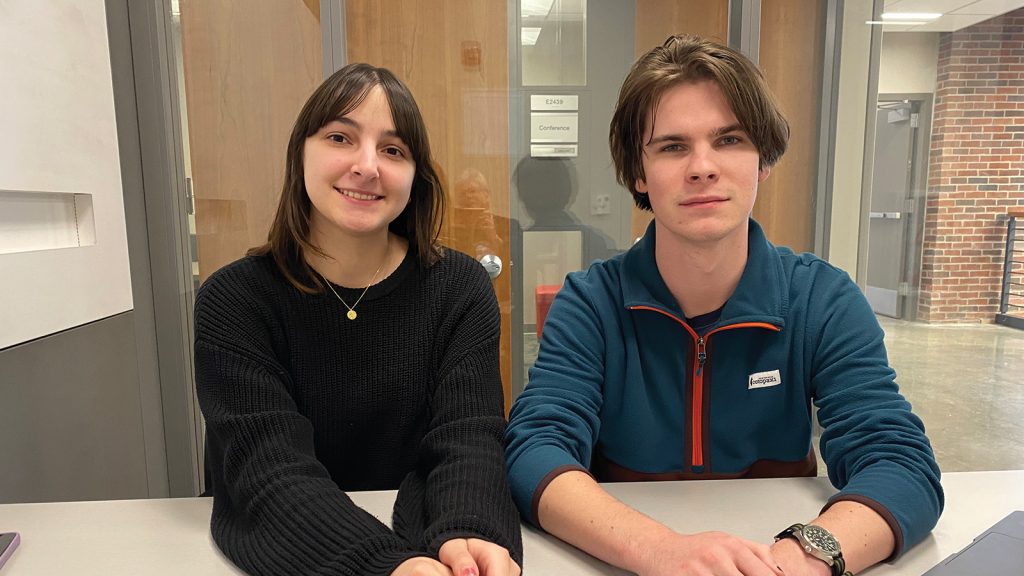
As Russia continues to punish their homeland, University of Missouri Ukrainian students Vlad Sazhen and Alina Rohulia continue to watch from afar.
Sazhen, 23, arrived at MU in January 2022, the month before Russia invaded. His now-fiancée, Rohulia, 22, joined him on campus in August 2022. Both earned bachelor’s degrees from Mizzou and are now pursuing doctorates: Sazhen in mechanical engineering, Rohulia in health informatics.
Meanwhile, the students’ families remain in Ukraine. With Rohulia’s father and brother serving in the Ukrainian military, concern for loved ones is never far from their minds.

Civilians Under Attack
February 24 marked four years since Russia invaded Ukraine. Ukraine pushed back Russia’s initial advances, and the military campaigns have since settled into a stalemate. But as Russia is halted on the battlefield, it launches daily drone attacks on civilian targets in Ukraine.
In the days before an interview with the couple in MU’s Lafferre Hall, Russian drones struck a passenger train in Kharkiv, killing six. Kharkiv is their hometown, and Rohulia’s parents still live there.
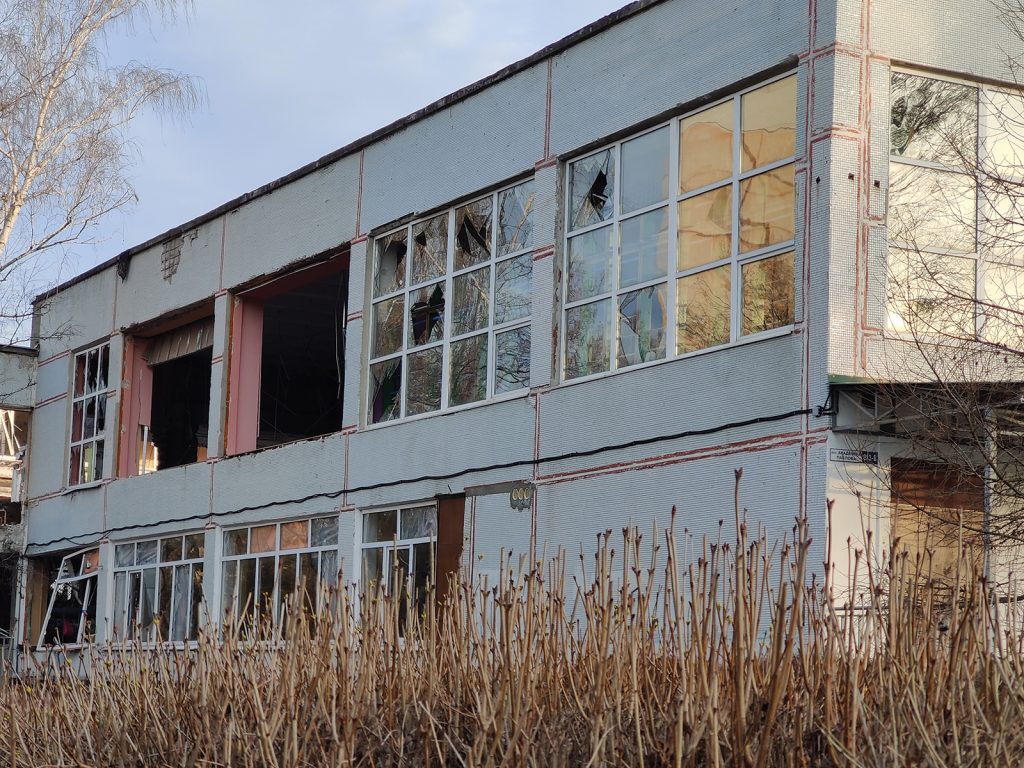
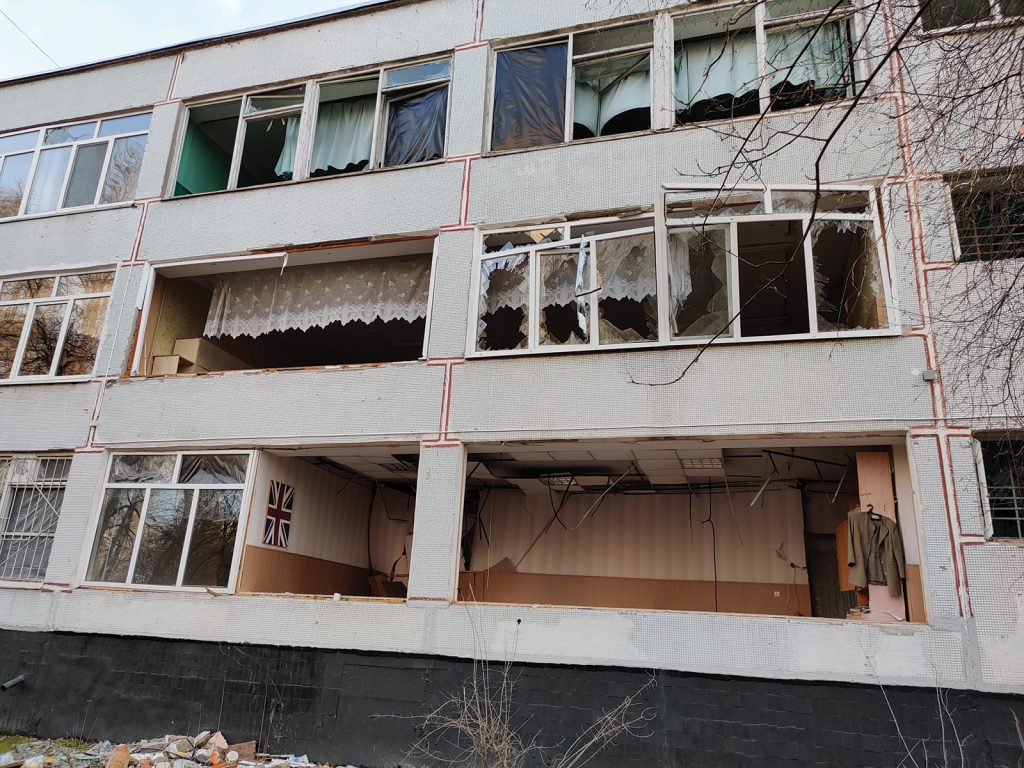
The two are tuned in to what’s happening in Ukraine and proud of their families and the Ukrainian people.
“People are still taking their kids to school,” Rohulia said. “Parents are still helping their children with math homework. Ukrainians are up to anything now.”
All of this as drones fall from the sky regularly.
School is underground school, essentially a bomb shelter. Sazhen’s sister, Anya, attends with other children three days a week in Kyiv. A photo Sazhen shared shows his sister near the back of the classroom, wearing a Ukrainian flag on her sleeve.
“My mom said that, in Kharkiv, typically they have like six hours of light per day to work and to stay warm,” Rohulia reported. “Most of the time they don’t have light. They don’t have heat.”
Things are worse in Kyiv, according to Sazhen.
“My granddad told me that he would have electricity outages,” Sazhen said. “He lives on the 15th floor of the apartment building, and he is 75 years old, so he has to walk downstairs to get groceries because the electricity will be out for 15 or 17 hours, and the elevators are obviously not running.”
The bombardment is nearly constant. “They would turn on the electricity for an hour or two, but then Russians will strike again, and electricity will be out again,” Sazhen said. “And no electricity on the 15th floor means no heating, also, because the pumps are not working, and in many houses, there are no backup generators because houses are older. So really, it’s been terrible for the citizens of Kyiv, especially for older and disabled people.”
Rohulia’s grandparents in the more rural Sumer region usually have just four hours of electricity a day. “It’s basically turned into a humanitarian crisis,” she said.
The Geopolitical Perspective
A January 2026 report by the Center for Strategic & International Studies predicts that Russian and Ukrainian casualties could reach 2 million by spring, with Russia having 1.2 million dead and wounded already.
“Despite claims of battlefield momentum in Ukraine, the data shows that Russia is paying an extraordinary price to minimal gains and is in decline as a major power,” the report’s authors note. “No major power has suffered anywhere near these numbers of casualties or fatalities in any war since World War II.”
The Russians can’t advance on the ground, so they punish Ukrainian civilians, Sazhen said. “They’re still producing thousands of drones a day, and all of those drones are flying toward Ukraine to strike infrastructure.”
Stephen Quackenbush, director of Defense and Strategic Studies at MU’s Truman School of Government and Public Affairs has also been paying attention to what’s going on in Ukraine.
Russia hasn’t fought within the rules of war, Quackenbush said. It has consistently attacked civilian targets, while Ukraine doesn’t. “In the Russian-occupied areas, we see all sorts of atrocities and war crimes: kidnapping Ukrainian children and taking them to Russia and things of this nature.”
While the U.S. was a staunch ally of Ukraine when the invasion started, Donald Trump began his term verbally ambushing Ukrainian President Volodymyr Zelenskyy in the Oval Office, telling him he didn’t hold any cards and berating him for the way he was dressed.
“They seemed to feel that, you know, if Zelenskyy could be brought to reason, then the war would end, and without any real concern about what that meant for Ukrainians or for Europe or for anything,” Quackenbush said.
Following that episode, a summit took place in Alaska with Vladmir Putin, but without Zelenskyy. “Trump seems to have learned somewhat that it’s not actually Ukraine that’s the obstacle to peace,” Quackenbush remarked.
Not that this realization has prompted the president to adopt a more pro-Ukraine position. “Within the past year with the Trump administration, U.S. military support has basically collapsed,” Quackenbush said, with European and NATO allies and Canada picking up the slack.
He added that there have been many issues that have distracted the American people and officials from focusing on the war since 2022.
“Events in Minneapolis are more pressing,” said Quackenbush. “[The conflict in] Gaza lasted a long time, but the [Hamas attack on Israel] took place well after the Russian invasion of Ukraine. So a lot of things have happened. Initially, there was a lot of attention on Ukraine. That attention, certainly within the United States, has waned over time.”
Now, trilateral talks with Ukraine, Russia, and the U.S. are taking place, but Russia’s demands include Ukraine surrendering its Donbas region, which it has been unable to occupy over the four-year war.
“I can’t say I’m particularly optimistic about an end to the war in 2026, but you know, there’s certainly chances,” Quackenbush said. “It’s hard to imagine the war coming to an end with Putin still in power,” he continued, adding that if the economy fails, the Russian oligarchs may bring him down.
The Student-Eye View
While many in the United States have shifted their focus away from Ukraine, Sazhen and Rohulia remain diplomatically grateful to their host country.
“We appreciate all the support from America and the American people,” Rohulia said. “We appreciate that people want the war in Ukraine to stop, and we really hope that happens.”
That said, Ukraine won’t give up its territory and shouldn’t, Sazhen insisted.
“It’s pretty clear what they want to do,” Sazhen said of Russia’s motives. “Once they get what they want, which is the rest of the Donetsk and Luhansk region, they can move the troops toward the Eastern Front of Europe, so closer to Estonia and Lithuania. This sets up a new platform for the potential Europe invasion that Russian media are talking a lot about. So, if Europe forces Ukraine to give up the territory, it essentially undermines itself, because it helps Russia prepare better for the Europe invasion.”
Along with their studies at MU, Rohulia and Sazhen are active in ShowMe Ukraine Society, a student group they co-founded. Currently, Rohulia serves as vice president, and Sazhen is its treasurer.
Established in 2023, ShowMe Ukraine is open to everyone and has a profile on Instagram. It has hosted multicultural events and music, potlucks, and fundraisers.
“We’re trying to stay active to now not only support Ukraine, but also share our culture and our language, our traditions with people, Ukrainians and non-Ukrainians,” Rohulia said.
To raise funds, the group sells handmake Ukrainian jewelry at City of Refuge Boutique.
“Since 2023 we fundraised more than $8,000 toward humanitarian aid,” said Rohulia. “Our latest donation was to children [who have had one or two parents die due to military actions]. We sent $1,100 toward support to those children. It was our Christmas donation. So we’re trying to build community here, and we’re trying to support people in Ukraine as much as we can.”