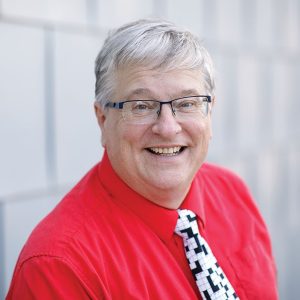
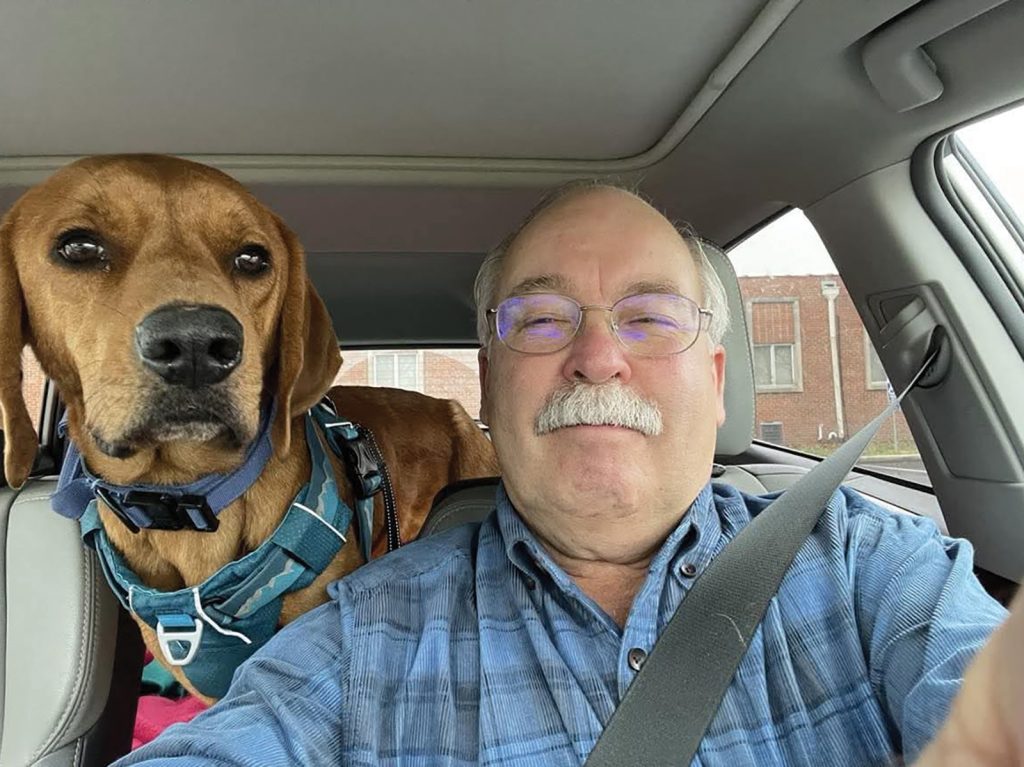
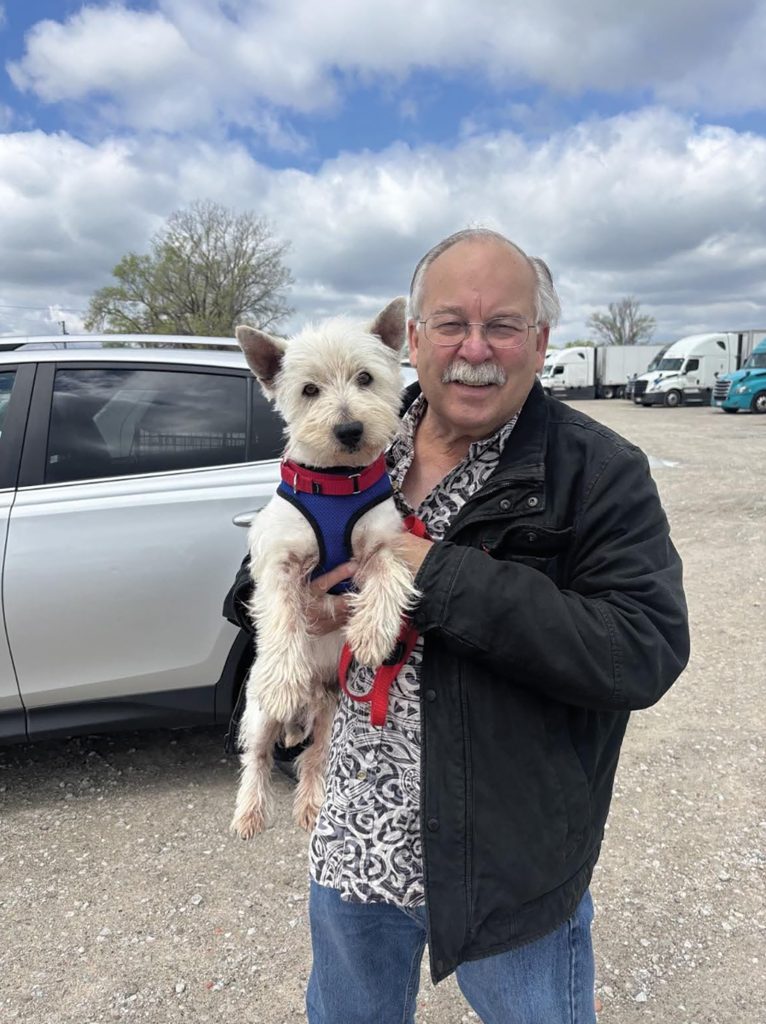
 Andy politely snuggles against a visitor’s leg, breathing a satisfied sigh after a reciprocating pat on his cream-colored head. It’s a quiet weekday afternoon, and Andy’s human, Chris Cummins, won’t be driving to transport one or more dogs from a canine rescue organization to their furever homes.
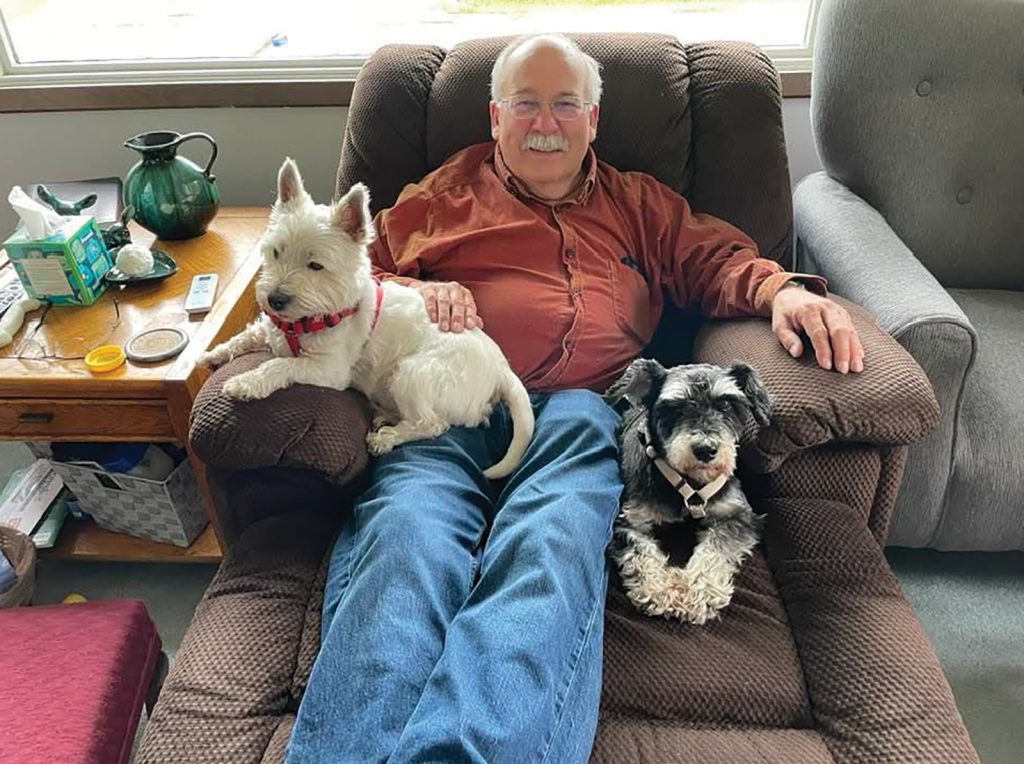
“Andy needs to be touching you. He’s just super affectionate,” Cummin says. He begins to tell the tale of how Andy, a spunky little Westie, came to live with him and Sally, a black miniature schnauzer who doesn’t seem to mind Andy but probably would be just as content without him. Cummins begins, “Against my better judgment …”
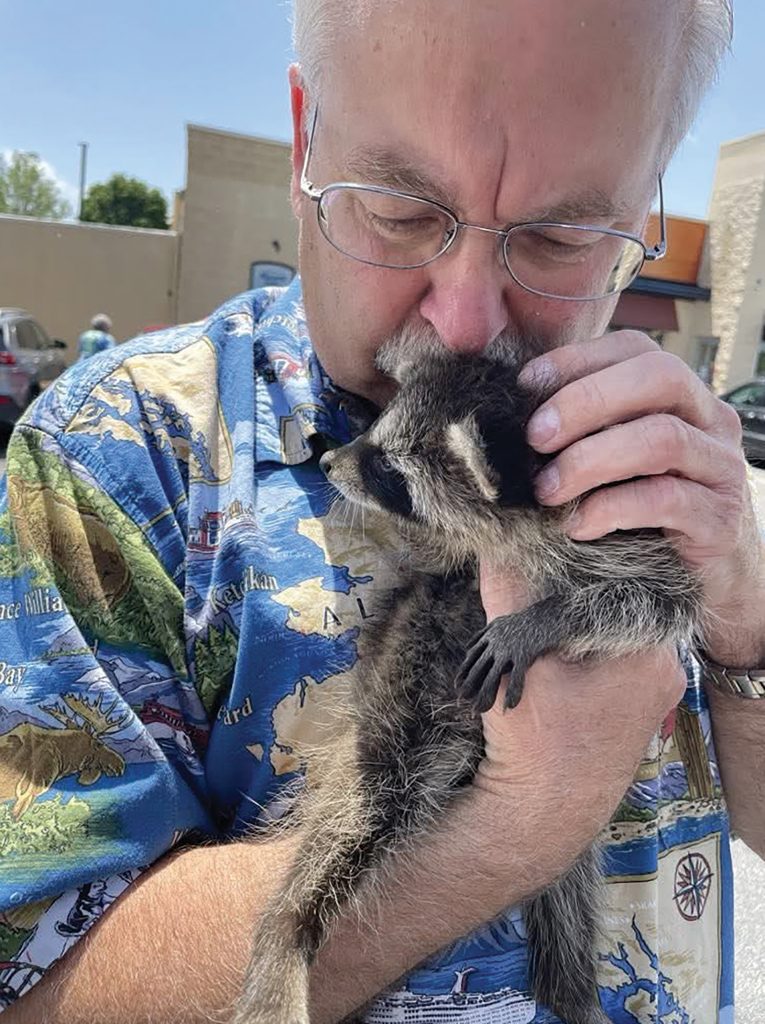
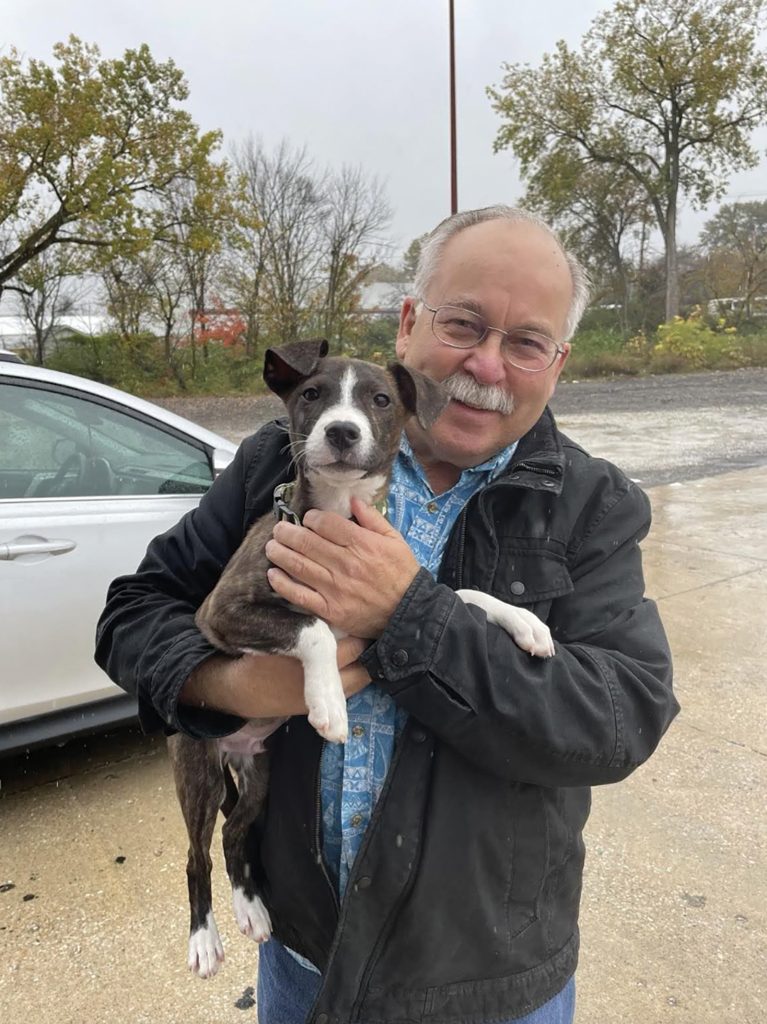
He rolls his eyes, his face slowly forming a friendly, mustachioed smile as he tells the story with a perceptible twinkle in his eye. Cummins became familiar with Andy through volunteer work as a rescue dog driver. In fact, in 2025, Cummins logged 13,808 miles over 70 trips to play a part in the fostering, adoption, or rehabilitation of 133 dogs, 12 cats, six raccoons, and two foxes.
Cummins will continue to play a role in that process, but he vows not to foster any other dogs. Sally, the pup perched in the chair once occupied by his late wife, Karen, seems unfazed by the conversation but also seems to approve. After all, Sally was there before Andy.
On the ‘mark’
He might not foster or adopt another dog, but Cummins has a particular passion for helping dog rescue groups connect their dogs with fosters or their permanent homes. Not long after he began transporting dogs for a variety of rescue organizations, he wound up transporting Andy three times, first picking Andy up in Boonville after the pup’s owner died and later taking Andy to Blue Springs where — allegedly — Andy peed on his new owner’s boyfriend’s boots. From there it was off to Wichita, and then he was destined to find a home with an Illinois family that seemed the perfect fit, except the family wanted a “perfect” dog. However, Andy has diabetes insipidus, requiring regular medication. There was also his habit of, ahem, “marking” territory.
The next part of the story involved “some arm-twisting” as Cummins was strongly encouraged to foster Andy, which is when the more practical part of his brain fell victim to his overpowering love of canines, especially pups with such besmirched characters. Against his better judgment …
“Then I was talked into adopting him,” he concedes. It also meant his experience became what is known in the dog rescue and foster process as a “foster fail.”
“People foster and then fall in love with the dog and can’t let it go,” he says. But Andy has been good for Sally. Mostly. Cummins adds, “He’s kind of brought her out of her shell a little bit, although I think she would prefer to be the only dog.”
The Foster Experience
Foster fails are not uncommon in the line of volunteer work that Cummins embraced not long after Karen’s death in April 2023. Most foster experiences go as planned, he guesses.
“I’ve talked to some who talk about taking them to their furever home, then bawling all the way back home,” he says. “I’m totally in awe of people who do that. It’s an amazing ability to be able to know that your heart’s going to be broken at some time when you have to give the dog up, but in the meantime, you’re keeping it from sleeping out on the street or a cold floor in a dog pound.”
Cummins retired from the University of Missouri’s international admissions office in December 2022. A former colleague later contacted him to see if he might be interested in playing a role in the dog rescue picture.
“She called me up and said, ‘I do this dog transporting,’” he recalls. “’We’ve got one on Saturday.’”
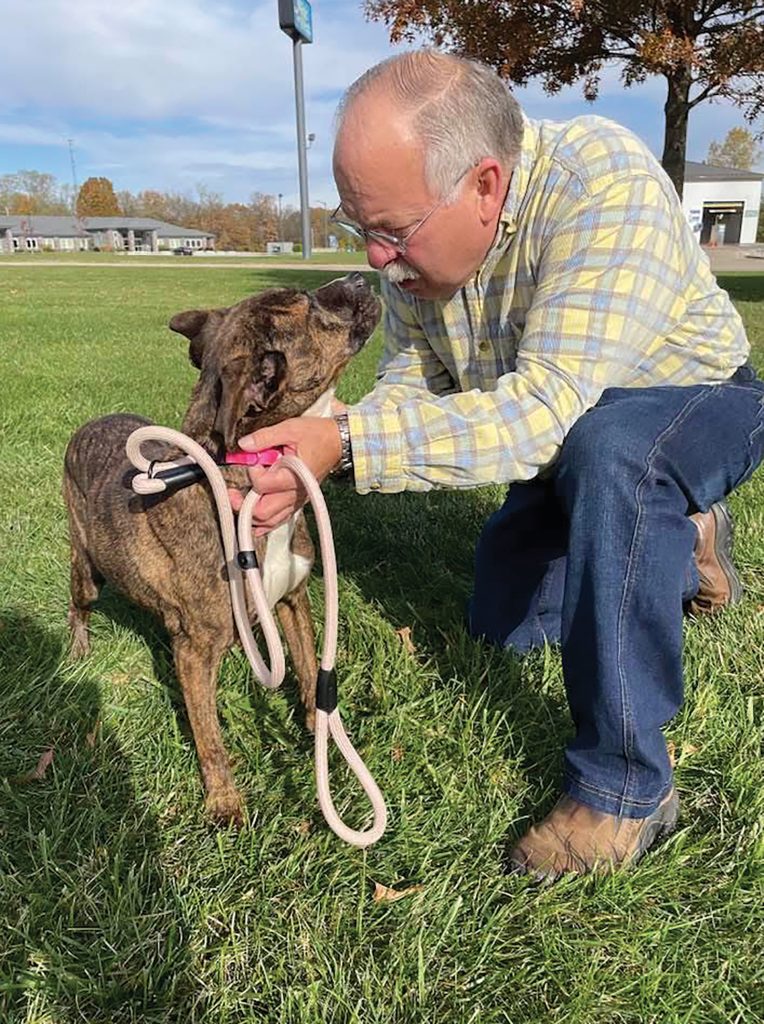
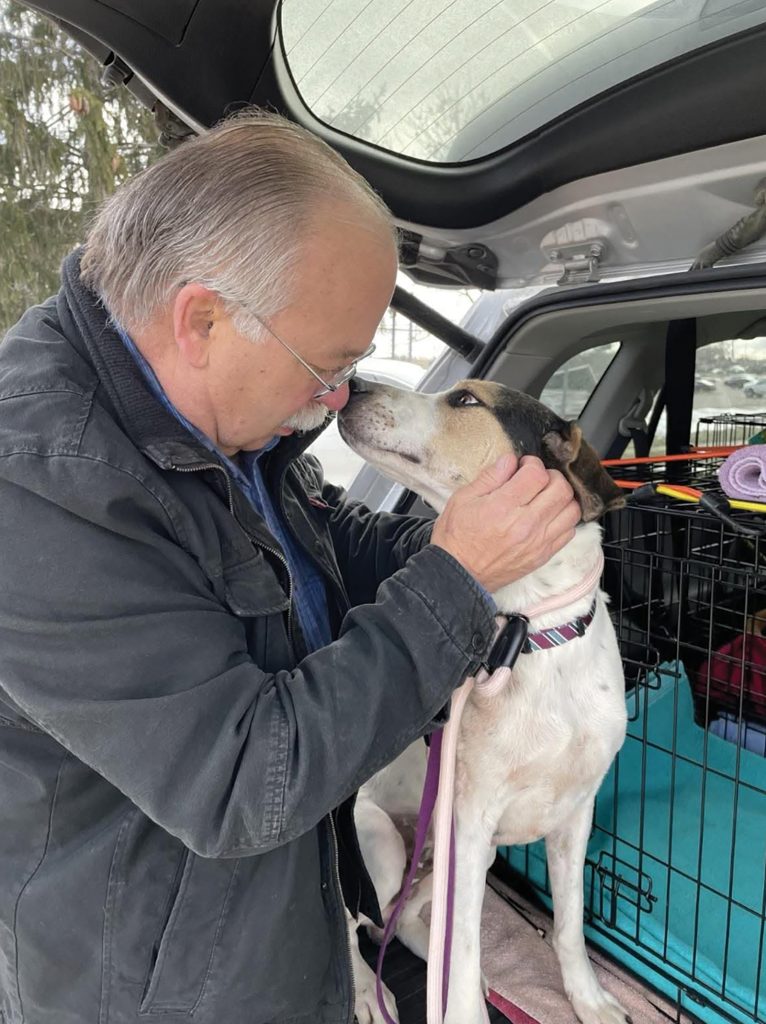
Cummins went along and was immediately hooked. He now has a special affinity for a dog rescue organization in the Bootheel, which he says is “just a couple of dogs short of burnout.” He rarely turns down their calls to set up drivers for getting dogs from southeast Missouri to other areas where foster or adoptive pet parents await. Among the myriad rescue groups he has helped with transporting dogs — or cats, raccoons, foxes, and even bobcat kits — are Headed Home in the Heartland, 3 C’s Rescue Ranch, and poodle and rottweiler rescues in Columbia.
He also has a soft spot for Westy Rescue of Missouri — which is responsible for his foster fail with Andy — and there’s a Facebook group that lists dogs that need transportation to a new destination.
Playing His Role
Cummins is quick to point out that he’s only one of the many players in the dog rescue and transport scenario. His tone softens even more, adding, “Some of these people have become like my family.”
Here’s how it typically works. The process might include as many as five or six drivers for a dog’s trek from the Bootheel to points north, perhaps as far as Nebraska or Minnesota, or east from St. Louis into Illinois.
“I get the ones going to Kansas City,” Cummins says. He has made numerous trips to either drop off or pick up dogs in Concordia off I-70. If his canine passenger is destined for the St. Louis area, he’ll take the pup to a meeting point in Kingdom City or a location farther east. For dogs headed north, those that he drops off might have different drivers from Concordia to Kansas City, then to St. Joseph, and then to Omaha, Nebraska, or beyond.
“Everybody volunteers. Nobody’s getting paid,” Cummins says, adding that drivers are sometimes offered cash to cover fuel costs. “But we want the money to go to the dog’s care.”
Rescue organizations do not ask veterinarians to give them free services, at least in his experience. “But vets will squeeze these dogs in” for impromptu appointments, he says. “They will make time for rescue dogs.”
A recent rescue transport involved four dogs headed to St. Louis from Concordia. One of the dogs was exhibiting symptoms of parvovirus, a highly contagious and often deadly disease. Cummins called ahead and had the dog tested in the parking lot. The parvo test was negative, but the extra time to tend to the dog’s health, wait for the test, and then be seen by a vet meant a nearly eight-hour day instead of a two- or three-hour trip.
Love at First Sight
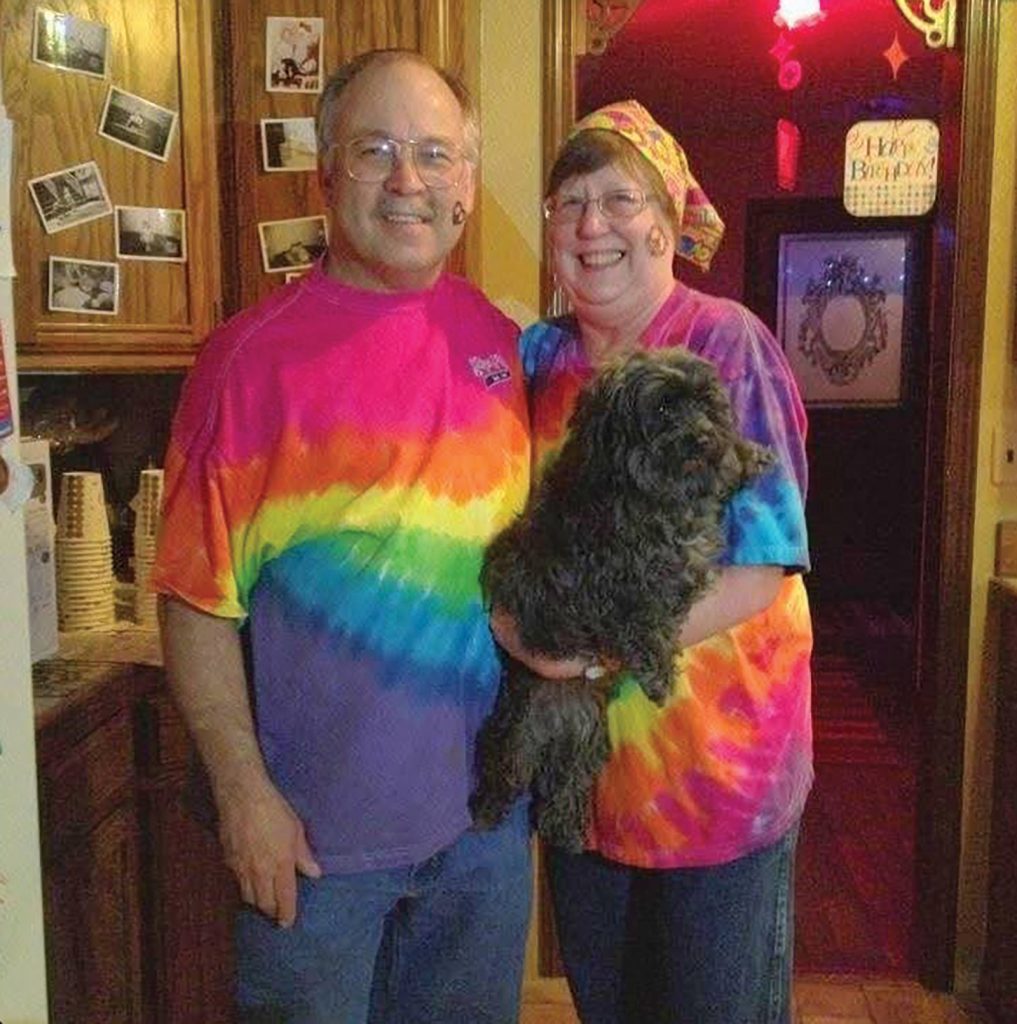
Cummins met Karen in Columbia when he was on his way from Rolla, Missouri, to the World’s Fair in Spokane, Washington, in 1974. It was a case of love at first sight, and that marked the end of his World’s Fair journey. They married a year later and moved to Alaska in 1984, spending nearly 30 years in the state where Chris grew up and where his parents still live. He worked for a cable television company and later was a staff member in the state’s payroll and personnel department. When they moved back to Columbia in 2013, Chris and Karen bought their house from a couple that worked and taught as veterinarians.
They were married 48 years.
The August before Karen’s death, the couple’s cherished, 13-year-old fluffball pup, Kacie, died. The black shih tzu-poodle mix had been Cummins’s shadow after being adopted through the Central Missouri Humane Society, and Kacie loved either flights or drives to visit Alaska.
The weekend after Kacie crossed the rainbow bridge, the couple went to a dog adoption event at Rose Music Hall, but none of the dogs seemed like the right fit.
“My whole life routine revolves around my dogs,” he says. “I was just lost.”
They heard about Sally, a “breeder rescue,” who had delivered five litters of puppies in five years. Sally was not exactly approachable or affectionate, and she had been adopted and returned at least once. Sally wasn’t a good fit for fostering either.
But with patience, his friendly demeanor, multiple daily walks, and a few treats, Cummins became her human, and the two are now inseparable. Well, along with Andy.
Sacred Nose Prints
Shortly after Sally came on the scene, Karen began chemotherapy treatment for lung cancer, with regular trips to the Missouri Cancer Associates in Columbia for treatments. They took Sally, who stayed in the car, often pressing her nose against the back glass to wait for her people to return.
Cummins pauses. He wipes his eyes.
“I’ve never washed those nose prints off the car,” he says softly. “They’re still there.”
This April will be three years since Karen’s death.
“I’m the eternal optimist,” he says. “I just knew we were going to beat it. Right up until we didn’t.”
Karen’s eyeglasses are still right where she left them on a side table next to the chair that Sally now occupies. The Christmas tree, a standing, permanent homage to Karen, has been up since Christmas 2023. Cummins smiles, confident that Karen would have relished the opportunity that he has to help facilitate connecting discarded dogs with individuals and families who will cherish the pets.
Meanwhile, Andy stretches, happy to get a quick belly rub from the visitor quizzing his human.
“One of the arguments for me to take him,” Cummins says, “was that Karen was sending him to me. My life was too sedentary.”
How do you argue with that?
“You don’t.”
His eyes got misty a few times as he spoke about Karen, then again when he reflected on the sheer number of dogs that do not get rescued and connected with forever love. He glances at Andy, then at Sally, who is quietly following the conversation.
“Those eyes …” he said. “They look into your soul.”
Cummins admits he doesn’t try to make sense of the glut of unwanted and discarded dogs, and he’s sure that the ones making their way to rescues are “just a fraction of the dogs out there that are not being rescued.” He adds a quick pointer for would-be dog owners:
Don’t buy dogs in a parking lot or off Craigslist. Get them from a rescue.
He shakes his head.
“It’s just never-ending,” he added. “And in Missouri, it’s easier to be a breeder than it is a rescue.”
Ultimately, the dog and cat (and fox, raccoon, and bobcat) rescue business is not unlike the story about the little boy throwing starfish back into the sea from a beach littered with stranded starfish. He knew he couldn’t save them all. But he could save some.
“Like I said, I’m the eternal optimist,” Cummins said. “Sometimes I think, ‘If I don’t drive today, it’s not going to make any difference.’ But it does. It makes a difference for one dog or one cat. Or one raccoon.”