
The name “The Pasta Factory,” elegantly announced in mosaic stained glass overlooking the dining room, conveys only part of the longtime restaurant’s legacy.
Although a bounty of pasta dishes grace the menu, many loyal patrons swear by the crispy eggplant parmigiano, sweet-and-savory chicken marsala, or an unexpectedly spectacular bacon cheeseburger with hand-cut fries.
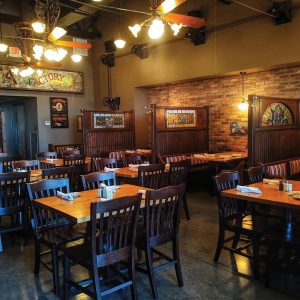
Likewise, “factory” might seem a bit industrial for the eatery’s cozy and inviting environs at 3103 West Broadway. The belt-driven ceiling fans set the pace, lazily circling above families toasting graduations, anniversaries, or simply Wednesday night. Laughter spills from the bar, mingling with conversation among antique wooden booths and retro signage that beckons nostalgia.
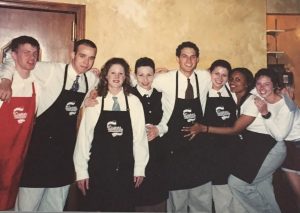
The famously friendly waitstaff adds to the charm. Over the years, countless students from Columbia College, Stephens College, and the University of Missouri have helped crew the “P-Fac,” cultivating camaraderie and lifelong friendships — and even a few marriages and babies.
The Pasta Factory has outlasted innumerable dining trends by doing something remarkably simple: serving consistently good food in a place that feels like home. That warmth has kept Columbians coming back — to three iterations throughout town — for half a century.
“It’s comfortable, casual, comfort food,” said Jenny Dubinski, who alongside husband Jason has owned the restaurant since 2001. “People feel welcome here, and it’s homey. That’s what we want it to be.”
From Scratch
In the bicentennial spring of 1976, Otto Maly was looking for a job. Then a sophomore at Mizzou, his first stop was Harpo’s Bar and Grill, the relatively new and wildly popular college hangout owned and operated by his elder Alpha Tau Omega fraternity brother Dennis Harper.
Staff told Maly that Harpo’s wasn’t hiring. Instead, they suggested he check with Harper’s latest venture: an Italian restaurant under construction at Crossroads West Shopping Center (2100 W. Broadway), which he was opening with business partner Mike Kroenke.
Pictured above
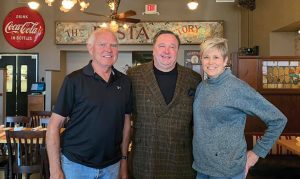
West Broadway location dining room. Dennis Harper, Otto Maly, and Jenny Dubinski.
When Maly arrived, Kroenke made him a deal: Help me tile the ceiling tonight, and I’ll hire you full-time in the kitchen.
“I had never done it before, but there I was, cutting sheetrock and climbing ladders,” Maly said. “We stayed up all night to finish the job. We talked and worked — and learned everything about each other that night. Mike is still one of my best friends to this day.”
Kroenke and Harper’s idea sprang from the trending popularity of family-style pasta joints in St. Louis. They hired Jerome Harvie, an orange Corvette-driving chef from the Gateway City, who taught the staff an array of authentic, from-scratch recipes.
“Jerome told me, ‘Mike, you need to learn how to cook all of these dishes because you’re the owner,’” Kroenke said. “People walk out or no-show all the time. I found I really enjoyed working in the kitchen.”
The restaurant’s motif was primarily Harper’s conception. He purchased what would become the iconic fans to complement the pressed-tin ceiling tiles. He collected the retro advertisement signs (Polly-O Cheese, Gladiator Cycles, Coca-Cola) at antique shops in Denver, and many of them still hang on the walls at the current location.
“We wanted everything to feel familiar and informal,” Harper said. “Maybe everything on the menu wasn’t authentic Italian, but it was good Italian.”
As much as Harper enjoyed the launch, he wasn’t long for the partnership. His time was already spread thin between Harpo’s and The Harvest Moon — a downtown steak-and-seafood place — so he sold his half of The Pasta Factory to Kroenke in 1978.
Kroenke also got the itch to pursue other avenues. Maly, now an ambitious 22-year-old restaurant manager, bought the restaurant in 1980 with financial help from his dad. Sales continued to improve, and in 1986 Maly moved the restaurant downtown to the Stephens Building: 7,000-plus square feet of space (more than double the original facility’s 3,500 square feet) at 1020 East Broadway.
For 25 years, The Pasta Factory thrived on the bustling corner of Broadway and Hitt, where an additional New Orleans-style courtyard and banquet space (“The Boiler Room”) increased revenue.
“To run a successful restaurant, you have to be there,” said Maly, who also founded Maly Commercial Realty. “You’ve got to be out front talking to everyone, meeting your customers, shaking hands, and kissing babies. Buy your best customers a drink. If someone doesn’t like something, take it off the bill. I became good friends with a lot of our customers over the years.”
Perfect Pairing
In 1986, Jenny Dubinski (then Jenny Johnson) was a rising MU sophomore living in Belvedere Apartments at 206 Hitt Street. A part-time lifeguard at the Natatorium, the university’s now-defunct indoor pool facility, she needed another gig to make ends meet.
“When The Pasta Factory opened downtown, I wanted to work there because it was such a short walk,” she said. “I was hired as a hostess, and I was surrounded by a bunch of crazy, fun people.”
One of those free spirits was Phillip Arnold, an enterprising Hickman High School wrestler who fibbed about his age to land a job as a busser. Arnold — who, incidentally, is the uncle of legendary Mizzou wrestler and Olympian J’den Cox — needed cash to buy wrestling shoes for competition.
“I rode the bus from Oakland Junior High School to Hickman, and then I would jog to work after practice,” Arnold said. “Sometimes I would even be in plastics because I was cutting weight.”
One fateful day in 1990, Arnold brought along a 6-foot-6-inch, Metallica-loving classmate who needed a job. Little did Jason Dubinski know when he first knotted his signature blue bandana around his head and stepped into the kitchen that his life was forever changed.
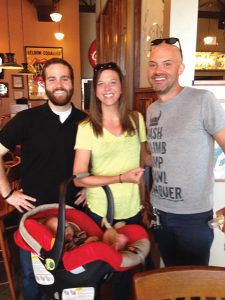
Becky and Chase Thompson with son and Ry Coleman.
“Jason was this lanky, long-haired guy who was quiet but obviously really smart,” said Jenny. “I was a manager then, and a bunch of us were going to the Steve Miller Band concert in Kansas City. I asked if he wanted to come along.”
Over the next five years, Jenny ran the front of the house while Jason established himself as a leader on the line. The couple married in 1995 and continued to put their collective stamp on an established COMO cornerstone.
“Being a behind-the-scenes kind of guy, I listened to customers’ comments and focused on putting out quality food,” said Jason, who has tinkered with the menu over the years. “I learned a lot from former cooks, and I read many cookbooks.”
For the Dubinskis, the millennium ushered in a new generation in more ways than one. In 2000, they welcomed daughter Abby, who spent many of her formative years in the restaurant’s aromatic confines.
When Maly decided to focus solely on his real estate enterprise and sell The Pasta Factory, the choice was obvious. Maly and the Dubinskis discussed the particulars of the transaction while the new parents traveled by train toward a Grand Canyon vacation.
“We felt like [ownership] was the next logical step for us,” Jenny said. “We were young and carefree.”
In 2011, the couple made another pivotal decision, relocating the restaurant to West Broadway. The restaurant’s loyal clientele followed. There, they further tightened the menu and maximized efficiency, thanks in part to a Jason-designed kitchen. Downsizing to a more manageable 4,000-square-foot space — along with the pandemic-era boom in takeout orders — reinforced the wisdom of the move. The streamlined operation also gave the Dubinskis and their staff a healthier work-life balance, allowing the restaurant to close on Mondays and Tuesdays.
“We’ve tried just about everything on the menu over the years, and it’s always such a tough decision to order because it’s all so good,” said Elaine Hassemer, a regular customer with husband Mark since the Crossroads West days. “I’m not surprised at all that the place is still thriving after 50 years.”
Family Meal
For countless employees, though, The Pasta Factory has always been about much more than the food. The Dubinskis have long had a knack for hiring good people. Combined with the energy of a college town, that knack has made The Pasta Factory a magnet for fun-loving, dedicated employees.
“Every dishwasher, cook, busser, hostess, and server was different — quirky, funny, and fun,” said Pam Pochel, a former hostess, server, and manager episodically since 1992. “It was always an eclectic group of people from all walks of life.”
Practically since the restaurant’s inception, busy nights have naturally morphed into off-the-clock revelry when the doors locked. Waves of metal, punk, and rap have perpetually emanated from the kitchen, while the servers’ shenanigans made for endless inside jokes.
“I’m sure we worked hard, but I don’t remember it — we were having way too much fun,” said Jerry Wagner, a bartender in the ’90s. “Jenny and Jason have done something at The Pasta Factory that most restaurateurs only dream about.”
Fifty years and two locations later, those ceiling fans continue their gentle revolution. Former employees still return with spouses and children, reclaiming favorite booths, swapping old stories, and introducing a new generation to the place where so many friendships — and futures — began.
“Working at the P-Fac changed the course of my life,” said Chase Thompson, a former line cook. “I learned how to cook, made lifelong friends, and met the most important person of all — my wife, Becky. Never before, or since, have I worked somewhere where we all genuinely wanted to hang out when we clocked off.”