
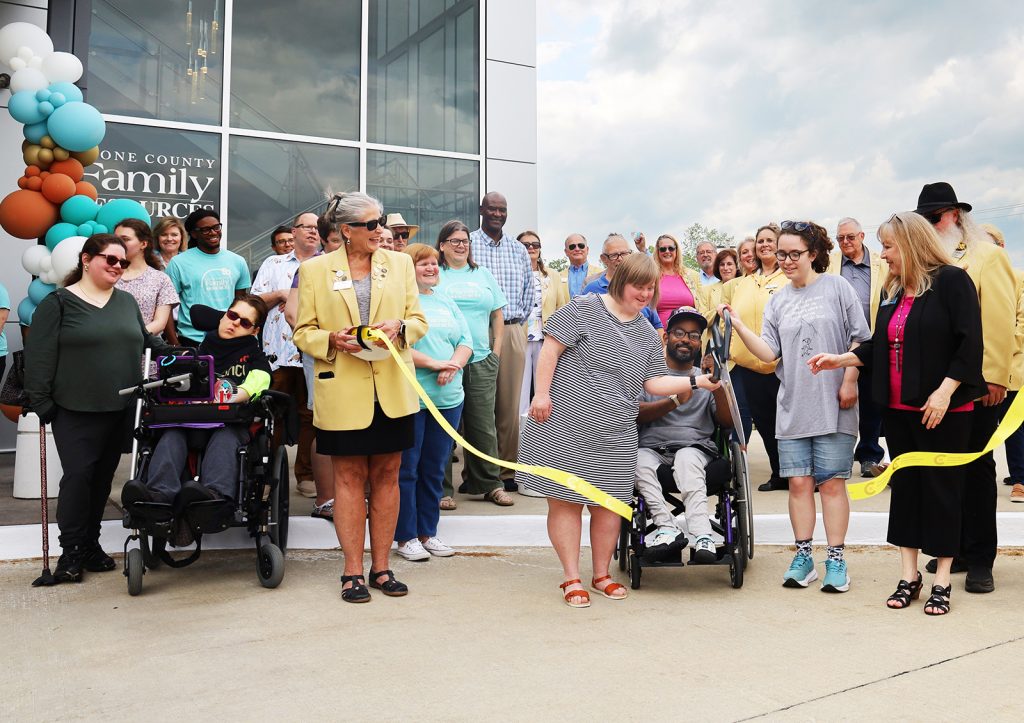
Boone County Family Resources celebrates its 50th anniversary
What started as a group home housing eight people 50 years ago has blossomed into an organization that today serves nearly 2,500 Boone County residents with developmental disabilities.
Boone County Family Resources, which was founded when voters approved a special property tax levy in 1976, has a mission to “enable Boone County residents with developmental disabilities to thrive in the community, connect with others and achieve their personal goals,” according to its website.
From young children learning social skills to adults finding their own independent future, “anybody with a developmental disability who resides in Boone County can qualify for services,” said Joanie Chenault, BCFR associate director. The organization provides support for individuals — and their families — who are struggling with living on their own, dealing with behavioral issues, having difficulty finding a job, or needing a community of people with similar life experiences.
One such connection is Ayla, a first grader who has received BCFR services since she was 2. A story posted on BCFR’s website said that Ayla’s behavior was once “very destructive,” and that girl would throw or pull anything she got her hands on. Sensory challenges made it difficult for the toddler to control her emotions.
Hannah Taylor, a BCFR support coordinator, has worked closely with Ayla and her family. Taylor helped Alya work on sensory regulation skills with the use of assistive technology tools such as sensory swings, a crash pad, visual schedules, timers, and “chewelry” (sensory teething jewelry). BCFR also provided home-based support services to provide behavior service support at home to bring Alya’s family relief.
Taylor continues to be a reliable support for Alya’s family.
“Hannah has been tremendous, and very good at parsing out what will be helpful,” Alya’s grandmother explained. “She’ll go the long haul with you. If there’s anybody who will go through thick and thin, it’s Hannah.”
With help from Taylor and BCFR, Alya is becoming more independent and confident. She is now in first grade, and she loves to learn and play and has “cheerful energy,” her grandmother said. “She’s gone from being very rigid to allowing more flexibility.” Alya continues to meet new milestones and make progress.
Families get to decide how much contact and how many services they need.
“We’re giving them resources that they may need, helping link them, finding a therapist that maybe works specifically with their child’s disability, or helping parents learn about their child’s disability,” Chenault said.
One of those options is the developmental disability education program, which funds educational opportunities that enable families to learn more. Chenault gave the example, “If your family wants to go to the conference on down syndrome to learn more about how to support their child, we can help fund some of those things.”
One of the adults that BCFR has helped to find independence through residential life services is Sydney, whose story is also told on the organization’s website.
“Some people have roommates, some people live on their own,” said Executive Director Laura Cravens. Services funded through the Medicaid support waiver are the reason Sydney was able to move into an apartment where she is able to live successfully and safely on her own, Cravens explained. Those services include a remote monitoring system, alarms, ring cameras, GPS, and smoke detectors with automatic safety calls.
Skill trainers within BCFR’s life and work connections program give guidance on learning skills for independent life as well as community skills. Each trainer works with a person requiring services to develop a plan to meet their personal goals, such as starting their laundry, learning how to ride the bus, or finding and keeping a job.
When transitioning to living on his own, Joey worked with BCFR to create goals to be able manage his household alone. Syd Blasczyk, a community skills specialist, helped guide Joey through recipes while Kiah Wright, a community employment specialist, focused on teaching Joey how to do laundry and cleaning. With the help of the specialists, Joey was able to prepare his own meals, do his own dishes, and keep his house clean and organized.
Gaining work experience from a young age can be beneficial when looking for jobs in the future. BCFR’s summer work experience program (SWEP) helps young adults with developmental disabilities in high school build skills that they can use in real-world jobs. Students are hired by Life and Work Connections, Inc. and work 20 hours a week over the summer at jobs, such as cleaning mats at CoMo Rocks.
Students work closely with a life and work connections community skills specialist to set goals, talk about their experiences on the job, and work through important workplace questions.
“I enjoyed watching both of my SWEP participants excel on the job and witnessing their confidence build up each week was absolutely delightful,” said Coresa Coloney, one of BCFR’s community skills specialists.
Employment is an important part of adult life, taking steps towards independence and being able to live alone. Finding the perfect job that works best for you can be difficult, which is why BCFR’s individualized placement and support program (IPS) helps people figure out what kind of job they see themselves working at. IPS provides one-on-one support that guides clients through the process of getting a job. They teach skills such as learning how to apply for jobs, practicing interviewing skills, managing benefits such as social security, and handling the stress of a new job.
Sixteen years ago, Tom found a job at the University of Missouri Student Union through the life and work connections program where he has been thriving. His current job involves opening the doors in the morning so the student union restaurants can serve students, followed by various cleaning tasks throughout the day.
Working alongside his community skills specialist, Mary DuBach, Tom manages the struggles he faces at his job such as keeping focused when visitors want to chat and sharing his workload with his coworkers to manage his schedule. His sessions with Mary also include talks about life skills, such as personal finances.

While BCFR receives about 28 percent of its funding for the county property tax levy, about three-fourths of the funding from the states and federal government to provide services for individuals with Medicaid and people who are part of the residential services.
“We work with a lot of different providers that contract with us for some of these specialized services that make a difference for individuals,” Chenault said. “I want to express our appreciation to them because we don’t do this alone.”
BCFR employees also support the community through donations and volunteering.
“We’re very fortunate to have a fabulous staff group,” Chenault said. “I mean, these are some of the best people you will find who work here.”
Both Cravens and Chenault noted how much support the agency receives from the Boone County residents. Cravens has worked in the developmental disabilities field for 35 years, with 25 of those years at BCFR.
“We are really proud of Boone County,” she said. “It’s a great place to live. There are a ton of services for people with developmental disabilities.”
Chenault has been with the agency for 32 years – and 42 years in the field. She said the agency’s biggest accomplishment in its 50 years of services is “all of the families that we’ve been able to help. I mean, that’s what it’s all about. If you add up over the years, it’s countless, thousands upon thousands of kids and adults.”
Cravens added, “We want every taxpayer in Boone County to know that their property tax that they pay to this agency is put to good use and it’s really necessary for their friends and neighbors with disabilities. We are here to offer services with developmental disabilities; that’s what we do. That’s the only reason we’re here.”
AN INSIDE LOOK
BCFR’s nine-member board of directors, appointed by the Boone County Commission, administers agency activities. Board members are:
Bob Bailey, chair
Janet Thompson, vice chair
Jennifer Bean
Tec Chapman
Yoki Gely
Elizabeth Heidt
Christina Jones
Heather Koch
Stacey Preis
FAST FACTS
- In fiscal year 2025, BCFR had $16 million in revenue and $14.2 million in expenditures – 14 percent for administrative costs, 28 percent for supported living services, and 48 percent for family supports. Nearly three-fourths of its annual revenue comes from government sources, including the Missouri Department of Mental Health, and Medicaid reimbursements. The property tax levy accounts for 28 percent of BCFR’s funding.
- Services directly provided by the agency have been nationally accredited by the Commission on Accreditation of Rehabilitation Facilities (CARF) since 1985.
- Just over one-fourth of adults served have competitive employment. BCFR employs 148 staff. The annual report showed that the organization made more than 6,000 home visits in fiscal year 2025.
- 53 percent of individuals served are between the ages of birth to 17.
- BCFR was originally established as the Boone County Group Homes Board with a property tax leavy of 5 cents per $100 of assessed valuation. In 1993, voters approved increasing the property tax levy to a maximum cap of 12 cents. The current property tax levy is $0.1120 per $100 of assessed value.
TIMELINE
1976
Boone County voters approve ballot proposition establishing Boone County Group Homes Board with a 5-cent per $100 valuation property tax.
1977
Parkade House, a group home for eight Boone County residents with developmental disabilities, opens.
1979
Hallsville House, providing a home for eight more Boone County residents with developmental disabilities, opens.
1981
Independent Living Services are developed to provide practical living skills training to persons with disabilities living independently or with their families.
1982
Diego Court Semi–Independent Apartments opens in the south part of Columbia.
1987
Granada Apartments open to extend supervised apartment living for persons with developmental disabilities.
1989
The Boone County Board and the Department of Mental Health sign a first of its kind Intergovernmental Agreement to pilot a Family and Community Living Support Program.
1990
The Boone County Board, in collaboration with other agencies and advocates, creates the first Early Childhood Advisory Council to improve services for infants and toddlers with disabilities.
1991
The agency is certified as Missouri’s first local government Medicaid-funded case management provider.
1993
Boone County voters approve Proposition H allowing for expansion of services, raising the local tax levy is 12-cents per $100 valuation.
1995
The Rehabilitation Accreditation Commission (CARF) grants accreditation to the Family & Community Living Support Program. It is the first Family & Community Living Support Program to be accredited in the nation.
1999
The agency acquires and remodels the Community and Family Support Center at 1209 E. Walnut St. to comply with the Americans with Disabilities Act.
2002
The agency celebrates 25 years of service to Boone County citizens with developmental disabilities.
2003
The agency acquired and renovated 16 residential apartments for accessibility and aging in place. This rehabilitation project was nominated for a national award by the Department of Housing and Urban Development (HUD).
2005
The agency changes its name to Boone County Family Resources, which is more reflective of the diverse services and supports provided.
2006
August marks the 30-year anniversary of the passage of a property tax establishing the agency.
2010
Boone County Family Resources helps gain governor’s approval to implement the Partnership for Hope Waiver statewide.
2015
Boone County Family Resources adds two services to its CARF International accredited programs: Community Employment Services and Employee Development Services.
2017
Boone County Family Resources (BCFR), along with its partners, celebrated the grand opening of Boone Point Apartments and the completion of two apartment buildings, Boone Point South, and Boone Point Central.
2021
BCFR moves into new headquarters located at 2700 W. Ash St. in January. The new building provides ample parking, 34,590 square feet of office space, enhanced accessibility features, and a multipurpose space that seats up to 200 people.