
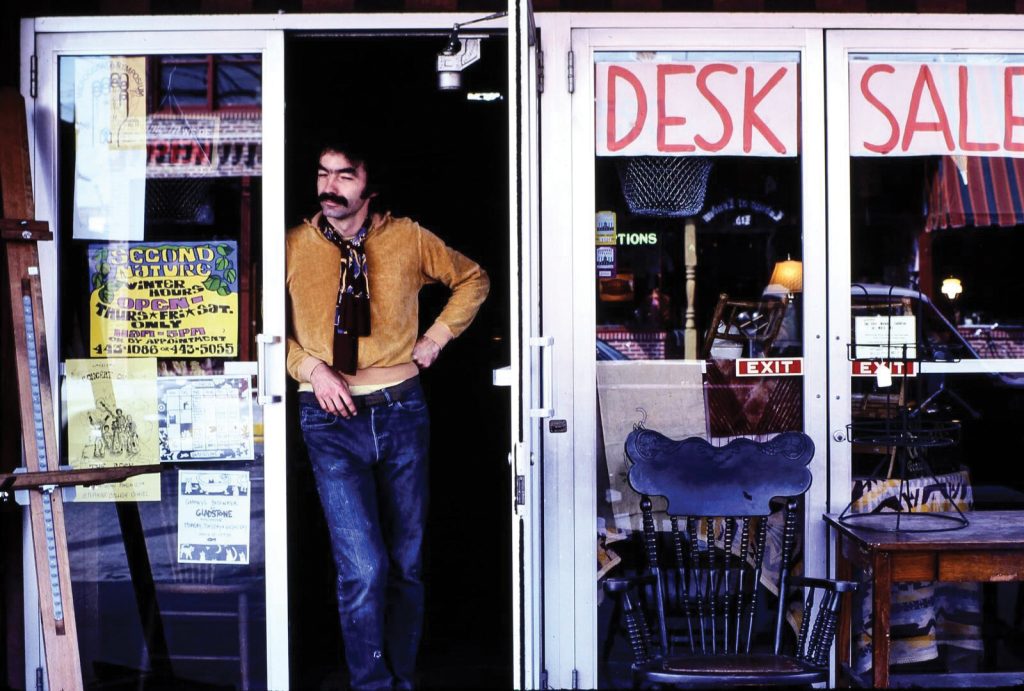
Cities try to manufacture arts districts all the time. Columbia got lucky — one grew here on its own. Long before anyone branded it the North Village Arts District, the blocks around Ninth, Tenth, and Walnut streets were quietly filling with painters, sculptors, illustrators, musicians, and the kind of resilient energy that thrives in cheap, overlooked buildings. It wasn’t planning that made the North Village Arts District. It was gravity.
But the roots go deeper than the current district. Decades before anyone imagined First Fridays or artist studios, the north side of downtown was already incubating its own off-Broadway ecosystem: a cluster of low-rent, creative, slightly renegade businesses run by young people who were discouraged from joining the downtown establishment.
The Birth of the North Village
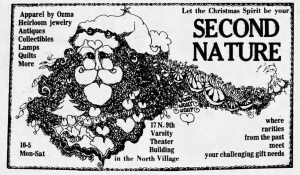
The earliest version of Columbia’s “North Village” took shape in 1973, when a handful of young business owners north of Broadway formed the Uptown Merchants Society. They weren’t folded into downtown’s mainstream. In fact, according to Michael “Smokey” Cochran — whose Second Nature antique store was nestled in the lobby of the old Varsity Theater — they were politely discouraged from joining the Downtown Merchants Association. So they built their own coalition instead.
“The DMA was composed of many old-guard businesses, the cream of Columbia’s retail establishments in those pre-mall days, and we were, in their eyes, a bunch of undesirable hippies,” Cochran says. “We were told, in the nicest way possible, that we were not invited and would not be allowed to join.
“We were occupying and reviving a business district that had come to be regarded by the mainstream as undesirable, at least partially due to the type of clientele attracted to the Ben Bolt [Hotel], generally regarded as a flop house — though it wasn’t,” he says. “The mantra was ‘don’t go north of Broadway.’ Thus there were a variety of locations available for minimal rents, in turn attracting a generation of young, good-hearted dreamers and hustlers.”
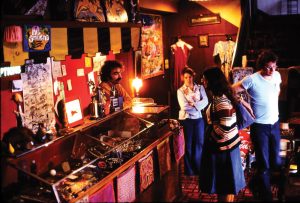
What emerged was a pocket of counterculture commerce centered around North Ninth Street. In just a few square blocks, you could buy records, antiques, leather goods, clothing, posters — and, of course, there were the head shops. These businesses gave North Ninth Street a distinct identity long before the Blue Note arrived — one that even today elicits one phrase: “the hippies.”
The group’s idea took off fast. In that first year, they launched street dances, sidewalk sales, and an annual “Spring Fever” festival.
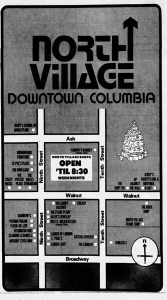
Cochran recalls that at a meeting of about 10 business owners, KOMU sales rep Douglas Edwards pitched a unified “North Village” marketing concept to the group — complete with a logo and a modest TV plan — and they adopted it. The momentum snowballed quickly; by 1975, the Columbia Tribune reported that the organization had 25 members. In 1976, it had grown to 45. By 1983, there were more than 70 businesses operating under the North Village banner during the neighborhood’s annual Super Sidewalk Sale.
The energy spilled beyond Ninth Street, giving the entire north side a shared identity. In 1977, the Tribune reported that the North Village had officially extended its boundaries. Projects like The Marketplace, a mixed-use commercial project housed in the former Long Bell Lumber Company building, brought new life to the neighborhood, signaling the district’s shift from a loose cluster of shops into a recognizable commercial area.
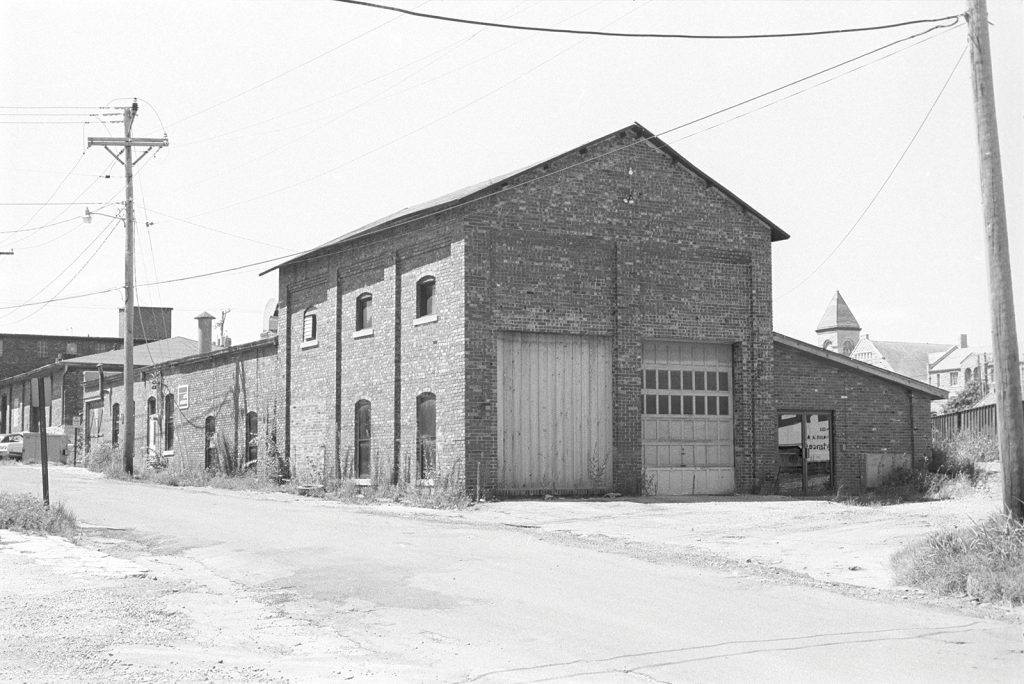
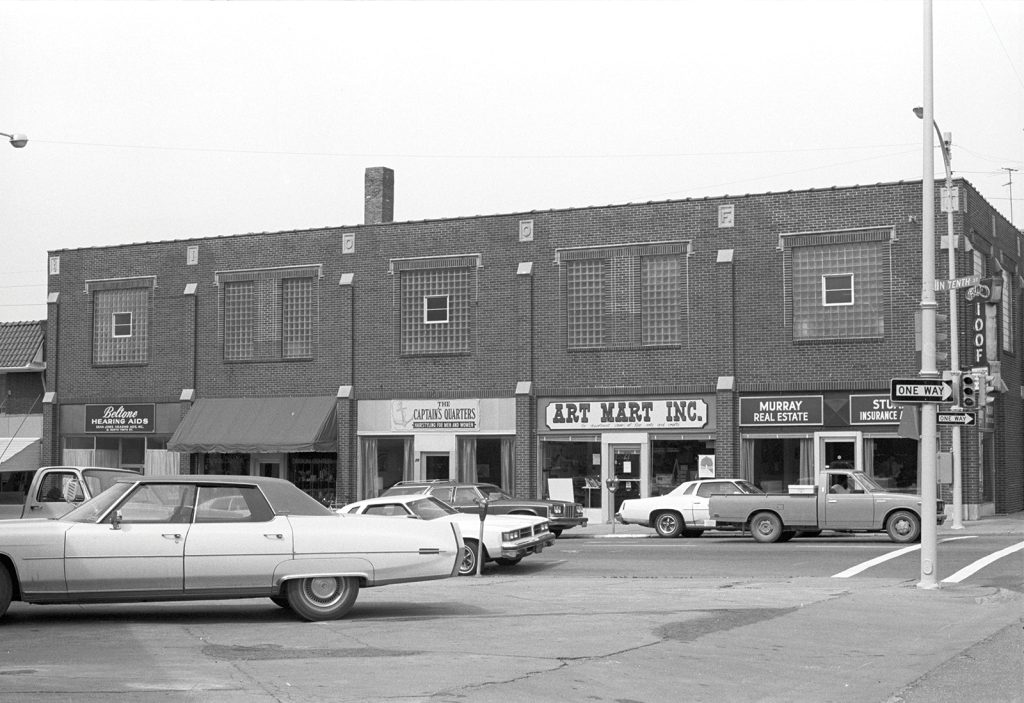
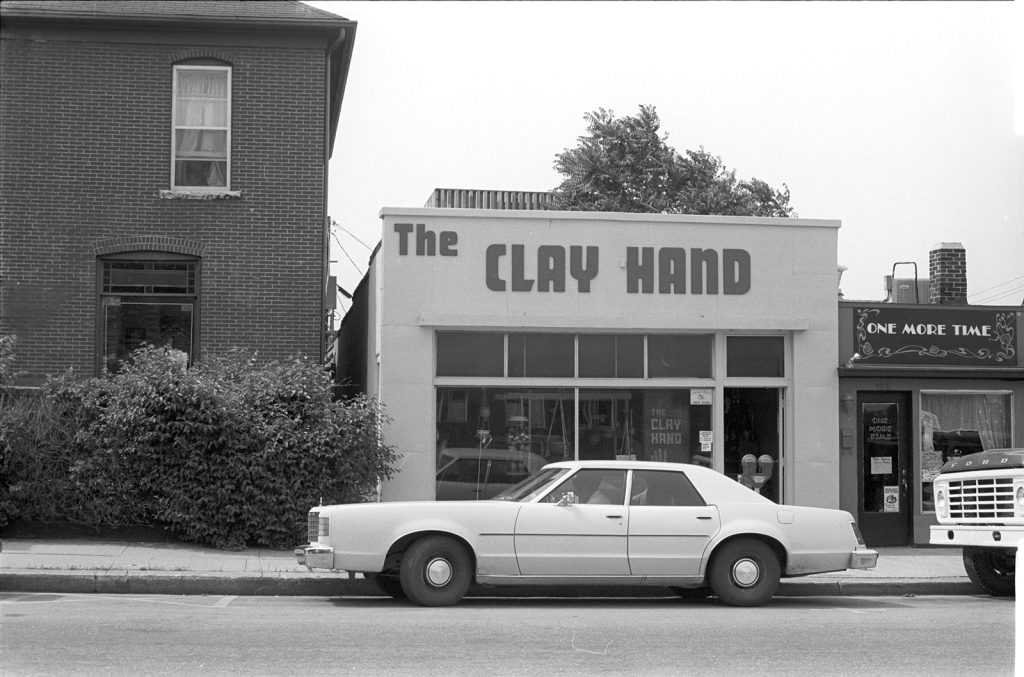
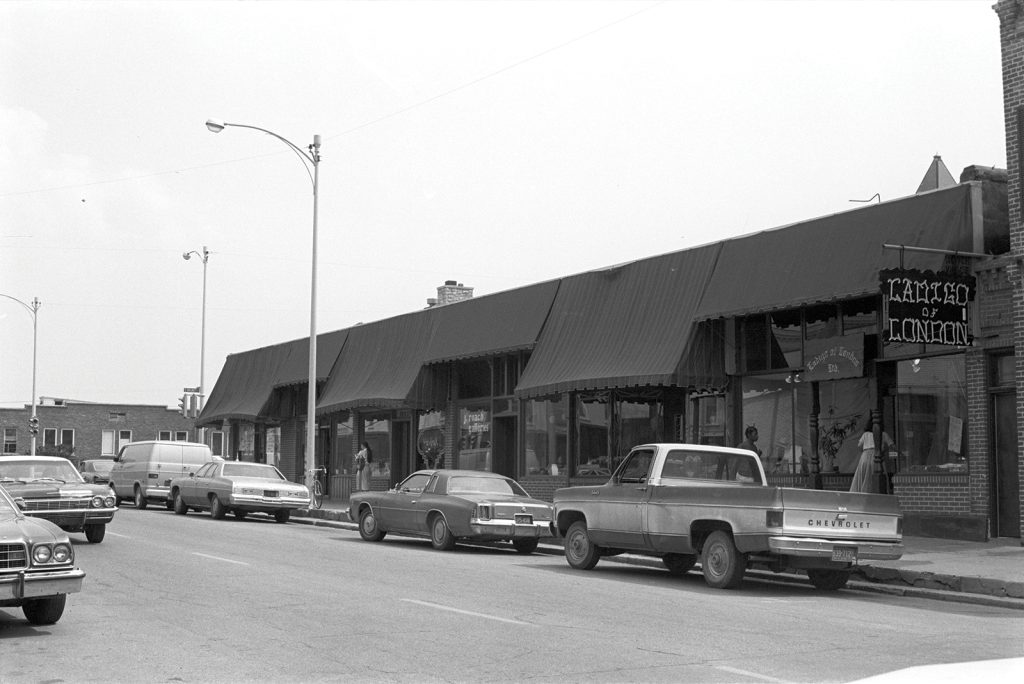
Credit: Courtesy of the State Historical Society of Missouri (SHSMO). Photos by Mary Matthews and B. Walters, 1978.
The Railroad and the Romantics
Long before the Uptown Merchants Society put a name to the North Village, the blocks bounded by Tenth, Walnut, Park, and Orr streets were shaped by the railroad. For decades, freight moved through the Wabash yard — groceries, lumber, coal, cattle — into a surrounding landscape of warehouses, yards, and industrial sites arranged around the tracks.
After passenger service ended in 1969 and freight dried up in 1984, the town’s industrial core hollowed out. What remained were large, cheap, underused buildings: the kind of overlooked spaces artists migrate toward long before anyone calls a neighborhood “creative.”
By the late 1970s, artists were filtering into the old industrial belt. Columbia College opened its Art Annex in the former coal-gas plant near the depot in 1978, anchoring one end of a quietly forming creative corridor that stretched from the railyard to the school’s Art Center on Broadway. Students and faculty walked between the Art Center on Broadway, the Annex near the rail tracks, and the main campus, passing through a landscape many Columbians barely noticed. A hodgepodge of shops also sprouted up to serve them — Art Mart, the Clay Hand, The Weavers’ Store, Up Against the Wall — forming a living ecosystem that predated the North Village Arts District era by decades.
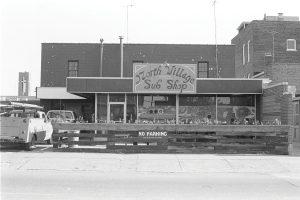
By then, the north side had its own rhythm. Neighborhood regulars ducked into Ernie’s for breakfast, grabbed sandwiches at the North Village Sub Shop, and ended nights at the Cork & Dart Pub — everyday fixtures that stitched the corridor together long before anyone formalized an arts district.
“Columbia College had a big stake in the area,” says Lisa Bartlett, the Columbia College art student who would later open the foundational Artlandish Gallery in the North Village. “I think that’s when the bohemians and the artists moved in, and they could afford spaces like that — and every nook and cranny had some cool artist or musician working out of it. And, yeah, it was a whole scene.”
If you weren’t part of that orbit, you could walk right past it and never realize how much was happening in plain sight.
End of an Era
For a scrappy, upstart coalition, the North Village organization had a decent run. The name shows up in ads and local news coverage for roughly a decade, into the early 1980s, before it starts to fade from public view. The last North Village festival took place in 1983. The last North Village ad also appeared in 1983.
Like the rest of downtown, the North Village entered the 1980s during a period of transition. Public debate around parking, changing shopping habits, and the future of downtown intensified in the years surrounding the opening of the Columbia Mall in 1985. While some merchants initially reported minimal impact, the long-term effects would unfold more gradually, with a wave of downtown business closures following later in the decade.
The main strip of the North Village, Ninth Street, became less retail-focused over time, but Leo’s Vintage and Variety held strong in its second-floor outpost for nearly 50 years, finally closing its doors in 2025. Cochran’s store closed after three years. Paul and Barb Mashburn, who had been involved in the North Village organization since the Uptown Merchants Society days, sold Ladigo of London, Ladigo Lady, E. Paul’s, and Mashburns in 1982. Rainbow’s Leather closed in 1985, and a few years later the space started its new life as the popular Italian restaurant Trattoria Strada Nova.
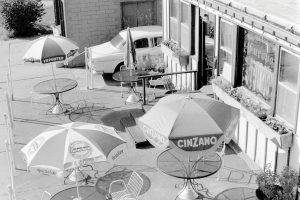
By the late 1980s, the rest of the neighborhood began to enter what some considered a period of decline. “We don’t like it over there anymore,” Chris Rappold, owner of the popular restaurant Cafe Europa, stated plainly in the Tribune when the restaurant left Tenth and Walnut in 1990.
A new conventional wisdom began to prevail: that nothing much had ever existed north of Broadway to begin with. The North Village name would slip out of public use by the time the grunge generation paced the streets downtown. The North Village Sub Shop moved closer to campus and dropped the “North Village” in 1992. And that was that.
Scenes, Not Silence
The neighborhood, however, did not go quiet after it was written off. It reorganized. Through the late 1980s and into the 1990s, a loose, informal cultural ecosystem began percolating along the industrial edge of downtown, based not in retail but in arts events. The north side became the place for performances, meetings, experiments, and scenes — some anchored in permanent venues, others flickering into being wherever space could be found.
What’s This? opened as a quirky art gallery near the corner of Ninth and Park in 1986, but by 1988 it had somehow become one of the city’s loudest spaces — a storefront where teenagers hurled themselves into mattresses and bands tested how much noise, speed, and politics could fit into a small room. It was messy, chaotic, and slightly alarming, but it gave young musicians and audiences a place to exist. No alcohol was served, shows were cheap, and minors were the venue’s lifeblood.
Then a scrappy little club called the Blue Note moved from the Business Loop into the old Varsity Theater in 1990, and suddenly the north side had a real concert hall. The venue came to dominate life on the block the hippies had flocked to years earlier, booking major national rock ’n’ roll acts — Sonic Youth, the Pixies, the Flaming Lips. It became the city’s musical mainstay, a place where people reliably ran into each other and into whatever band was passing through that night. Over time, it made Columbia feel less cut off — like a small town that was part of the larger circuit instead of a detour from it.
At the same time, the north side was also home to quieter, more inward-facing forms of gathering. The Chautauqua Center opened in 1983 in an old brick duplex at 1109 E. Walnut St. as an apolitical, nonprofit space for spiritual, creative, and personal exploration. The center offered an eclectic mix: computer courses alongside East Indian concerts, yoga and meditation next to astrology talks and creative writing classes. In a 1983 Tribune article, local artist Jeannie Ramlow Roach described it as “one of the few showcases for local artists.”
Just down the block in the Berry Building, a humble vegetarian cafe called Mixed Company Coffee House opened in 1990 and functioned as sort of a crunchy small-town community center. In a given week, you might find a talk about UFOs, a slideshow on alternative communities, or live music spanning a wide range of genres. Political action groups met there. Ethnic drumming groups met there. Yoga classes, poetry readings, and college kids playing board games all shared the same space.
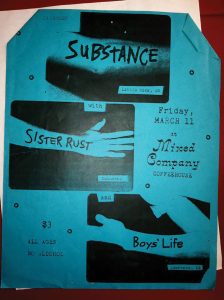
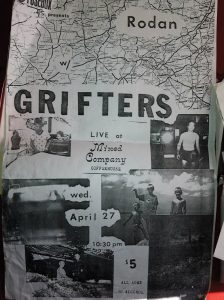
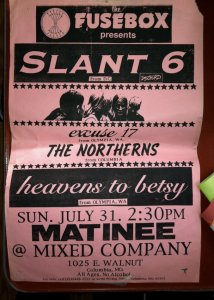
A pop-up venue called The Fusebox, headed by MU journalism student Veronica Del Real, emerged in the early 1990s as a response to the limits of Columbia’s existing music scene. It wasn’t trying to compete with the Blue Note so much as to make room for smaller, more underground acts — the kinds of bands that had nowhere else to go.
“A big reason for doing The Fusebox was we were sick of the homogenous scene in Columbia,” says former Fusebox promoter Mark Walters. “The Blue Note/Faye Records stuff was cool, but there was nothing for the smaller bands, the underground.”
The Fusebox started out in the basement of Whizz Records, at 23 N. Tenth St., before shifting largely into the back room at Mixed Company. The venue booked small, touring independent bands like Unwound, Heavens to Betsy, Excuse 17, and Bikini Kill.
King bought a second club in 1997, an old Texaco oil shed on the northern end of the North Village called Mojo’s (now known as Rose Music Hall). It had gone through several lives by that time — first as a beloved oyster bar called SOB before becoming a revered local blues bar known first as Park Place and then as Deep Blues. Unlike the student-driven venues closer to campus, Mojo’s drew an older crowd — they were there for the blues. King upgraded the space and moved away from that identity. The club became a smaller companion club to the Blue Note, booking early shows with bands like Arcade Fire and the Black Keys.
Elsewhere in the neighborhood, David Wilson and Paul Sturtz were experimenting with new formats for gathering. Ragtag Film Society, yet another pop-up venture, began hosting independent film nights around town after the Campus Twin, the town’s only art house theater, closed in 1998. They started with screenings at the Blue Note and other temp spaces before moving into the former Whizz Records storefront and adding food and booze to the mix. Ragtag was conceived as a place where film became a reason to gather, not just something to watch.
And then there was the speakeasy. Jim Bradshaw’s semiweekly party — every Wednesday and Sunday — has become the stuff of local legend. By Bradshaw’s count, more than a thousand people crossed the threshold of the speakeasy, where local musicians hung out and performed casual jams in a space that existed mostly thanks to word of mouth.
The north side’s grunge-era creative burst didn’t collapse so much as tucker out. The Art Annex was taken over by MU in the 1980s and demolished in the early 1990s due to contamination from its days as a functioning coal-gas plant. What’s This? didn’t make it into the ’90s. The Fusebox came to an end in 1995 as its organizers graduated or moved on to other projects, and Mixed Company closed that same year. The Chautauqua Center followed in 1999. Ragtag stayed in the neighborhood for eight years before relocating to its current Hittsville home in 2006. Bradshaw moved his company out of the Catacombs in 2007, and the speakeasy was no more.
By the time real estate developers Mark Timberlake and John Ott began creating the North Village Arts District, the north side’s biggest anchors — the Blue Note and Mojo’s — were still standing, but the smaller, more experimental spaces that had once defined the neighborhood had all closed or relocated.
And that’s how people came to think of the North Village as somewhere nothing was going on. Today, that era is easy to flatten into a before-and-after story: a dead zone until the “real” arts district arrived. But when you listen closely to the people who lived through it, what you hear instead is a long, messy middle — a time when the original North Village branding had faded, the mall had gutted downtown’s confidence, and the north side was surviving on patchy, underground momentum.
The Village Art Team
Sheer neglect is what really led to the birth of today’s North Village Arts District. The late-1800s warehouses had fallen too far into disrepair, and the metal-sheathed industrial buildings nearby frankly didn’t seem to have much intrinsic value. By all accounts, when Timberlake bought the east side of Orr Street between Walnut and Ash, he had no idea what to do with it.
Enter the Village Art Team.
In 2004, as the neighborhood continued to struggle through a period of disinvestment, a small band of artists and homeowners became the North Village’s newest, biggest boosters. Tucked away in the residential area just north of the commercial North Village and inspired by Greenwich Village in New York City, the group printed brochures and launched an aggressive media campaign to pitch the North Central neighborhood as an artists’ paradise.
The first thing they did was rebrand: The North Village, after years without its name, was reintroduced as The Village. They also substantially expanded the neighborhood’s footprint: A 2005 article in the Columbia Missourian stated the boundaries as Providence Road, Business Loop 70, College Avenue, and East Walnut Street. In 2006, the team launched the Village Art Walk — an ambitious project featuring art by more than 70 artists — including yard art installations by neighborhood locals as well as painting, music, dance, poetry, performance art, and more. And by 2007, local artist and art team member Susan Taylor-Glasgow was quoted in the Columbia Missourian saying that more than 100 artists, musicians, and writers were living in the area.
By all measures, their efforts seemed to be working.
At the suggestion of then-downtown Special Business District Executive Director Carrie Gartner, the Art Team — among many others — met with Timberlake.
“I had gotten so many calls from artists looking — ‘Do you know where we can can get sudio space?’ And I was like, ‘No, but I know guy who just bought a warehouse,’” Gartner says with a laugh.
“He was great,” she says. “I sent him to a bunch of people and said do some research. And I sent him some examples in other cities. And God bless him, he did. He was willing to do that level of research and commitment.”
Suddenly, the buildings Timberlake had purchased seemingly on a whim made sense. Orr Street Studios was conceived, et voilà: An arts district was born. Again. For at least the second time. Or maybe the third.
The North Village Rises (Once More)
By now, it should be clear that the North Village Arts District did not appear out of nowhere. It emerged and re-emerged. What people later came to call an “arts district” wasn’t the creation of something new so much as a formalization of something that had already been happening, quietly, for decades.
Gartner calls this a “naturally occurring arts district.”
“You can’t just make that happen,” she says. “You can’t build an arts district from the ground up like that, unless you have a ton of money. You just kind of go with the flow of what the neighborhood’s doing.”
For Gartner, that meant resisting the urge to formalize things too early. “It just kind of made sense, right, that, hey, we don’t need a consultant. We didn’t need formal plans, we don’t need someone to design this. We just need to let these artists kind of run with it.”
In other words, the story of the North Village is not one of top-down planning, but of bottom-up persistence. It formed through accumulation: of people, of practices, of scenes, of memory.
According to Ott, when it came time to name the “new” district, they chose North Village Arts District specifically as a nod to the former lives of the neighborhood, knowing how dearly Columbia holds its history.
“I pushed North Village, and others did as well, because I knew about the history of North Village,” Ott says. “I was in the North Village in the ’70s, too.”
But is the future of the North Village secure? The story is probably as old as the arts: Artists move into an area; the area becomes more desirable; the artists are priced out. So what’s to prevent this from happening in Columbia’s beloved arts district?
In March 2025, serious conversations about further development of the area arose. The “Feasibility Study for a Convention Center in Columbia, Missouri,” penned by CSL International, explored different locations in Columbia for a potential 30,000-square-foot convention center. The report discussed siting the development both north and south of Walnut Street in the North Village Arts District. The project would have brought investment, foot traffic, and visibility to the neighborhood, but presumably at the cost of buildings that house a portion of the arts district.
Ultimately, the downtown location was deemed second choice, but the fact that the discussion even happened is a big deal.
“I think it will bring good and bad things,” says Tootie Burns, a local artist who has worked at Orr Street Studios since 2008, about future development of the neighborhood. Burns is also a former president of the North Village Arts District. “I think additional traffic would bring hotel guests or convention center guests who would visit our galleries, restaurants, shops, businesses. That’s a good thing. We don’t have a lot of parking down there, which I think is a major sticking point for the convention center concept, and you can’t create more space. So, you know, I love the idea of additional people down there and additional draw for people. But I don’t know the best way to make that happen.”
Even in the face of future development, the arts district will likely continue to find its way, much as Shakespeare’s Pizza did when its old building was replaced and the restaurant was rebuilt, remarkably unchanged, inside the new complex at Ninth and Elm.
“This is not a get-rich-quick scheme,” Ott says. “All we’ve done is, you know, invest and reinvest in these properties.”
The North Village has never been a blank slate. It has always been a place people found when they needed room to experiment, to gather, to make things that didn’t yet have a market or a name. Its value has never been in the buildings alone, but in what people have done inside them.
The Arts District did not replace what came before it. It sits on top of it — layered over the railroad yards, the uptown merchants, the punk clubs, the galleries, the cafes, the half-forgotten rooms where scenes once lived.
It is not one thing, or one era, but the accumulation of many.