
Boone County Sheriff’s Regional Training Center opens
Some reporters tried to avoid “crashing” a police vehicle, others checked out the inside of a jail cell, and they witnessed a jiu-jitsu demonstration for subduing an uncooperative suspect, all as part of a media tour of the new, $20 million Regional Training Center at the Boone County Sheriff’s Office campus.
The tour and demonstrations took place on January 7, three days before hundreds of people showed up for a public tour when Sheriff Dwayne Carey, his staff, and Boone County commissioners showed off the new building at 2013 County Drive.
The first Law Enforcement Training Institute class of the year has already begun training in the sheriff’s annex and will move to the training center in February. The facility will provide training for law enforcement and corrections officers throughout the state.
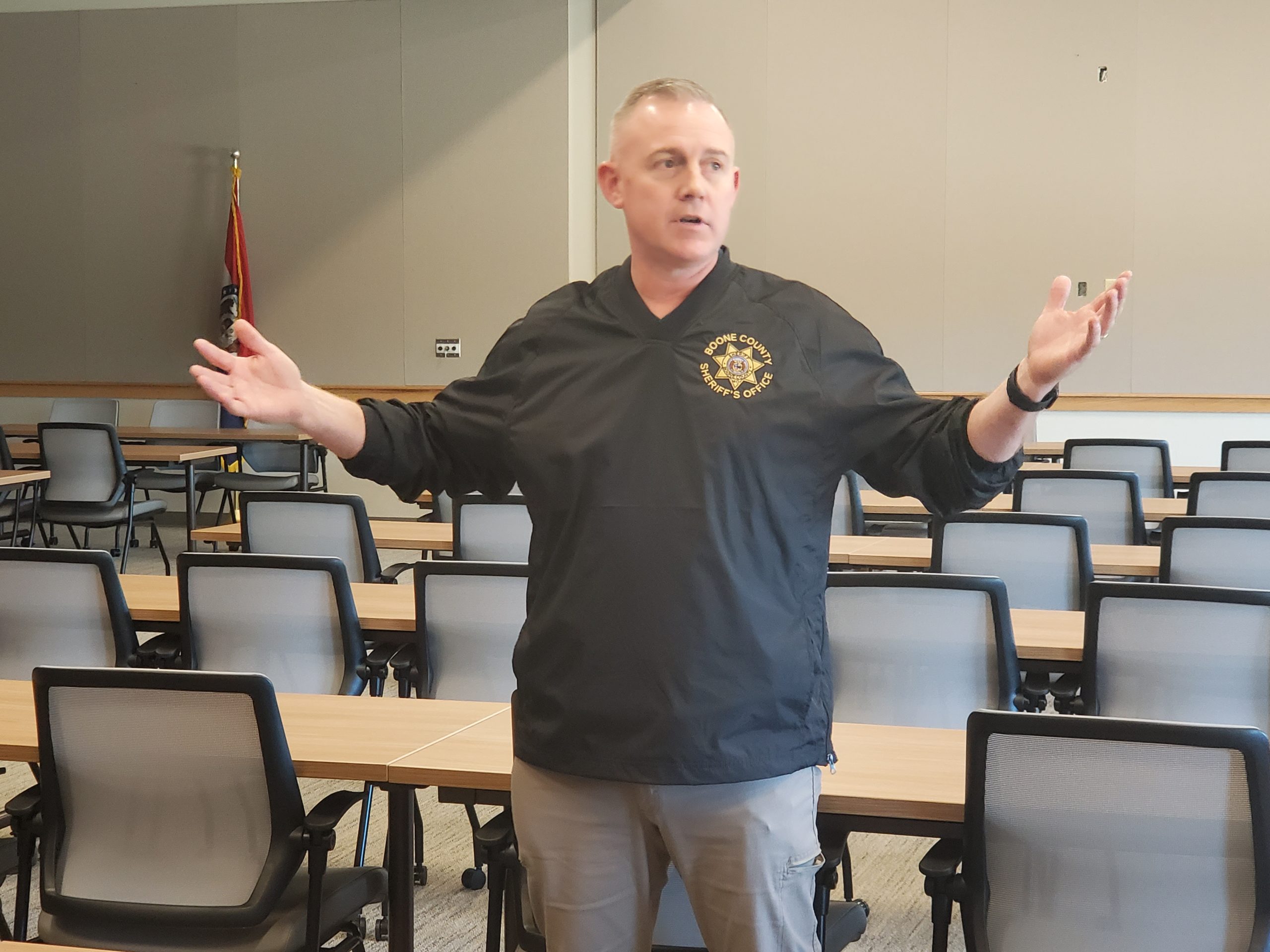
During the media and public tours, sheriff’s personnel provided demonstrations throughout the facility and offered hands-on training using the driving simulators and virtual reality technology. The facility design includes a 160-seat training room, a defense tactics room, an indoor tactical gun range, a large indoor “warehouse” area for traffic stop training, and other training focused on tactical scenarios, building searches, and crisis intervention and domestic violence response training.
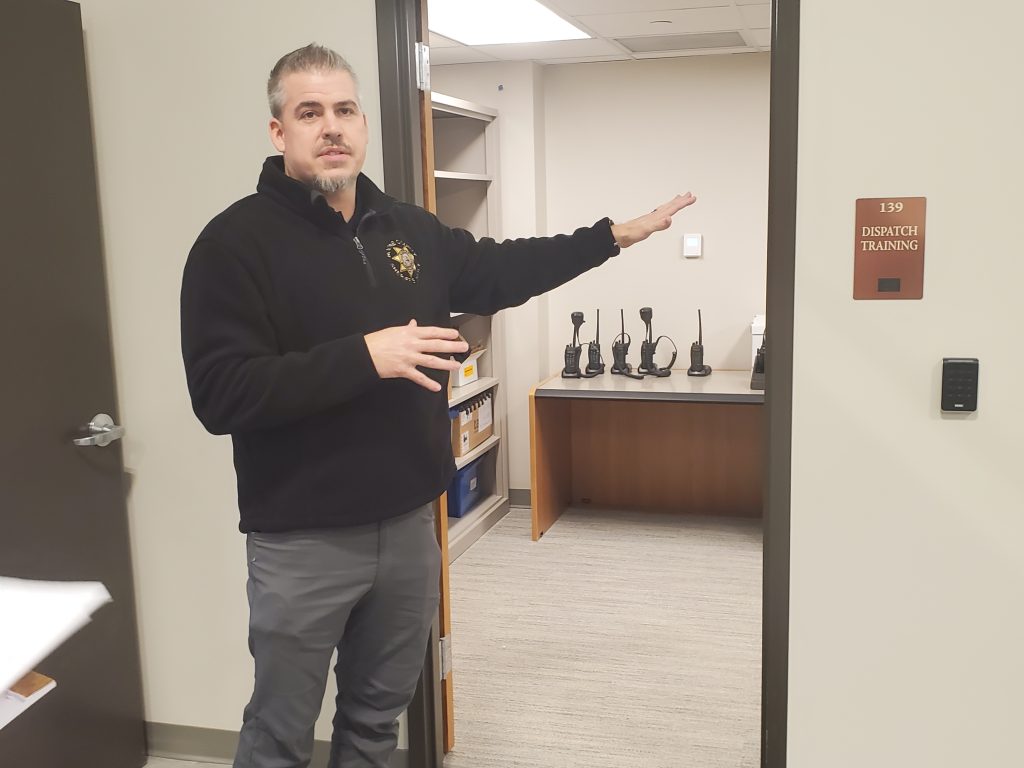
The new facility also features a mock joint communication setup, allowing dispatchers to train alongside law enforcement recruits. Training Branch Commander Damon Reynolds, who previously oversaw administration at the Boone County Jail, said he hopes to have monthly cross-training simulations between dispatchers and law enforcement.
Standing in the massive warehouse area, where multiple vehicles can be staged to simulate traffic stops and other scenarios, Capt. Brian Leer said joint communications staff can look out and see what’s going on. Conversely, law enforcement officers can see what the 911 center staff are handling during their response.
The facility will hold classes and training for prospective and current officers forty-eight weeks out of the year, Leer said. With around thirty students per academy, that means some 100 law enforcement and corrections officers will pass through the training center each year. The institute will have twenty instructors from fifteen law enforcement agencies across mid-Missouri.
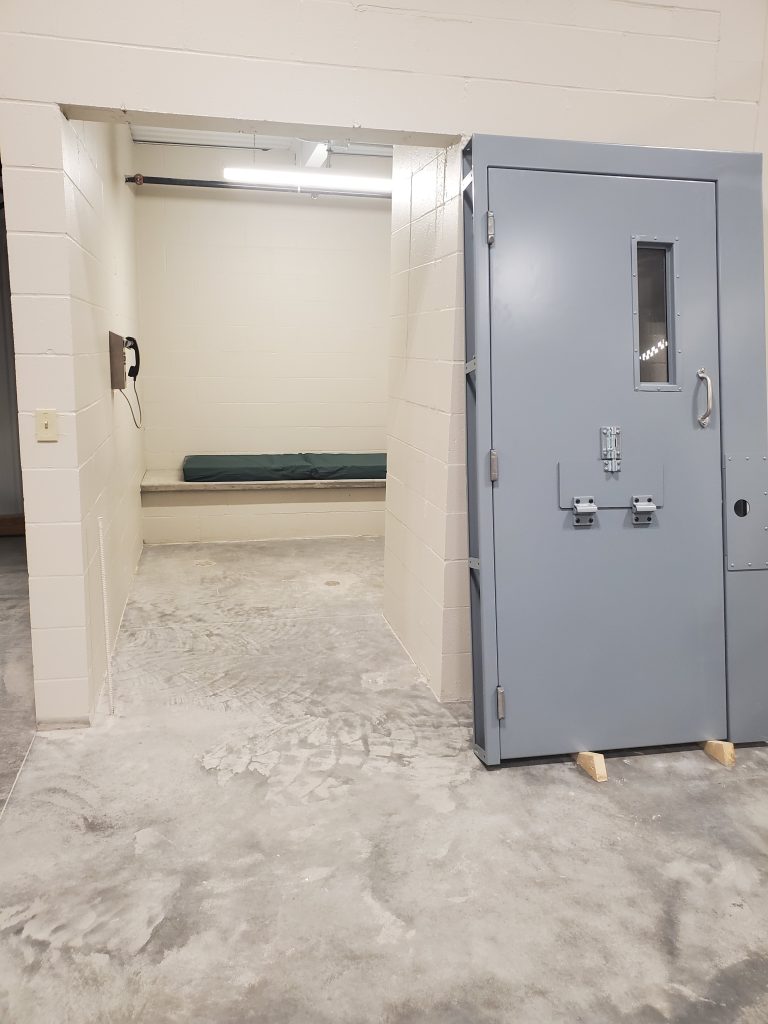
Reynolds said about 30 percent of training will take place in the classroom, with the main focus on providing hands-on experience. The mock jail cell is designed for scenario-based training for jail officers. Those scenarios include cell extraction and de-escalation techniques.
In addition to the Law Enforcement Training Academy, the Boone County Sheriff’s Office was already providing K9 training for more than forty law enforcement agencies. Ongoing training will also include active shooter training, crisis intervention training, and school resource officer training.
“There’s no place like it,” said Austin Kidwell while taking a break to catch his breath. He demonstrated jiu-jitsu moves to handcuff a noncompliant subject without having to strike blows, a method that is designed to decrease liability for law enforcement officers. That aspect of the training is something Carey has embraced and touts as a significant element of the training center’s programs.
In fact, Carey has instituted the training as mandatory, and all personnel are required to complete two hours of defensive training each month.
The new facility also comes with new mandatory training. Carey said all Boone County Sheriff’s personnel are now required to complete two hours of defensive tactical training each month.
“If our staff and our partners are trained in what he’s teaching, you’re going to limit liability for every agency and every law enforcement manager,” Carey explained. “It’s such a big piece of what we do every day.”
Reynolds emphasized that Kidwell’s techniques don’t require a high level of martial arts mastery.
“Anybody here can learn what he did in a matter of minutes,” he added. “It just takes repetition and practice.”
Leer said Kidwell’s experience in the military and as a sheriff’s deputy are tested and proven.
“He’s done this out on the street,” Leer explained. “He’s had to be in an uncomfortable position for five or ten minutes waiting for backup without someone getting hurt.”
Kidwell noted that when the training center unofficially opened on January 1, fifteen individuals came in for his training.
“Every time they come in, we’re a little better. We’re a little safer,” he said.
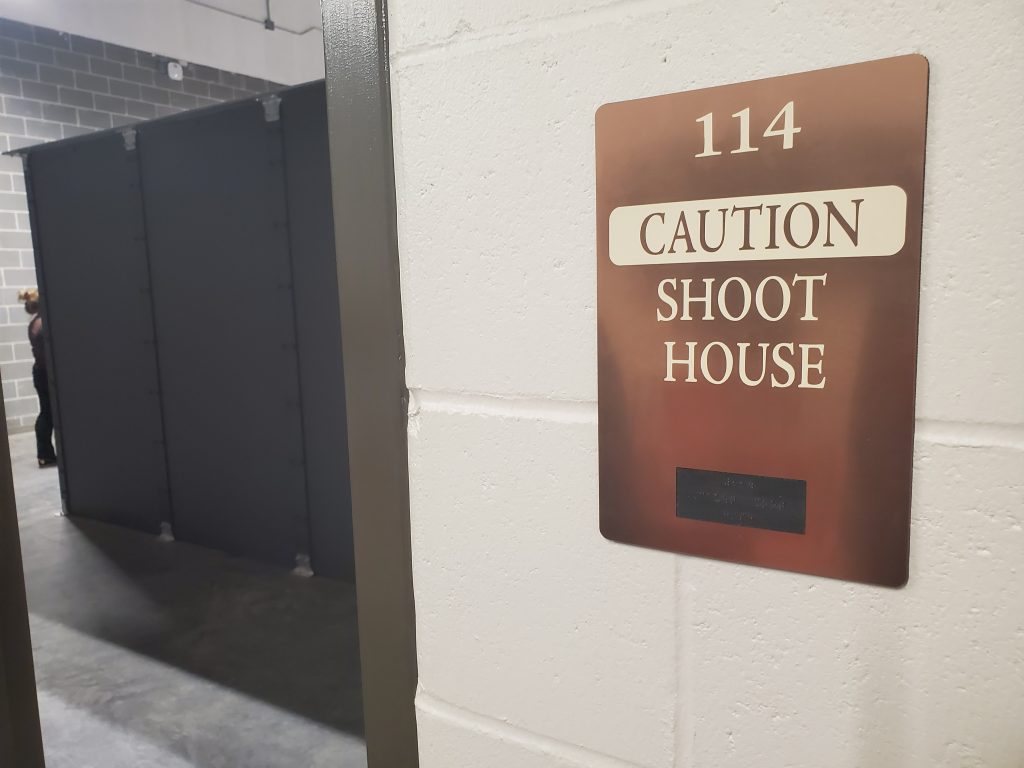
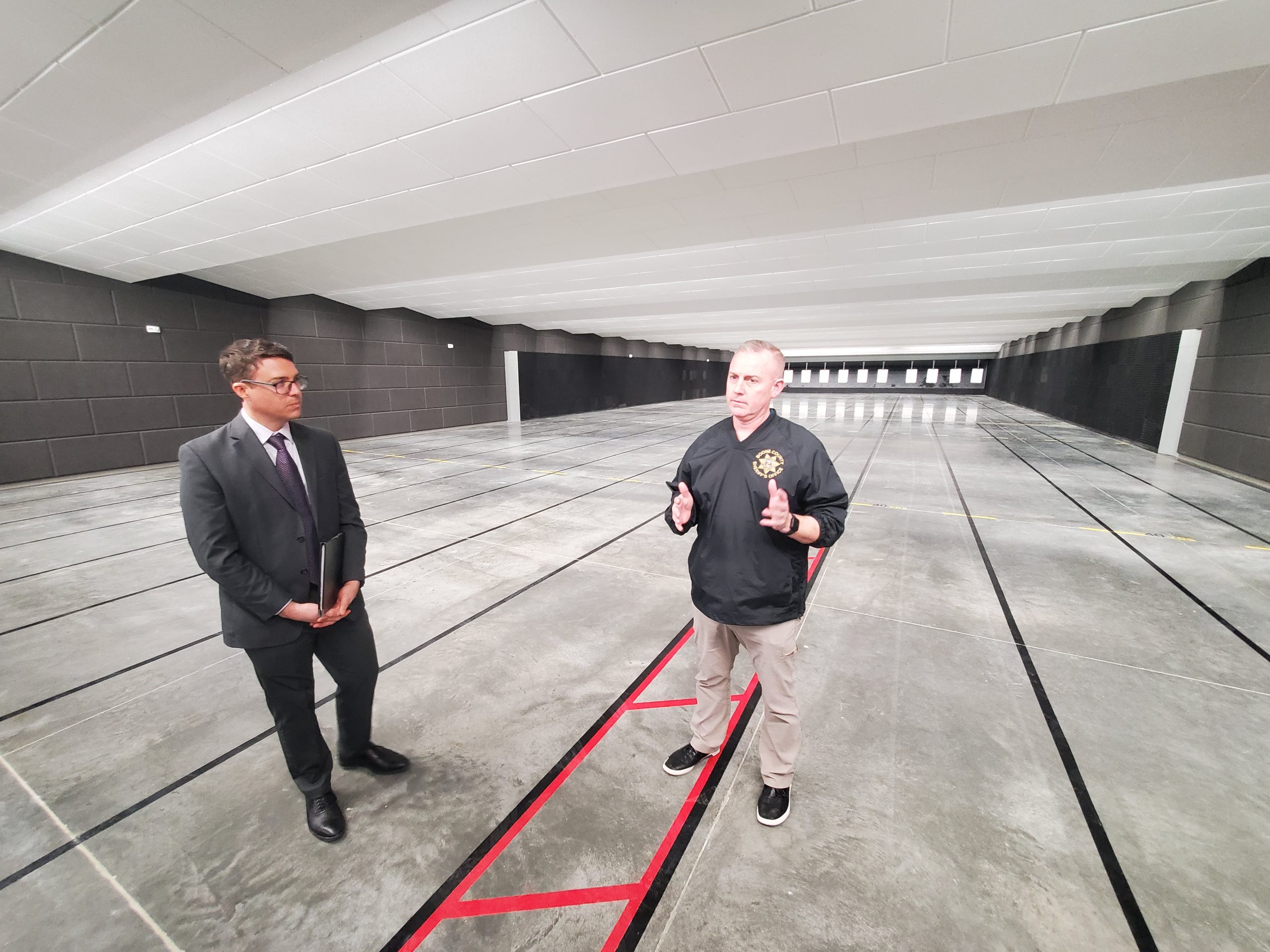
The training center also has two firing ranges – one fifty yards and the other 100 yards – as well as “shoot houses,” where officers will encounter scenarios from domestic violence and armed intruders to suspect apprehension and hostage situations.
The shoot houses are a series of rooms with hallways, closets, and other features that can be reconfigured to mimic different indoor room layouts. One of the possibilities could be an all-day training experience, beginning with dispatching two deputies to the “house,” where they encounter a suspect and a victim. Working with the mock 911 call center, officers in training might retreat from inside the property, work to secure the victim’s release, and secure the perimeter to provide a better scene for hostage negotiation.
“We can call in the SWAT team with the hostage negotiation team,” Leer said, repeating a phrase he used with many elements of the training center: “Imagination is our only limitation.”
With the push of a button, the indoor firing ranges can be modified for low-light or nighttime fire situations. The 100-yard range is ideal for patrol rifle training, Reynolds said. Leer pointed out that the ventilation system is “very sophisticated” and recirculates and cleans the air.
The training center had its planning genesis a few years ago when Carey and Presiding Commissioner Kip Kendrick went to Jefferson City to seek funding from state lawmakers. The roughly $20 million facility received $4 million from both the state and the county, with the remainder financed through revenue bonds.
Meanwhile, an on-site child care center for joint communications, jail, and sheriff’s staff is under construction. Kendrick predicted that the facility could be up and running by this August, “if we have a cooperative winter.”
The county hired a child care center director in June 2025 to prepare for its operation. The $5 million facility could eventually serve first responder personnel from throughout the county, providing care for up to ninety children.