

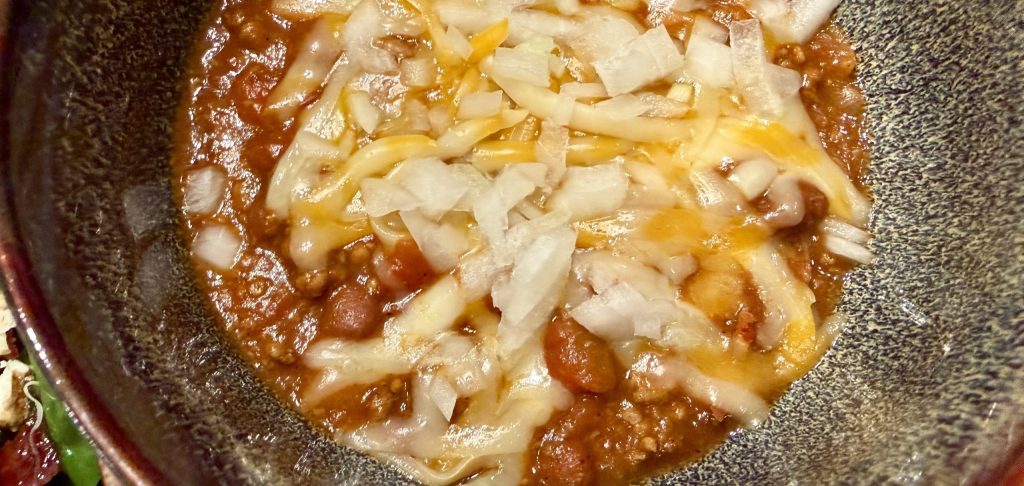
Chili is an iconic American one-dish meal. Like so many things considered American, however, chili originated in multiple countries and cultures. Its roots are over 500 years old and stem from Spain and Mexico before arriving here in the United States, on a journey from Texas to New Mexico to the Midwest. Part of what makes this dish so American is its complex, collective history.
Because of its broad heritage, chili is social. In my experience, most of us can appreciate a bowl of any style almost anywhere. But when we make our own, chili becomes more personal, invoking passion, inviting opinion, encouraging debate. Ground beef or braised chuck? Beans or no beans? Should it be served at breakfast? Should it be served on its own or over rice or spaghetti?
I grew up loving my mom’s homemade blend — a nurturing, mild, brothy stew of ground beef, onion, green pepper, canned tomatoes, bay leaves, chili powder, salt, cayenne pepper, paprika, and kidney beans (I still have her recipe). Toppings were chopped onion and green pepper. Sides were broiled, open-faced cheese-bacon-green chili pepper sandwiches topped with sour cream.
Mom’s chili was pure, consistent, and comforting. When she prepared that dinner, the night seemed more relaxed than others, but also more of an occasion. My mom didn’t discuss secret ingredients. She followed the instructions. Though Mom’s bowl of red was different than the one served at a friend’s house, a school fundraiser, or a family picnic, somehow each interpretation tasted just as it should have. I learned there are many ways to enjoy this prized dish.
When I moved away from home, like a rite of passage, I wanted to find my own official recipe. I eventually adopted one from The Southern Living Cookbook, which called for additions of celery and tomato paste and produced a thicker and slightly more complex version than what my mom had made.
Then one evening before a Maceo Parker concert at Jesse Auditorium, my friend Myles cooked a memorable pot of his homemade chili. I stood in the kitchen with him as he finished the batch and asked him about it. He narrated the standard base of ground beef, onions, garlic, chili powder, canned tomatoes, and beans, but also a few surprising additions.
The quest to develop my own concoction continued until I found an intriguingly folksy home cook’s recipe. The resulting chili had a friendly feel and texture reminiscent of the pre-show meal Myles had served. Over the years, I offered batches to friends and family coming over for dinner or joining a tailgate. I adjusted the spices and ingredient ratios, following the same technique.
But when I ran across a smoke-enhanced variation in a Sunset Magazine cookbook, I learned a few new tricks. This adaptation included beer and bacon. The combination was a hit and further taught me about seasoning. Chili, after all, can evolve and grow, and it doesn’t need to stick to one way of being. When I think of associated words — football, tailgating, cook-off, tradition — I think of people.
Last weekend, Lyle’s sister, Noelle, and her husband, Rusty, invited us over to meet their new granddaughter and enjoy a lunch of Rusty’s homemade chili. Rusty’s a great cook, loves to feed people, and respects ingredients and combinations. His rendition was just as I anticipated: meaty, well-balanced, homey, and fulfilling. Topping options were shredded cheese, chopped onion, Frito’s corn chips, and sour cream. I fixed myself a bowl and felt cared for in a natural, casual way.
Rusty and I talked about how our recipe interpretations have developed over time. He explained his preferred ingredient ratio and revealed his two favorite secret additions. I shared that one of those special elements is also one I stir in. We weren’t just swapping notes. We were taking part in the sociology of chili: celebrating our home and our history, finding our way, feeding our family.