
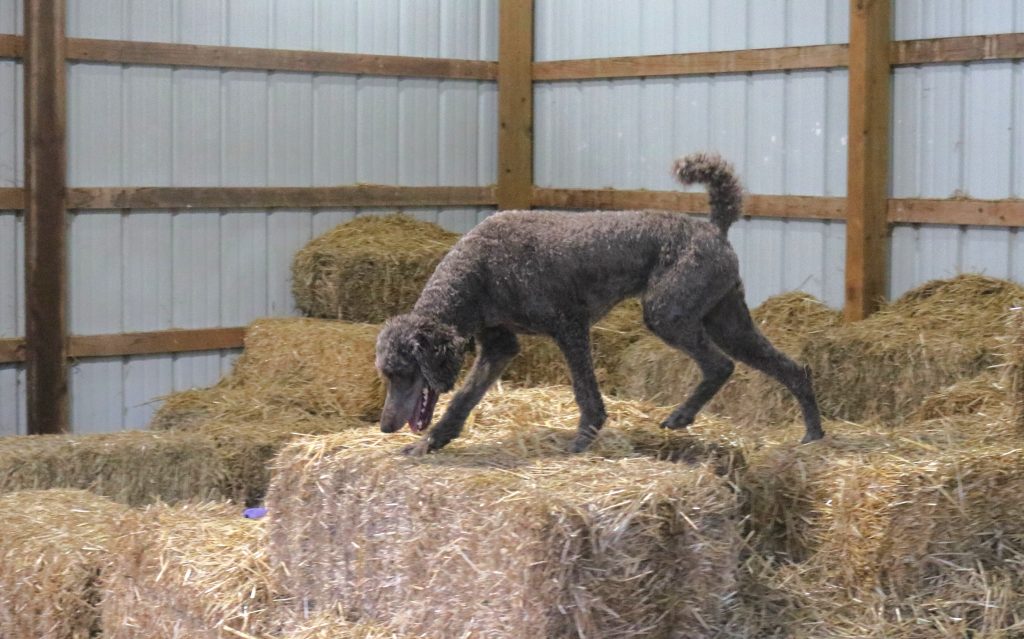
As a small standard poodle, Beatrix is well suited to leaping across straw bales and ducking through tunnels. Her ancestors weren’t bred to root out rats or follow scents on the ground. They were bred for the athleticism of swimming and retrieving. Poodles may not be widely recognized for their history as water retrievers, but that is the breed’s origin. Even the classic poodle clip, with its closely shorn legs and longer hair around the chest, was developed for practical reasons: to reduce drag in the water while keeping the body warm.
Regardless of breed, dogs have a natural prey drive and a powerful sense of smell. Both are on display as Beatrix searches for a rat hidden among the bales, picking out its faint animal odor against the earthy sweetness of the straw. This is play, but it is also practice: an opportunity to use her nose and develop her searching skills. Her owner, Amanda Wright, calls it “intelligence applied.”
Barn Hunt is a dog sport built around three tasks: finding rats, climbing a straw bale, and navigating a tunnel. For each trial, a rat wrangler hides rats — safely enclosed in protective tubes — somewhere among the bales. Neither the handler nor the dog knows where the rats are hidden or how many there are, from one to five. Once released, the dog searches the course, while her handler watches for an “alert” signaling that it has found a rat.
That’s the tricky part. Every dog has its own tell. Occasionally, the signal is obvious: a dog might scratch at the straw around a tube. More often, it is subtle — a shift in energy level, an extra wag of the tail, or even a side-eye glance toward the rat.
Barn Hunt was developed to give dogs an outlet for their natural behaviors, but the sport is about more than instinct. It is also about communication, learning, and trust. Beatrix and Wright are still figuring out how best to communicate with each other. Wright says Beatrix seems to prefer surveying the course for all the rats before signaling that she has found one. Her alert is often little more than a slight pause before she moves on.
Barn Hunt founder Robin Nuttall explains that, unlike many other dog sports, Barn Hunt requires communication to go in both directions. In obedience or agility training, a dog responds to a handler’s directions. In Barn Hunt, the dog leads the search, and the handler must learn to listen — to read the dog’s signals and understand what it’s trying to communicate. As the pair grows more attuned to each other, the dog also learns what it must do to make her discovery clear to its handler.
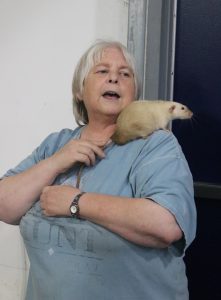
Jennifer Riess enjoys every role within the sport: She participates, trains dogs and handlers, wrangles rats, and judges competitions. Both Riess and Wright value Barn Hunt for the teamwork it fosters between dog and owner. When all the rats have been found, the team must give an “all clear” signal to end the trial. This requires a high level of confidence that the search is complete — something the handler can know only by reading the dog. Getting there requires trust, attention, and good communication.
Columbia Canine Sports Center (CCSC) is the local home of Barn Hunt. Created by Nuttall in Columbia in 2012, the sport has spread across the country and beyond the United States. Dogs can earn certifications at several skill levels, including Novice, Senior, and Master. Handlers from around the world send Riess their results, which she processes as part of her work managing certifications.
Barn Hunt is breed inclusive; any dog can participate. Riess fondly remembers a Great Dane who used to train at CCSC. For that dog, navigating the tunnels presented an extra challenge: Getting that long, lanky body through the tunnels was no mean feat.
Although rats are the quarry in this sport, their safety is a top priority. Dogs who show aggression toward the rats are not allowed to participate. The protective tubes are designed to give the rats room to move comfortably, and the animals are rotated out frequently so they have plenty of downtime. Wright says she wouldn’t want to participate in Barn Hunt if she thought the rats were distressed.
Riess breeds the rats used in trials and considers them working animals as well as companions. Her affection for them goes back to college, when she had a rat that would perch on her shoulder as she rode her bicycle. Sometimes, it even went to class with her. Riess has a deep respect for the rats’ abilities and individual personalities.
When Wright and Beatrix first began competing in Barn Hunt, Wright worried that the sport might intensify Beatrix’s prey drive and put her chickens at risk. Those concerns turned out to be unfounded. In fact, Wright now feels more confident calling Beatrix away from chasing squirrels into the neighbor’s yard. Wright says Beatrix is more interested in praise and treats than in the rats.
Riess explains that the rats in tubes don’t trigger the same predatory response as a moving target would. Barn Hunt is about finding, not chasing.
Most of all, the dogs seem to be having fun. Beatrix is spring-loaded, bounding across the straw bales, twisting and turning as she investigates one scent after another. Watching her work the course makes one realize how little humans can smell by comparison.
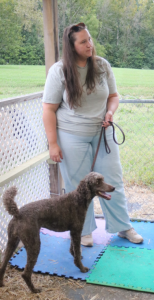
One of Wright’s goals is to teach Beatrix to slow down, though she is glad her dog has an outlet for her mental energy. Each run lasts only a few minutes, but one or two trials are enough to leave Beatrix worn out. As Wright puts it, “A tired dog is a good dog.”