
Public art and the people who fund it.
Columbia is home to many pieces of public art. We see that art on buildings, in parks, and throughout the city. But behind many of those pieces is someone willing to believe in an idea — and willing to help make it happen.
Paul Land and his wife, Julaine Stiers, have been part of the community for many years. Land is no stranger to commercial real estate, and Stiers spent her career as an MU Health Care physician. Together, they have also been long-time supporters of charities, the arts, and the city they call home.
“I really love to give back to a community that has given me so much,” Land said.
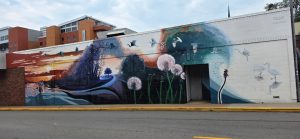
One of their early ventures into public art started simply enough: with a wall. A mural transformed that wall into something people recognized and remembered. Land understands that idea particularly well because of his years in commercial real estate.
Buildings become more than structures. We pass them on the way to work. Our kids grow up seeing them. They become landmarks, and over time, they are part of how we identify our community.
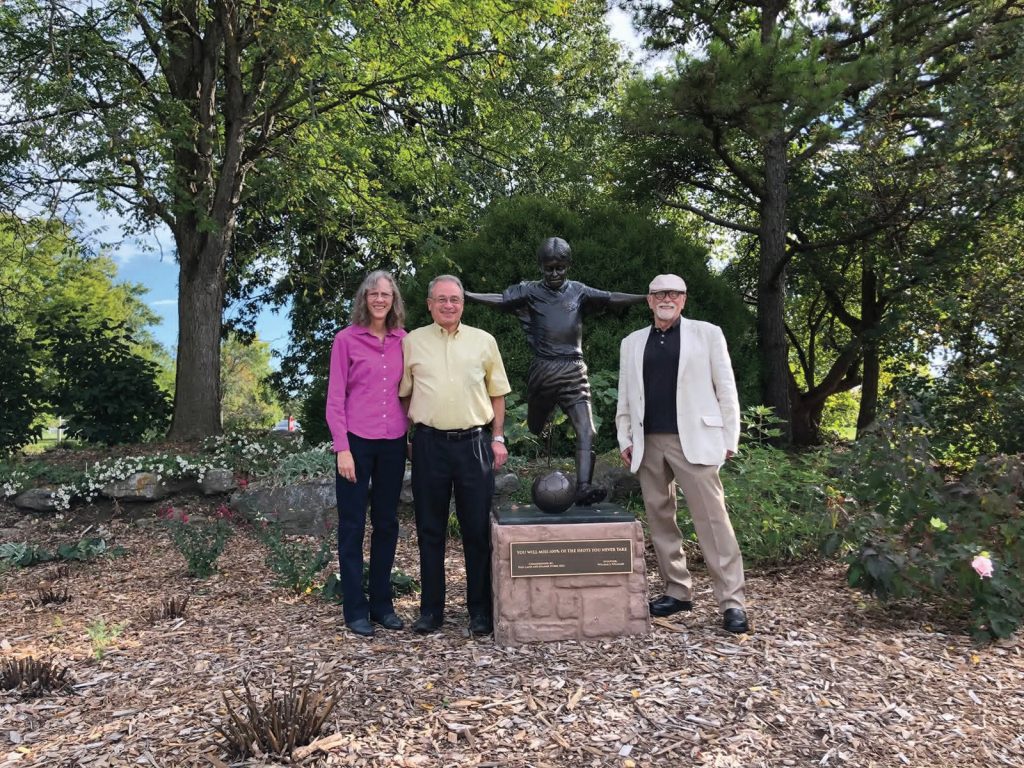
Land sees public art in much the same way. That thinking has carried into a number of projects he and Stiers have supported around Columbia. At Cosmo Park, the soccer sculpture “You Miss 100% of the Shots You Don’t Take” is particularly personal. Land coached soccer, and the sport was also the avenue through which he and Stiers met.
But the sculpture’s message goes well beyond the game. Life is a risk. Take a shot. That’s part of what Land looks for in public art. The pieces he and Stiers support tend to tell a story you can recognize when you see it.
You shouldn’t have to stand there wondering what you’re looking at or have someone explain why it belongs there. The story and the location should work together. Sometimes the motivation behind a piece of public art is passion. Sometimes it’s purpose. And sometimes it’s function.
At the Bank of America building, Land had a retaining wall where he tried to grow flowers without much success. I don’t know whether he has much of a green thumb. Maybe it was the location. Either way, eventually he found another solution: flowers that didn’t need watering. Large, colorful flower sculptures brought life to the space in a completely different way.
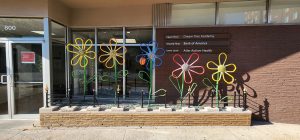
With a children’s center nearby, the flower sculptures also created something kids and families could enjoy and interact with. In a way, those flowers represent something bigger about the couple’s philosophy. If you can’t grow something in the ground, maybe you can still plant something in a community.
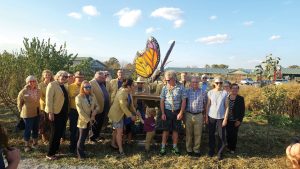
The butterfly at the Columbia Center for Urban Agriculture’s community garden is another example. These pieces aren’t hidden away in private collections. They’re intentionally placed where people are already living their lives — parks, businesses, and public spaces. They’re meant to be seen, understood, and enjoyed.
Land’s interest in giving back doesn’t stop with Columbia. He’s currently having another piece created for Ferguson, Missouri, where he grew up. The idea comes from memories of going fishing at a lake with friends and family. It’s a story from his childhood that he wanted to bring back to the place where it happened.
That’s one of the interesting things I’ve noticed working with Land. An idea can change as the artwork develops. As it starts becoming real, he begins thinking about where it truly belongs, what story it tells, and who might be inspired by it. A personal memory can become something thousands of other people experience.
I’ve known Land for around 15 years, and I’ve had the opportunity to create several projects with him. From my perspective as an artist, people like Land and Stiers are part of the creative process themselves. They may not be the ones holding the tools, but they’re willing to imagine something that doesn’t exist yet and invest in making it real. That takes creativity.
It also takes some risk.
“When you’re young, you don’t have money,” he said. “When you get money, you don’t have time.”
The couple has supported many charities throughout their years in Columbia. As Land explained it, when they’ve had good years, the charities have had good years. When they’ve had bad years, the charities haven’t done as well, either. There’s something very straightforward about that. You give what you can, when you can.
If you don’t know Paul Land and Julaine Stiers but happen to run into them around Columbia, say hello. They’re two of the kindest people you’re likely to meet. Land may be a little quirky — and I think he’d be OK with my saying that — but they’re people who appreciate the arts and enjoy giving back to places that have given so much to them.
Being an artist, I’ve learned that it takes a lot of people to make public art happen. You work with committees, art commissions, cities, foundations, businesses, and property owners. Every one of those people can play an important role. But eventually, somebody has to fund it. I don’t think we give those people enough credit. I’ve been fortunate to work with foundations, private individuals, business owners, and people like Land and Stiers who are willing to take their own hard-earned money and put it toward something other people may enjoy for decades.
They don’t have to do this. That’s important. They could spend their money somewhere else. They could find another hobby. Instead, they choose to help create something that tells a story, improves a place, and becomes part of a community.
So, the next time you stop to look at a sculpture, mural, or other piece of public art, appreciate the artist who created it. Appreciate the people who helped put it there. And don’t forget to appreciate the person who was willing to pay for it. Without the sponsors, the funders, and the people willing to take a chance on an idea, a lot of public art would remain exactly that — just an idea.