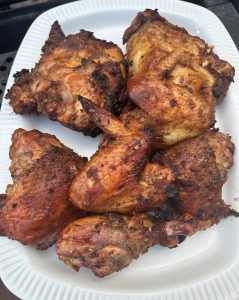

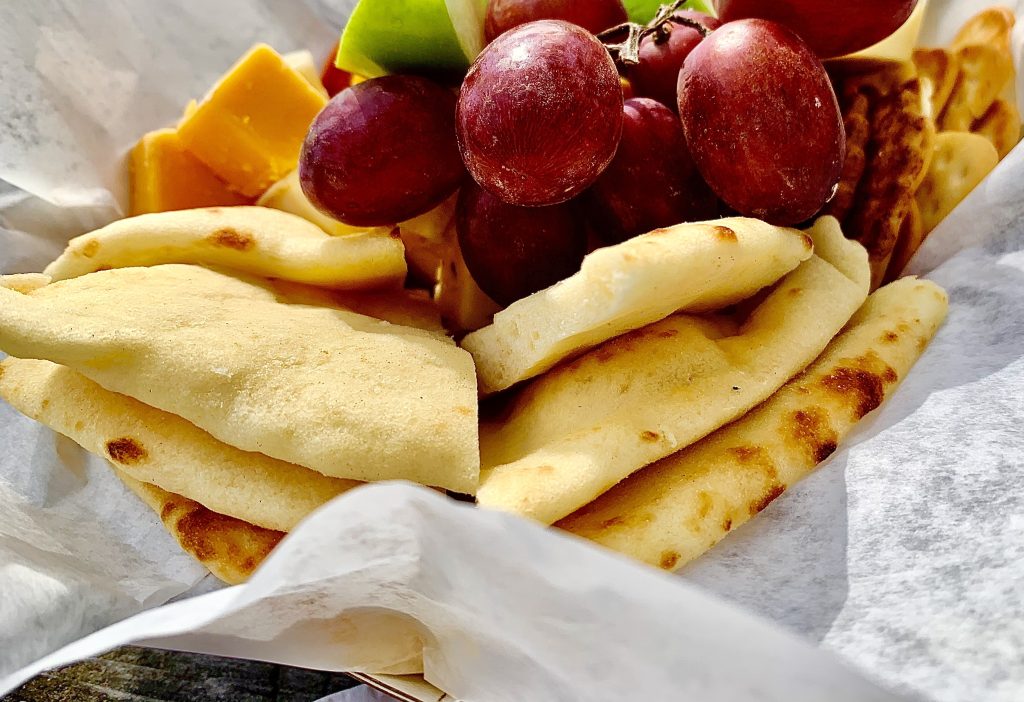
A ploughman’s lunch is a simple meal of bread and cheese, sometimes pickled vegetables, and, for my family, summer sausage or salami, mustards or other condiments, and fruit. Though the traditional version is served with beer, my parents served theirs with wine, and they celebrated. This special meal sometimes occurred as a planned outdoor picnic, but most often it happened on the spur of the moment, standing at the kitchen counter. After my sister, Tracy, and I became young adults and could fully participate in the event, it became a family tradition. In my parents’ older years, a ploughman’s lunch, also referred to as a Fun Lunch, was usually followed by a happy mid-afternoon nap, a favorite component of the occasion.
One reason this meal became so special to our family was its spontaneity. My parents were both planners. My mom made extensive lists of upcoming meals and grocery needs. Both of my parents wrote notes on recipes, sometimes positive, but other times utterly punitive. Cooking for them was a serious occupation. While the ploughman’s lunch — a special, ever-changing, kitchen-counter festival — was always well-balanced with high-quality ingredients, Mom and Dad were less demanding when they prepared one. They let go a little.
Last fall, my dad, who had suffered from dementia for years, entered hospice care at his retirement home. His health steadily declined until last month, when his nurses stopped giving him medication and suggested to Tracy, who lives relatively close to the Boise-based facility, that his time was very limited. He became unresponsive. Months earlier, I had already thanked my dad and explained to him how much he meant to me. I thought my goodbye was enough and complete. But when Tracy told me on a phone call that she asked Dad what he’d like for his ploughman’s lunch with Mom — who’d been gone for almost 14 years — my mindset changed.
I hadn’t considered Dad’s death as a reunion with Mom. Factually, I figured that once Dad was also gone, my parents — no longer a set but two separate people — would exist only as memories. Imagining my parents together again, mystically sharing a ploughman’s lunch in the ether, was a new idea. I felt a peace with Dad’s imminent passing I’d not yet allowed myself. Still, I needed to see him one last time.
After the phone call, my husband, Lyle, and I booked a last-minute flight to Boise. On the flight, I tried to convince myself I would be all right if Dad passed before got there. We’d see Tracy and her husband, Jeremy, and we would hug and cry together. I took a short video for Tracy to play for Dad, explaining that I was on a plane to see him but suggesting that if he had to rest before I arrived, that was OK.
When Lyle and I arrived in Dad’s hospice room late that night, we hugged Tracy and praised and thanked Dad. Hospice nurses had given Tracy a mattress to sleep on so she could stay with him. As we left to check into our hotel for the night, I kissed my dad on the cheek, and though he was otherwise motionless and unresponsive, he turned his right ankle.
The next day, hospice workers checked on us in Dad’s room. They were kind but seemed confused, looking at him intently. A small battery-operated candle the hospice chaplain had brought Tracy the morning before blinked on a table across from his bed. Tracy had printed and framed two photos I’d sent her of Mom and Dad. The frames were also on that table. One of the photos was a black-and-white photo of Mom and Dad on their wedding day, and the other was of Mom kissing Dad’s cheek, both of them clad in plaid shirts while on a camping trip. Dad’s nurse said, “He’s holding on to something.”
We sat with Dad and shared stories. I told Dad I think of him when I take photographs. When I was a young girl, on a family trip to Staten Island, I raised my camera toward the Statue of Liberty. Dad asked me if I realized how many people had captured that image similarly. I didn’t. He asked me to look around at other people taking photos. He suggested I consider the Statue of Liberty from another angle. At his bedside, I mentioned that ever since that day, I’ve constantly searched for new angles and different ways of seeing things, profoundly opening the world for me.
I also reminded Dad of an old drawing I made of our family dog, Snowball, a white, fluffy, curly-haired miniature poodle we adopted from a downtown COMO pet shop. Back then, I took piano lessons downtown, and after lessons, Mom, Tracy, and I walked to Cheese Villa for frozen yogurt. The pet shop was in between, and its window showed a pillowy creature with two dark, large eyes. After I pleaded with my parents, we brought Snowball home.
When I drew Snowball, I made sure to document all his curls, and I was proud of my thorough creation. But when I showed the drawing to my dad, a watercolor artist, he asked me what color Snowball was. “White,” I responded. “Then, why is that dog gray?” he asked me. He then explained that, when drawing, I didn’t have to convey every detail. Instead, he taught me to suggest Snowball’s wavy fur by simply drawing a few curls. In my dad’s hospice room, I thanked him for those lessons and insights into the world of creativity, thought, and expression.
Dad continued his shallow, regular breaths. His nurse asked us if we’d assured him that it was OK to let go. I’m not sure if we had or if we ever answered that question. She asked us whether any family members hadn’t yet had a chance to say goodbye. We called his sister and her husband, our Aunt Lyn and Uncle Doug. We held the phone next to his face so they could talk to him.
Aunt Lyn and Uncle Doug took turns speaking, invoking his nickname and telling Dad, “We sure had a lot of good times, Buzz.” They reminded him of his success in bringing the Ronald McDonald House to Columbia back in the 1980s. They told him about the new Ronald McDonald House, the third iteration, and said he helped make that happen. They remarked that he has two wonderful daughters. After they said goodbye, Dad moved his ankle.
His breathing, however, remained unchanged. We decided to say the hard part out loud. We asked him to understand that we didn’t and don’t blame him for our mom passing away too early. We explained that she went on her own, and that wasn’t his fault. The sheet down at his ankle shifted. We couldn’t be sure that his movements were corresponding to the moments we were experiencing. But just the hope that the motions weren’t coincidences, and had meaning, was helpful.
Even if he didn’t understand what we were saying, Tracy and I needed to say that hard part to each other and know that we meant it. The catharsis was palpable. Something was still missing, though. Tracy calmly stood up and looked out the window, then toward his bedroom door, and then at Dad as she suggested that since he so enjoyed the physical pleasure of eating, maybe he worried he would miss that favorite worldly treat. Maybe he wanted one more experience. It was time for a Scheffler family ploughman’s lunch.
Jeremy left for the convenience store nearby and returned with small travel bottles of chardonnay, some cheese, and salami. We poured five glasses and raised each in a toast. Tracy and I took turns dipping a medical swab into Dad’s glass and lightly brushing his lips with wine. We assured him that, from now on, he could enjoy these special lunches whenever he wanted, and they didn’t have to be an escape anymore. Every Fun Lunch would simply exist legitimately on its own merit, fully earned. Though his mouth had been open since we arrived, Dad closed his mouth around the swab. Though he’d been silent, he attempted what sounded like an utterance of appreciation that sounded like, “Mmm.” Though he’d been motionless, he turned his ankle.
Earlier that day, Dad’s hospice nurse had instructed us that while some people pass surrounded by loved ones, others wait until they’re alone. After our powerful interaction with Dad, we decided to give him some space to process the joy, appreciation, forgiveness, and spontaneous family celebration we had shared with him. I leaned down and kissed his cheek, and said, “I love you, Dad. I hope you enjoy a wonderful post-Fun Lunch nap.” As we walked out of his room, Tracy touched the sign outside his door that said, “Leonard Scheffler.” That afternoon, Dad’s nurse explained through a soft smile that the moment we left, his breathing changed. Then she watched our dad peacefully take his nap.