

Educational video games aren’t exactly new — what grade schooler hasn’t died of dysentery at least once on The Oregon Trail? — but at Adroit Studios, a game design space on the University of Missouri campus, developers are taking them to new heights. The studio’s developers create learning games for audiences ranging from middle school to college students on topics that include health, education, science, math, language, business, and communication, among others.
“Any kind of purpose you could think of, we’ll try to design a player experience to get them to that end goal [of higher learning] we are trying to reach,” said Joe Griffin, Adroit’s founding director.
A History of Video Game Success (By Any Name)
The studio’s first project dates to 2009 with the start of the iSocial project, which the Adroit website describes as “a new tool for children with autism spectrum disorders to learn and develop social competence.” Griffin joined the studio in 2011 as an undergraduate to become one of its first code developers and was a designer on the iSocial team.
He later became a project manager on Adroit’s next project, Mission HydroSci, a game that teaches middle school students hydrological science and scientific argumentation. Mission HydroSci was an early success and is still the studio’s largest project. “We are going to deploy it to classrooms later on in this coming semester and a larger scale the following semester after that,” said Joseph Fischer, Adroit’s project manager.
In Adroit’s early days, video games hadn’t yet achieved universal respect in education circles. In fact, the team that developed iSocial wasn’t permitted to call the project a learning “video game,” but was instructed to call it a “virtual learning environment” instead. By the time Mission HydroSci came on the scene, however, the status of such games had improved. The studio could now refer to its projects as learning games and focus more explicitly on the game development aspect. From then on, Adroit Studios began creating a greater variety of high-quality learning games that were engaging for students and effective for instructors.
Fischer said that these days, the studio has “about 10 projects going on at any given time.” One of its current projects, titled Westworld, is a simulation for the Trulaske School of Business at MU. Westworld recreates the business school environment with AI-driven characters positioned in various locations, such as the front desk.
Fischer explained, “With a headset on, you walk in, and you can talk to the secretary. You can ask where the different people are in the environment that we created.” The simulation can be used by the business school faculty to create learning scenarios, such as interview practice or negotiation practice using the virtual environment’s AI.
Griffin also highlighted vSchool and ScanBright as two of his favorite projects currently under development at the studio. He said Adroit is taking “commercialization steps” to market the video games for real-world settings.
Designed for middle school kids, vSchool is an after-school behavioral simulator that presents students with tasks such as making pizza, making slime, playing basketball, or creating art projects. As players do those tasks, they are interrupted by game characters with different conversation prompts. The game assesses how the student interacts with the characters, whose behavior can vary from rude, to nice, to weird.
For ScanBright, a game that helps radiology residents learn how to read and analyze X-ray scans, the studio had to transition from a middle school audience to a medical school one. The game allows players to swipe through scans and identify whether they are clear or not and explain why. Griffin said med school faculty have already used ScanBright with positive results. “It’s really cool to have that sort of tool out there that we created,” Fischer said.
Kick Out the Jams
When the studio’s creators aren’t busy simulating business environments, explaining hydrological science, and the like, they hold an annual video game creation competition. This year will mark the 10th Game Jam that Adroit Studios has hosted on the MU campus. Griffin described the competition as a “lock-in for a weekend, where we do a hack-a-thon or a coding competition,” with prizes and free food. The event is held at the Reflector in 201 Townsend Hall.
Teams typically consist of four people, who have 48 hours to create their best-possible video game. Anyone can enter, from artists and designers to developers to sound designers to complete newbies at video game creation. This year’s competition starts at 5 p.m. on Friday, February 20, when the game theme is announced, and ends at 5 p.m. on Sunday, February 22.
“It’s pretty exciting, pretty fun,” Griffin said. “We get some really cool projects coming out of it every year.”
The competition is judged by experts in the gaming industry, who may potentially hire entrants to work at their companies. The competition is also an ideal opportunity for general networking.
“[The judges will] answer questions of what it is like to work in the industry” and act as mentors to the entrants, Griffin said. “At Adroit, we’ve actually hired someone [from the competition], at least one person every year. It has been really successful for us.”
The competition, which is free to enter, offers cash prizes for winners in three categories: K-12, college, and professional. Prizes are awarded for the top three games in each category, while the grand prize for best game overall is $5,000. Fischer noted that the large cash sum is “one of the larger prizes for a Game Jam out there.”
Space to Dream
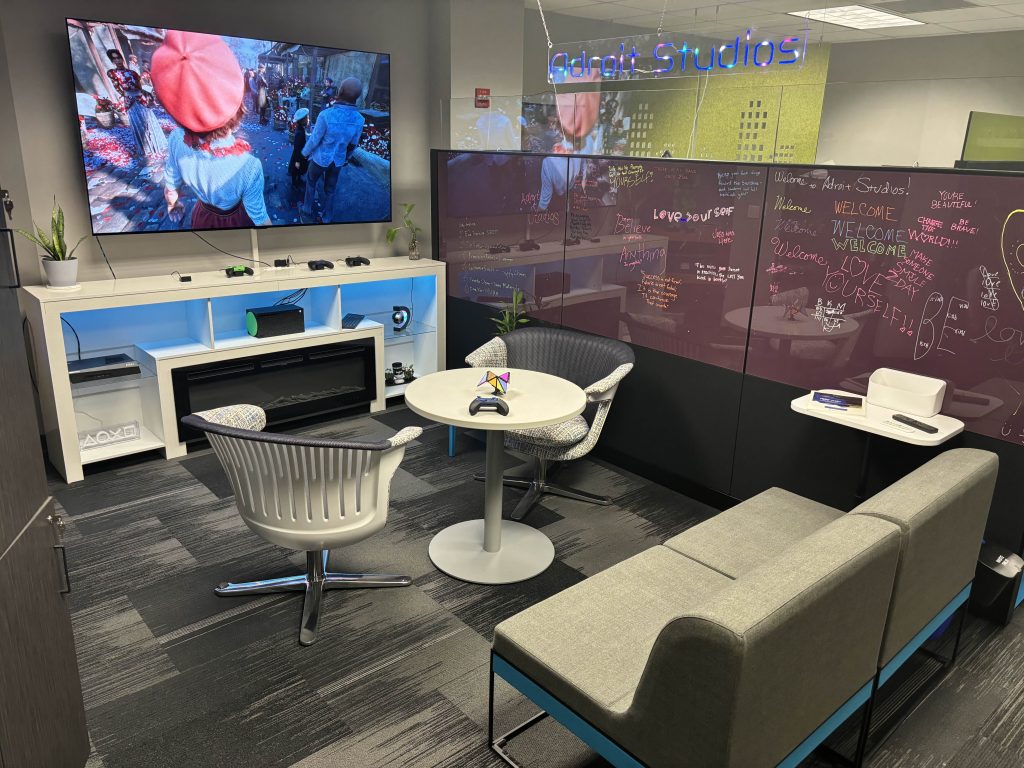
To encourage collaboration and creativity, the Adroit Studios space was remodeled last summer from a typical office space to one that contains everything a budding video game designer could ask for. There are coding stations and game development software set up, as well as a game testing station with a couch, chairs, and a large TV. The center of the room features maroon marker boards for brainstorming sessions. In the corner, a sound booth enables creators to conduct interviews or record sound effects or music for games. The newly revamped studio is any game designer’s dream.
For the spring semester, Adroit is hoping to open the studio space to more students, and Griffin and Fischer invite students to find indie developers for new game projects. Fischer encourages the MU community to come check the studio out: “There’s room for pretty much anybody.”