Nash Vegas on East Broadway, Calvary Episcopal Church on Ninth Street, and the Guitar Building on the corner of Eighth and Walnut streets.
Columbia residents and visitors encounter these places constantly, whether they are partying it up at the city’s most popular country bar, feasting on Shakespeare’s Pizza, or getting a haircut at Renz Blendz barber shop.
But how many know that inside those buildings — or on the ground where some of them used to stand — women were quietly making history? Now, a new initiative aims to bring their names and stories into the light.
“Where Women Made History: The First Chapter Tour” is a two-hour, half-mile experience that shows participants the spaces and places that were connected to the work of pioneering women who lived in Columbia from the 1800s to early 1900s. The tour was launched in March by CoMo Preservation, a local nonprofit dedicated to preserving Columbia’s history. Founded in 2022, the organization primarily aims to educate the public about the city’s history, advocate for historic preservation, and recover architectural materials from buildings set to be torn down.
The brainchild of local historian and CoMo Preservation co-founder Dianna Borsi O’Brien, who primarily leads the tour, Where Women Made History also involved many other volunteer researchers. After O’Brien pitched the idea to co-founder Deanna Wasman last fall, the two began assembling a research team. In addition to themselves and CoMo Preservation’s third co-founder, Elena Vega, they were joined by Nancy Obermiller Kiser, Mercy Austin, Mary Jo Herde, Jen Gerken, and Deb Sheals as they set out to uncover these women’s histories.
“There are many invisible people in our world,” noted O’Brien. “There were women that were making history all the time, and like African-Americans, a lot of their efforts are either erased, unacknowledged, or not even mentioned.” The team’s goal was to un-erase them.
Since the core of CoMo Preservation’s work is historic architecture, the team decided that the tour would center around interesting architecture that was linked to these women’s lives. “Knowing history and knowing the stories of the people who made history there brings our community to life in a way that nothing really else can,” O’Brien said.
In the Steps of Columbia’s Trailblazing Women
The tour kicks off at the corner of 6th and Ash streets with the story of Annie Fisher. Born of enslaved parents, Fisher was a cook for wealthy white families in Columbia before becoming a caterer, restaurant owner, entrepreneur, and owner of close to 20 rental properties.
While Fisher was achieving fame for her beaten biscuits, Luella St. Clair Moss was racking up firsts in educational and political leadership. She was the first woman to sit on the Columbia Board of Education and the first to become a Democratic nominee for Congress. Among her other trailblazing feats, St. Clair Moss became the first female president of Columbia College, stepping into the role when her husband and then-president, Franklin St. Clair, died in 1893. That made her one of the — yes — first women college presidents in the U.S.
Tour guides share St. Clair Moss’s story when participants walk past the “decapitated” one-story O’Rear Building on East Broadway, which today houses the country bar Nash Vegas. A little over a century ago, the scene was decidedly different. The building had three floors and was home to the Tuesday Club of Columbia, of which St. Clair Moss was a member.
One of the city’s first women’s groups, the Tuesday Club of Columbia comprised dozens of intellectually and philanthropically minded women who established the Columbia Free Library, the precursor to today’s Columbia Public Library. They operated the library out of a rented room in the same building, although in the early 1900s, the library moved locations several times, including the courthouse among its temporary locations. In 1919, Tuesday Club member Emily Harshe, another woman featured on the tour, was unhappy with the insufficient space in the courthouse and eventually sought out a new location for the library: the Guitar Building.
At the corner of 9th Street and Broadway, tour-goers meet Ann Hawkins Gentry, whose residence doubled as a tavern and post office. Since the structure has been demolished, O’Brien said she instead shows tour participants a historic photograph of the building that used to be.
It was in that structure that Hawkins Gentry became the second American woman to serve as a postmistress. According to O’Brien, Hawkins Gentry had been helping her postmaster husband with his job long before she was named to the position. The role was officially his, but he was away fighting in the Second Seminole War, so she performed his job on his behalf.
“Anne had been doing that job a long time before she was appointed,” O’Brien said. “That is the story of women throughout history. We’re doing things, and people don’t see us.”
Hawkins Gentry is often lauded as a pioneer who held a professional position while raising 13 children, but CoMo Preservation’s research uncovered something that had been left out of other history books.
“This hurts my heart to say, but what we also learned is, I believe, she had between five and eight enslaved people,” O’Brien commented. “I don’t mean to be ugly, but you can get a lot done when you have enslaved people helping you.”
“So, were her accomplishments impressive? Yes. But the accomplishments she made — did they miss part of the story? Yeah.”
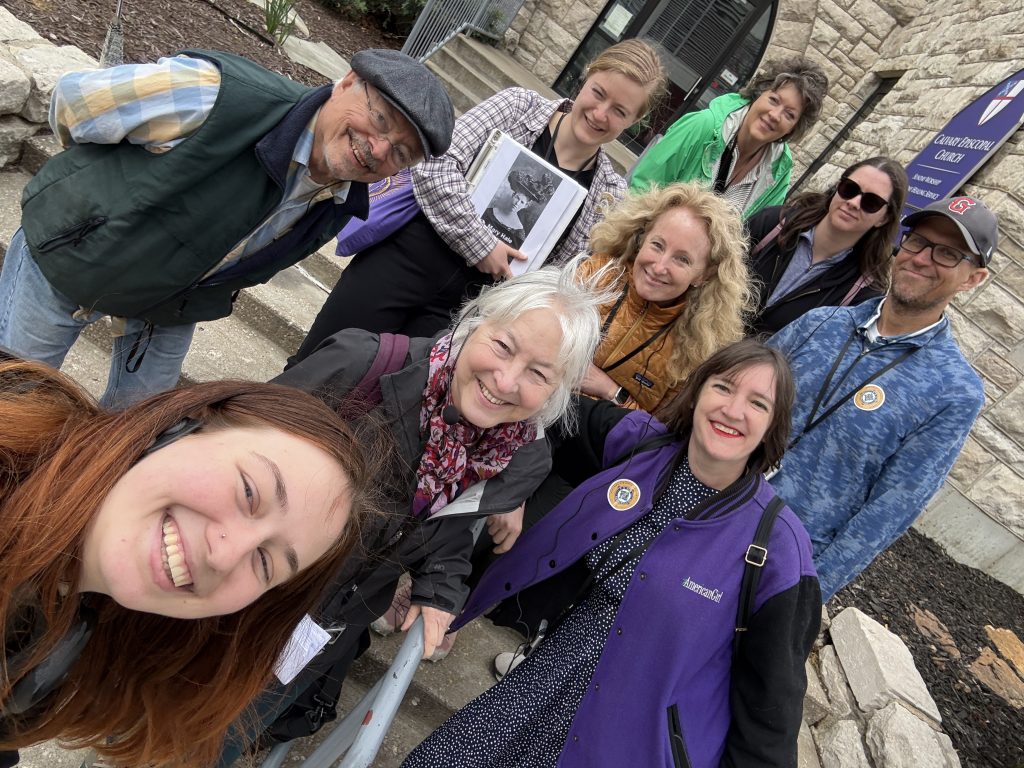
As tour attendees walk past the Boone County Courthouse columns, they’re seeing remains of the courthouse where Laura Matthews served as Boone County’s first official court stenographer. Strolling by the Niedermeyer Building, they learn about its origins and the story of sculptor and Boone County Historical Society Hall of Famer Sabra Tull Meyer, who was Frederick Niedermeyer’s granddaughter. At the age of 80, Tull Meyer sculpted the Lewis and Clark Corps of Discovery monument in Jefferson City. Calvary Episcopal Church marks the stop for Mary Louise Hale Lafon, one of roughly 40 female architects of her time. She designed the church and Columbia College’s St. Clair Hall.
After two hours, participants eventually end up at 7th and Elm streets, where O’Brien discusses Vinnie Ream, whose portrait hangs in the nearby State Historical Society of Missouri, and Mary Louise Gillett, the first woman to graduate from MU.
At just 18, Ream became the youngest person and first woman to receive a commission for a statue from the federal government. Her carved marble sculpture of Abraham Lincoln is displayed in the U.S. Capitol. Gillett enrolled in MU’s “normal school” in 1867 and graduated in 1870. Posthumously, she became the first woman for whom an MU building — Gillett Hall — was named.
Preserving the Past
For O’Brien, Where Women Made History is more than a way to keep the trailblazing women’s stories alive — it ties into a broader mission of historic preservation.
“If we can get people to love history, they will work to preserve history,” she said, adding that people are likely to feel more strongly about preservation of specific buildings if they knew the stories and history they held.
“The idea is, when you know more about your history, you appreciate it more, and when you love something and appreciate something, you’re less willing to allow it to be swept aside,” O’Brien said.
The Where Women Made History: The First Chapter Tour is expected to resume in October. In the future, O’Brien envisions as many as five more tours covering different women and corresponding parts of the city, including the campuses of Stephens College, Columbia College, and the University of Missouri, as well as a tour focused on Black women. Those interested in taking a tour, volunteering, or following CoMo Preservation’s ongoing work can visit comopreservation.org.
COMO BRICK & MORTAR PROJECT
In April, QR code decals popped up on the windows of six different downtown buildings. Scan one, and it’ll show you a little nugget of the building’s history.
One of these can be found outside Birdie’s Deli on Broadway. While the building has hosted many businesses in recent years, few know that it was built in the late 1800s for the Columbia Herald newspaper and the E.W. Stephens Publishing Company.
Cluing people in to the past is the idea behind the CoMo Brick & Mortar Project, a new digital initiative by CoMo Preservation in partnership with The District. The project aims to make information about the city’s history accessible to the wider public, one QR code at a time.
In its inaugural edition, the project chose six buildings to represent different facets of downtown said Deanna Wasman, co-founder of CoMo Preservation, who was involved in the project.
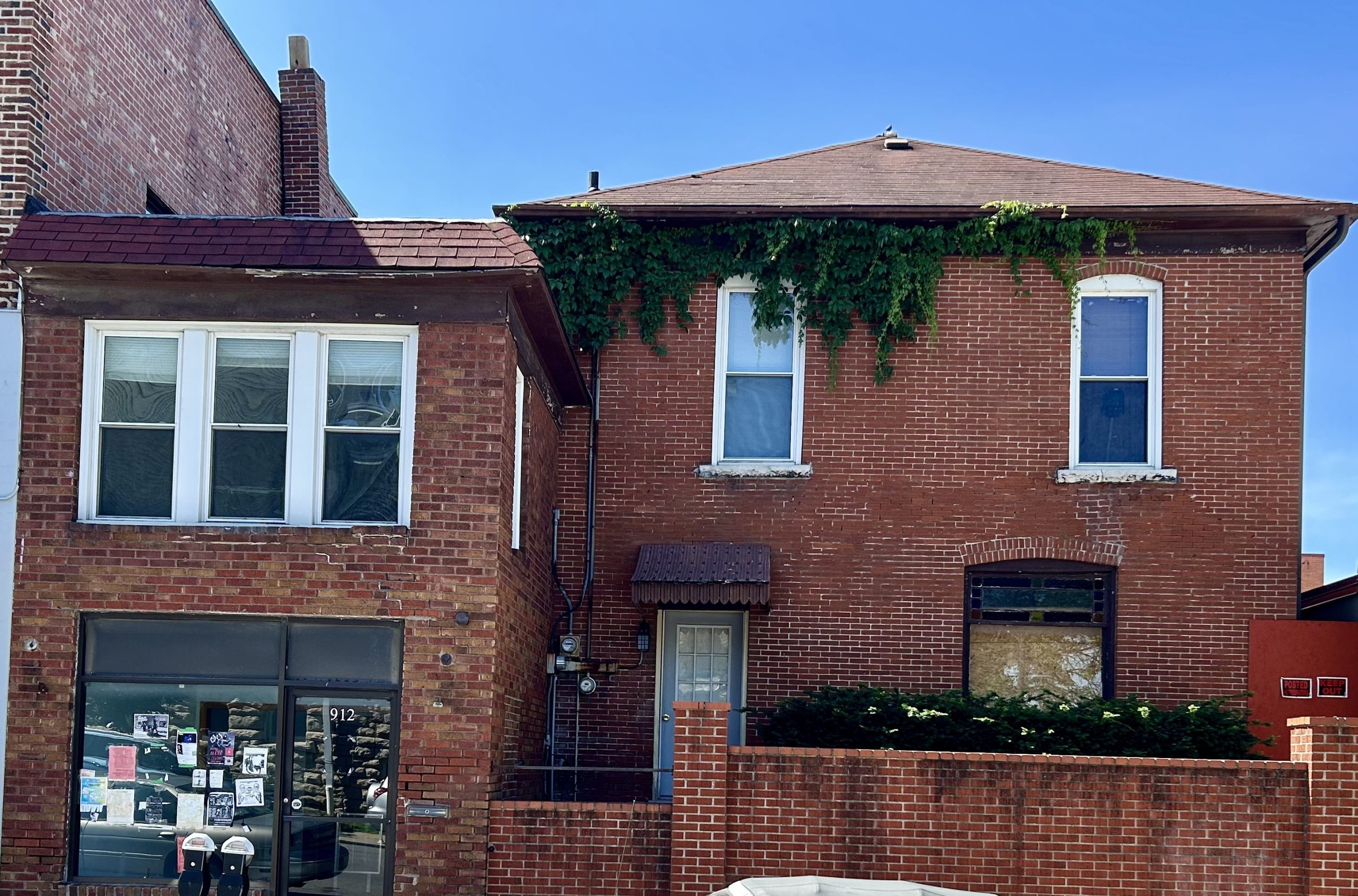
The Herald Building was chosen for commerce, the Howard Municipal Building for government, the M.K.T. Railroad Passenger Depot for transportation, The Hall Theater for entertainment, the Tiger Hotel for lodging, and the Crane-Cho Building as one of the few remaining downtown residences.
Michael Limmer, a CoMo Preservation member and history PhD candidate at the University of Missouri, came up with the concept when he realized firsthand how little people knew about the hidden history of the buildings around them.
“In 2020 through 2022, they tore down a series of very historically significant buildings, one of them was where my office was,” Limmer said.
“There wasn’t value around the historic built environment of Columbia and Mizzou … because Columbia’s such a transient city; I’m always shocked (at) how little public history is being done in projects, like, people are in and out so much.”
Limmer is originally from Florissant and moved to Columbia in 2019 to pursue a master’s degree and PhD in history at Mizzou. As a transient person himself, he said he approached CoMo Preservation because he wanted to ensure the project’s continuity beyond him.
Brick & Mortar received $1,059 from the City of Columbia’s Office of Cultural Affairs’ annual arts programming grant in FY2026, according to Kristin Gadsden, program specialist with the City of Columbia’s Office of Cultural Affairs.
Limmer called it a “jetpack” that enabled the project team to turn CoMo Brick & Mortar into more of a “community project.” With the money, they could provide paid and unpaid research and writing internship opportunities to high school and college students.
Additionally, Gadsden said that CoMo Preservation has received $500 from the city’s Small Request Grant Funding in FY2025 to host an “ART-chitecture Contest.” Held annually, the contest invites people of all ages to create artwork inspired by one of the 12 buildings that are part of the project; six more building histories are currently being researched and written.
Eventually, Limmer envisions the project covering the history of over 20 buildings downtown. “We can’t do every building, but we can do justice to a good two dozen,” he said.
And QR codes are just the beginning of something bigger. “From there, we can plug this information into walking tours, apps, a digital story map,” Limmer added. For me, the project is about getting the information together and then trying to find other lanes to plug it into.”
For now, Wasman hopes that at least a tidbit of information sticks with those who scan the QR codes and read the bite-sized summaries of the buildings’ histories.
“If they, 30 years later, come and say, ‘Hey, I remember this little bitty piece and passed it on to someone else or had a conversation (about it),’ I mean, that’s a win,” Wasman said.