
The ‘why?’ behind my photographic journey through Columbia.
Over 25 years ago, I started photographing downtown Columbia in earnest. It was my dad who got me started in photography and who, on my 12th birthday, presented me with a Nikon film camera and a 50mm lens. For years, this was the only camera I used or needed, gradually adding a few lenses and later a tripod. My earliest photos of Columbia were taken on color print film when I had free time on the weekends.
As I became more engaged in the art of photography, I began photographing downtown Columbia with black and white film on a casual basis. Equipped with a Nikon film camera, two or three lenses, and a tripod, I set out each week during the late 1990s to photograph the downtown area. My initial intention was not to document, but to artistically interpret the streets, alleys, bars, storefronts, and neon signs of this comfortable college town that I called home. Informed and inspired by the work of Brassaï, Edward Steichen, André Kertész, and Josef Sudek, my aims were artistic rather than documentary.
In 1998, I enrolled in an intermediate photography class at MU with Professor Oliver Schuchard. Our class assignment was to create and submit a topic for the end-of-semester portfolio. For reasons both pragmatic and creative, nighttime offered me the best opportunity to wander our city’s streets in search of inspiration and vision, so I selected Night Photography as my topic and began to photograph downtown Columbia in earnest.
When I started photographing Columbia at night, I was on a quest to find scenes that displayed the visual magic and the poetry of a city after dark. I was captivated by the bewitching beauty and simplicity of a city at night, and I recognized the power of darkness to transform the quotidian into something elegant and mysterious. During 1998 and 1999, I put more time and energy into photography than any other activity, and I became fascinated by the creative alchemy that I experienced during nighttime photography.
The earliest photographs in this body of work stretch back to 1996, with creative peaks occurring in 1998, 2001, 2003, 2011, and 2013. From 1996 to 2010, I was making my photographs on film with a manual focus camera and a tripod. In 2010, I shifted over to digital image making and moved away from the use of black and white film and a tripod in much of my photography.
A portfolio topic chosen 28 years ago led to an obsession with night photography and to a long-term project to document downtown Columbia at night. I continued photographing Columbia in this fashion from 1998 until 2003, when life interrupted and took me to a new city. I moved back in 2008, and in late summer 2009, I began to photograph the downtown area, once again bringing a film camera and tripod, but now with a new and compelling motivation.
Columbia’s skyline and infrastructure were changing rapidly in 2009 and 2010, and because of this, my approach to photographing our downtown took on a documentary purpose. Some of the buildings and houses I had grown familiar with were being demolished and replaced with high-rise developments. The softly weathered bricks and familiar neon signs of my 1990s Columbia were becoming glass, steel, and concrete structures, imposing rather than beckoning. My goal was now very clear, and it was to document the Columbia I knew before it changed and disappeared.
In 2011, I started photographing with a Nikon D700, my first attempt at creating black and white from a digital camera. Using the new camera transformed my approach to photography, moving me from tripod-based photography to a handheld approach. It also increased the speed at which I could document the changing face of downtown. I now use a Nikon D750 and a Nikon Z6III for much of my photography, and I continue to document downtown Columbia, by night and by day.
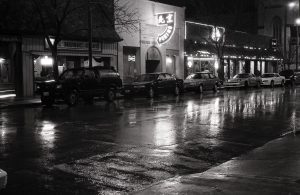
“Ninth Street in Rain” 1998
It is an effort to try and remember everything that was located on this beautiful stretch of Columbia’s Ninth Street in the late 1990s. This photograph helps. On the far left was Billiard’s, before it moved to Broadway. Next was The Music Café, followed by the restaurant with my favorite neon sign ever to grace a Columbia eating establishment, Peking. The next address after Peking was Quinton’s, then there was a comic book and gaming store whose name escapes me, and finally on the corner of Ninth and Cherry was a clothing store called Te Shurt. If you have been following my weekly, Friday morning posts of nocturnal Columbia photographs, you will already know that I was long fascinated with this stretch of South Ninth Street, coming back several times in different seasons and in different weather to photograph this particular block.
This image was taken on black and white film on a raw, rainy night in February or March of 1998. It was one of those evenings where, after a brief dalliance with warm weather, the meteorological powers that be seem to lose faith in the concept of spring and declare a mandatory return to winter. A week or two later, this stretch of Ninth Street was covered in snow.
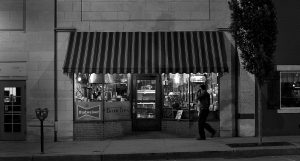
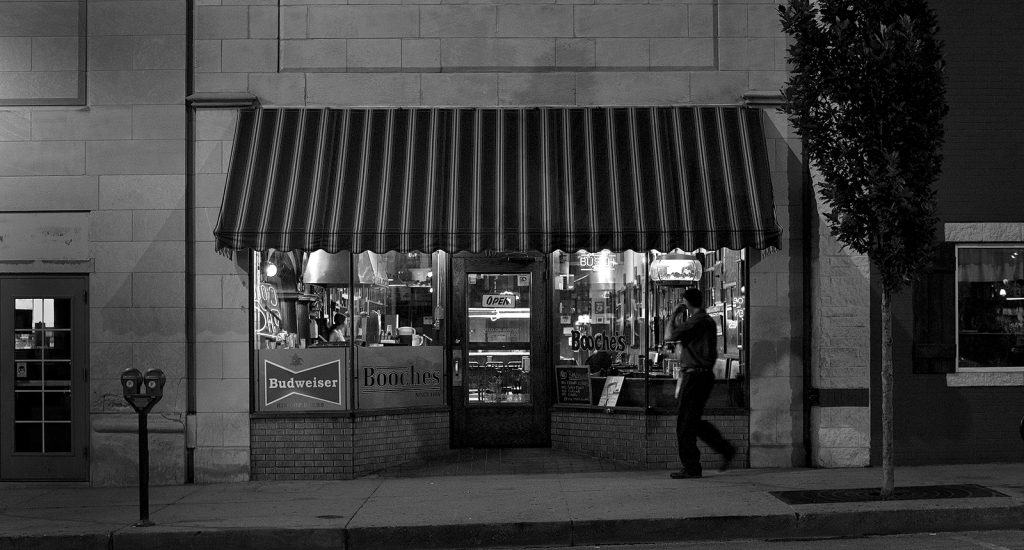
ON THE COVER “Booches on a Summer Night” South Ninth Street – June 10, 2014
Even after living in Columbia for nearly 25 years, I haven’t taken that many photographs of Booches. I know that Booches is a unique and historic business in Columbia, with many devoted patrons and burgers that hover somewhere just shy of a mythical quality, but the front of the building is so hard to photograph because Ninth Street is usually full of parked cars, blocking any meaningful photographic vantage point. A few weeks into summer break on the calendars of our three collegiate institutions, and this problem resolves itself. Columbia loses some of its scholarly residents, and parking spots and empty streets appear everywhere across the city.
This photograph was taken on June 10, 2014, one of the very few times I have had a clear view of Booches with no cars parked in front. There is a significant amount of history tied up in this establishment and in its founder, Paul “Booch” Venable. The buildings to the left and the right of Booches also have their own histories … the imposing Hall Theatre to the left, and a now-demolished building to the right. I think I will save these stories for another day. I am not completely sure that this image is finished. … I think with some work I could bring a little more out of it, but for now, here is Booches on an early summer night in 2014.
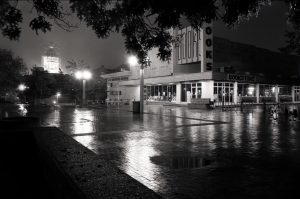
“Summer Rain on Lowry Mall” 1996
In 1996, I lived in a rented house on Anthony Street, very close to the campus at MU. Because I occupied a very small bedroom, because we had no air conditioning, and because I had a lot of free time on my hands, I wandered around Columbia a lot. In January of 1996, I enrolled in a basic design class at MU and in a beginning photography class at Columbia College. After a semester of taking both classes while working as a baker in a local bakery, I was certain of several things: Taking a class was more engaging than simply working a job, photography spoke to me on several different levels, and Lowry Mall at MU was the most visually intriguing public space I had discovered in Columbia since moving here in 1995.
Using black and white film and a manual focus camera, I took this photograph of Lowry Mall on an evening in June, just after a summer rainstorm had moved through and left everything clean, wet, and reflective. Campus was empty, the students having all gone home for summer break. The Missouri Bookstore was still a presence on Lowry Mall, serving as an alternative to the University Bookstore, and its vintage signage broadcast its wares in several different fonts. McDonald’s was still located on Lowry Mall in 1996, and the distant dome of Jesse Hall was scaffolded for renovations. This photograph also reminds me of some of my early inspirations in photography, including André Kertész, Josef Sudek, Brassaï, and Henri Cartier-Bresson.
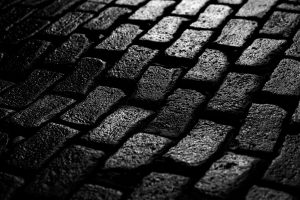
“Short Street” 2011
Of the many things we take for granted, some are just beneath our feet. These are the well-worn pavers of Short Street, a downtown Columbia street whose original path now lies beneath a hotel and a parking garage. In 2009, I came back to photographing downtown Columbia after a hiatus. New construction was springing up and rapidly changing the skyline and the footprint of the town I had called home since the mid-1990s. My photography work during the late ’90s and early 2000s had been an artistic and visual exploration of the downtown area, but in 2009 I was motivated by a desire to document the community I had known for 15 years. My approach to night photography became more methodical and more literal. Except for the occasional image like this: a portrait of a group of mist-bedecked pavers on a cold night, taken just a few months before development began on the Short Street Parking Garage and expansion of the adjacent hotel. According to some fairly reliable sources, these pavers were saved before development began on this site and were taken to a city storage facility for possible future use in a downtown street project.
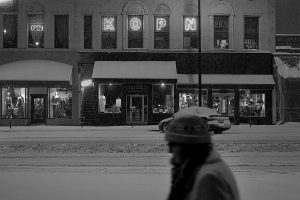
“KOPN on Broadway” 2011
This photograph is as much about the weather as it is about the glow of the neon letters on the other side of Broadway. This was taken in January, during the magically snowy winter of 2011. This was the second or third in a series of snowstorms that eventually brought Columbia to a new record snowfall total for the season. These same snowstorms made downtown Columbia a wonderfully transformed environment for night photography, and I recall several outings during these storms for the purpose of photographing a very cold and snowy Columbia. This image was made on the 900 block of East Broadway, right across the street from where the KOPN studios were at the time. I had seen this view of Broadway many times and was convinced that this was something that needed to be documented. I took several photos of this scene before a woman walked by, dressed for the weather and wearing a very warm-looking winter hat. Had she not walked through the image, this would simply be a very documentary-style photograph of the north side of the 900 block of East Broadway at night. Her passage added the poetry that my initial images were lacking.
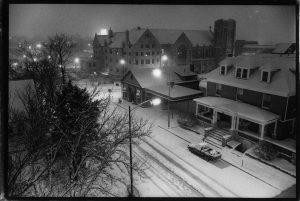
“Tenth and Locust in Snow” CC’s City Broiler and the former Elks Lodge, South 10th Street – 1999
This photograph represents a departure from some of the work I have been sharing lately, both chronologically and stylistically. In this image, we step further back in time on a corner of Columbia that has completely changed in the last 25 years. Here we are in the Cherry Street parking garage, looking out over the corner of 10th and Locust. At this point in Columbia’s history, CC City Broiler occupied the former bus station on the corner, and the long-ago Elks Lodge at 121 S. 10th St. is an apartment building with a single pickup parked out front. On the opposite side of Locust rises the immense gothic revival stonework of the Missouri United Methodist Church, its windows darkened on this snowy night. In the distance, obscured by snow, the chimneys of the university power plant blink quietly, while the dome of Jesse Hall stands as a beacon in the storm. To our immediate left is a group of residential houses that once stood on South 10th Street.
This photograph is not only a window into Columbia’s history, but it was also executed in a now historic method of photographic capture: film. Film is the reason that this image is not tack sharp and crystal clear. Film is the reason for the slow shutter speed that allows the falling snowflakes to blur in clusters around the streetlights. Film is the reason for the grainy appearance to the dark, winter sky, the grain structure of the film sometimes confusing itself with the snow in the air.
Film gives this image a slightly more poetic look, like an illustration out of a storybook for children. In this storybook, I remember taking long walks across nighttime Columbia from the public library to my rented house in East Campus. Passing the corner of Locust and 10th, the delicious smell of oak wood being fired in the ovens behind CC’s City Broiler conjured visions of a decadent steak dinner being served in a warm, dimly lit restaurant. This is one of the few images I have taken that captures a night in Columbia in a poetic or fairy tale fashion, and it was made at a time when my own artistic vision was less realistic but truer.
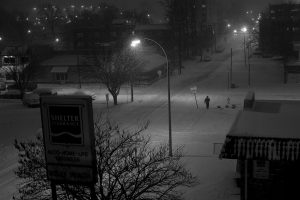
“Snowy Night on Hitt Street” 2002, Hitt and Locust
This is an image that performs better when you don’t enlarge it. I have tried to view this photo as a large image that fills the screen and as a tiny image that occupies only a thumbnail of space. And its sweet spot is somewhere in between. To enlarge it is to lose the fantastic magic that is the snow falling across this nearly deserted intersection of two downtown Columbia streets: Hitt, moving traffic and pedestrians north and south, and Locust, funneling the same foot and vehicle traffic east and west. Somewhere between too small and too large is the perfect size for this photograph, a size that preserves the detail of each flake of snow as it crosses the path of the streetlight, a size that allows the viewer to distinguish the poise and purpose of the walker’s arm as he trudges confidently southward, and a size that does not attempt to exploit the magic of a scene that could be taken from a children’s fantasy book, or an upended snow globe, or a Russian novel. Keep this image small when you view it. This is also an image to which, I must confess, I find it difficult to confidently ascribe a date. Was this taken in 2002, or in 2011? Was I standing on the corner of this parking garage in a snowfall with a film camera or with a digital camera? This particular vantage point was one of my early and favorite locations from which to photograph downtown Columbia, and my first roll of night photography slide film included an image taken here in 1996, when University Market occupied the southeast corner and Bambino’s and International Café were on the opposite side of Hitt. This photograph is less about the buildings and businesses that occupy these corners, and it is much more about the emptiness of the scene, the softness and quiet rendered by a nocturnal snowfall, and the lone, striding figure, bringing movement and meaning to an otherwise uninhabited composition.
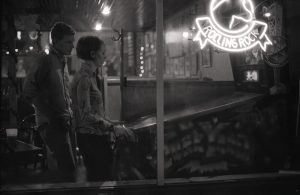
“Playing Pinball at Shakespeare’s, Winter 1999” 1999
This photograph was taken at a time in our local history when Shakespeare’s was a nighttime hub for art majors, painters, musicians, bartenders from Shattered, J-School students, and photographers. It was also a time when “Shakespeare’s” only meant the original Ninth Street location and there was no confusion about what you meant when you said, “Meet me down at Shakes …” This was taken on a weeknight, probably in early December, when the nights were just starting to get cold and the windows of Shakespeare’s exhibited a beguiling perspiration formed of rising dough, pizza ovens, the warmth of hungry patrons, and the rich effervescence of pitchers and cups of freshly poured beer.
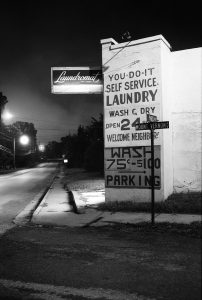
“Paris Road Laundromat” 2002
We have now reached the end of my collection of images selected for our Nocturnal Visions exhibit at Columbia College’s Larson Gallery. The exhibit was proposed and planned by Kevin Dingman back in 2022 and features nighttime photography work by Notley Hawkins, Dingman, and me. I wanted to let everyone know that I will be donating 20 percent of any of my own print sales to the local nonprofit Como Mobile Aid Collective. I also wanted to say that my photography work now has a permanent home at stephenbybee.com, a website talented local web designer Natalie Feibish is building each day as I post these gallery images. She will be adding to the website when I have a free moment and can send her the content to develop.
On November 1, I began posting one image each morning from my collection of 17 prints selected for the exhibit. We are now finishing this exercise with the last image in this series, the Paris Road Laundromat. I made this photograph in August or September of 2002, when this beautifully adorned structure on the corner of Paris Road and Mt. Vernon Street was officially decommissioned and closed. Like so many things in Columbia, this was a building that I passed by on a regular basis, always admiring the signage and the character of the building, but never stopping to make a photograph. When I learned that the Paris Laundromat was going to be closed, I made a determined effort to document the structure, and all of its glorious signage, before it was permanently changed.
This photograph was taken with black and white film, using a tripod, while standing in the middle of Mt. Vernon. Fortunately, the street doesn’t get a lot of traffic at this time of night. It looks like I was using a 35mm manual focus lens, and I stayed for a while to get multiple views of the building. For those of you who might have seen this image before, I have posted it to Facebook, and when I did so, I had so many people post personal memories and recollections of coming here to do their laundry, or to study while their laundry dried, or to drink beer while their laundry dried. This corner laundry was apparently a community hub in this northeast Columbia neighborhood. My approach to making this image was a little less artistic than some of my previous work and was closer to the documentary approach taken by American photographer Walker Evans. I was more concerned about documenting the structure and everything it had to advertise and was less interested in making a fine art piece.
Of the many views of our city that I have photographed since starting back in 1996, this is one of the views that I am happiest to have preserved. A week later the business was closed, the doors were locked, and the signs were being removed or painted over.
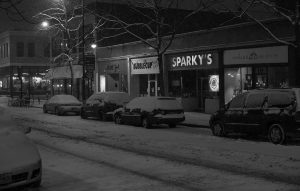
“Snowfall on South Ninth Street” South Ninth Street, January 2011
We are back on Columbia’s South Ninth Street again, during a January snowstorm in 2011. While some of my earlier images of South Ninth Street focused on the east side of the street, this photo gives us a view of the west side of the street, including several retail storefronts and two very prominent corner buildings. If we work our way north building by building, starting from the south (or left) end of the photo, our retail tenants on Ninth Street at the time included Tiger Spirit on the southwest corner of Ninth and Cherry, Kaldi’s Coffee on the northwest corner of Ninth and Cherry, Mustard Seed, Bubblecup Tea Zone, Sparky’s, and Makes Scents. Of these six retail tenants, four are still thriving 14 years later, while Mustard Seed and Kaldi’s are no longer with us on Ninth Street. The space occupied by Kaldi’s since 2007 is now inhabited by locally owned Shortwave Coffee, and the storefront once known as Mustard Seed is now occupied by Makes Scents. And those prominent corner buildings I referenced? Well, they both have more than one name, depending on whom you ask, and they both occupy their respective corners of Ninth and Cherry.
On the southwest corner sits the stately, yellow brick building known as the Virginia Building. An immense amount of work was done on this building in the early 2000s to restore its former architectural majesty. Built in 1911, the Virginia Building is, according to architectural historian Deb Sheals, the only Columbia building with bricks of this particular color and finish. For a brief period during the 1960s and 1970s, this building was renamed Strollway Center after a remodeling altered the exterior, covering much of the original brick with metal siding and converting and consolidating the once autonomous storefronts into an urban mini mall connected by a central hallway: hence the epithet “Strollway.” The historic rehabilitation of the structure in 2000 and 2001 removed the changes wrought on the building 40 years prior and restored the building to its original appearance. Across Cherry Street from the Virginia Building is the slightly older, slightly smaller, but equally historic Ballenger Building.
I have heard this building referred to as the Ballenger Building, The Troxell Building, The Paramount Building, and the Kaldi’s Building. Built in 1892, it has housed a variety of retail tenants on the ground floor, including Troxell Furniture and Caskets, Ballenger Stove and Implements, a realty company, a Safeway grocery store, a flower shop, Glenn’s Café (one of their several locations), and Kaldi’s Coffee. And the basement tenant of this location, the inspired French alchemist who once brewed and bottled delicious elixirs from spring waters once flowing freely on this site … well, Rene Butel is a story for another post, and another day.
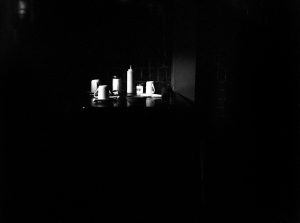
“Lucy’s Diner After Hours” Lucy’s Diner Interior, May 2011
Photographed on a quiet evening in May 2011, this intimate view of the interior of Lucy’s Diner was taken through a window, after hours. Lucy’s was located on the southwest corner of Sixth and Broadway in downtown Columbia. Now occupied by El Oso, this corner was long the home of Ron’s Country Boy, a well-established diner in downtown Columbia when I moved to town in 1995. In fact, Ron’s Country Boy had been serving steak and eggs and hot cups of coffee on this corner since 1981. When the restaurant changed owners and became Lucy’s, little else was changed, including the menu and the restaurant’s interior. The swiveling stools at the counter were an iconic feature of Lucy’s Diner, and everything on the countertop is positioned and ready for the next day’s breakfast crowd. This photograph offers an interior view of a cherished Columbia eatery after hours and preserves a small slice of our community’s visual history.
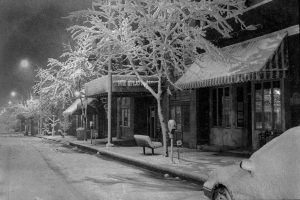
“The Blue Note in Snow” Blue Note and North Ninth Street Late Winter Snowstorm, 1998
I have not shared this photograph in a very long time. Not on my website, not in a social media post, and not in a gallery exhibit. This photograph was one of the prints displayed in a three-person photography exhibit at Orr Street Studios. I took this photograph during a life-changing winter storm in March 1998. It was the kind of winter storm that takes a community by surprise, with everyone thinking that winter is over and that the warms rains of March and April are soon to follow. The snow started falling around 8 p.m., but I decided to wait until it was serious, leaving the house at 10:30 p.m. with two cameras, three or four rolls of film, and a tripod.
Navigating the empty streets of downtown Columbia, I chose several locations to set up my tripod and to take a few photos. After a couple hours in the cold, and with the snowfall intensifying, I decided to head home. On my way home, I was captivated by this vision of the trees on North Ninth Street. At this point, the tripod was becoming cumbersome, so I switched over to my handheld option — a late 1960s Pentax SP loaded with 3200 speed film and sporting the only Pentax lens I had, a 50mm f 1.4. This photograph and several others were captured handheld with this camera and lens combination, something I rarely did at that time in my creative career.
In 1998, Trattoria Strata Nova occupied the storefront under the awning, followed by The Blue Note. Dryer’s Shoe Store and Leo’s were on the next block after the alley, along with several businesses whose names and memories escape me. Despite the fact that I have not publicly shared this photograph in 28 years, the image is very important to me. The night on which it was created was a watershed moment in my creative journey as a photographer, and it reinforced a lifelong appreciation for the beauty of winter. This photograph, and all the photography on my website, is evidence of a long-term project and a slow-motion love letter to the streets and stores, the buildings and alleyways of downtown Columbia. A love letter I have been writing and correcting, improving and revising, since 1998.