

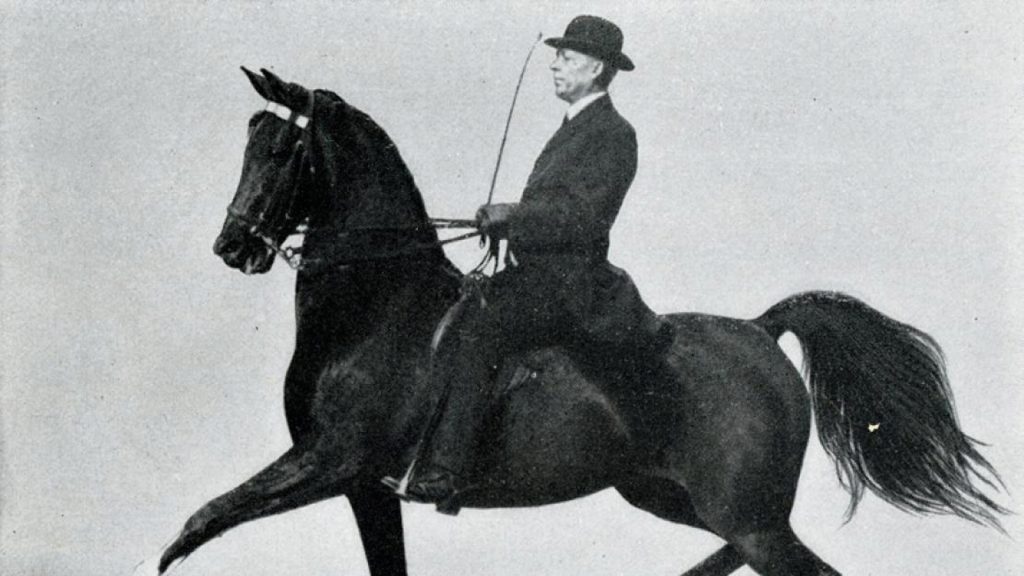
Before Jackie Robinson ever donned a Dodger uniform
— there was Tom Bass.
Before Rosa Parks ever demanded a seat in the front of the bus
— there was Tom Bass.
Before Martin Luther King ever had a dream
— there was Tom Bass — the Black horse whisperer.
Born a slave, the friend of Presidents, the most famous Black American horseman this country has ever known, today his story is consigned to oblivion. Yet, once his name was a household word synonymous with equestrian feats of unparalleled beauty
and achievement.
But he didn’t start out famous. He started out in chains.
– Written by CuChullaine O’Reilly
Tom Bass was one of the most extraordinary talents to ever come out of Boone County, Missouri. And yet, unless one is familiar with equestrian feats of the late 19th and early 20th centuries in America, or a fan of American Saddlebred horses, most mid-Missourians have never heard of Bass.
Tom Bass was born on January 5, 1859, in a slave cabin on the 5,000-acre Eli Bass Plantation in southern Boone County near Ashland. His mother, Cornelia Gray, was a slave, and his father was a 22-year-old white man, William Hayden Bass, the son of the plantation owner, Eli Bass. Tom was born just four months after his father married Boone County society belle, Irene Hickman Bass.
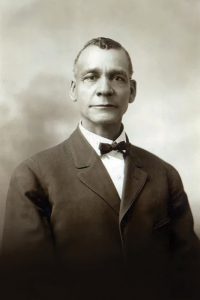
When Tom was no more than 2 or 3 years of age, it was said that, to the horror of farmhands, he was playing in the bull pen — the bulls unbothered by the toddler’s presence. By the time Tom was 4, he was riding horses so large it was said he could have walked under their bellies without his head being touched. At the age of 9, Tom had taught the family mule to canter backward — a skill unheard of for mules. The young boy was already developing a natural and special talent that would bring him fame and fortune as an adult.
In the spring of 1878, 19-year-old Tom left the Bass plantation for Mexico, Missouri, to take a job as a hotel bellhop. It was in Mexico that Tom would eventually open his own training stable.
As the years passed, Tom earned a reputation as a fair and honest man whose training methods produced remarkable results with horses — attracting wealthy and prominent individuals from across the country to his stable. Theodore Roosevelt journeyed to Mexico to ask Bass to provide him a well-trained mount for the New York bridle paths. Queen Victoria invited him to London in 1897.
Despite the prejudice he often encountered at horse shows, Tom would earn tremendous personal and professional respect from statesmen and leaders all over the world — unheard of for an American Black man in that era. President William McKinley came to his home, as did William Jennings Bryan. On one of his visits to the Bass home, “Buffalo Bill” Cody brought along a young Oklahoma cowboy named Will Rogers.
In 1892, Tom moved to Kansas City, Missouri, where he opened the Tom Bass Stables at the corner of 39th and Main streets. In that same year, when the Kansas City Fire Department needed a way to raise funds, Tom suggested a horse show. The horse show eventually became the American Royal — one of the biggest horse shows in the United States and one of the three jewels of the Saddlebred Triple Crown. Unsurprisingly, Tom Bass was the first African American to exhibit a horse at the American Royal.
In 1893, Tom showed horses at the World’s Columbian Exposition in Chicago and won the championship on his Saddlebred mare, Miss Rex. Tom later moved back to Mexico and continued training horses. In 1917, it was estimated that over 1 million people had seen him perform with his horses. He was credited with making Mexico, Missouri, the “Saddle Horse Capital of the World.”
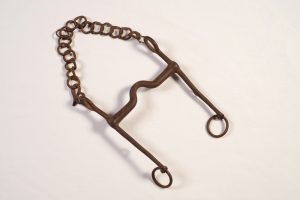
Besides the legendary Rex McDonald and other Saddlebreds, Tom trained the notable high school horse Belle Beach, who could bow, curtsy, and dance. He invented a curb bit that became known as the “Bass bit.” It was designed to give the rider control without causing pain to the horse.
Interestingly, Tom never patented the invention. The Bass bit is still in use around the world. For his contributions to the state of Missouri, Tom was posthumously inducted into the Hall of Famous Missourians in 1999, becoming the twentieth person so honored. Tom is also featured in the American Saddlebred Museum in Mexico, Missouri, and the American Royal Museum in Kansas City.
Bass died of a heart attack on November 20, 1934, at the age of 75. His friends believed that grief from the recent death of Belle Beach, one of his best horses, contributed to his death. Bass is buried in the Elmwood Cemetery in Mexico, Missouri. His tombstone reads, “One of the World’s Greatest Saddle Horse Trainers and Riders.” Upon Bass’s death, the legendary humorist, Will Rogers, devoted an entire newspaper column to him, saying in part:
“Tom Bass … aged 75, died today. Don’t mean much to you, does it? You have all seen society folk perform on a beautiful three- or five-gaited horse and said, ‘My, what skill and patience they must have had to train that animal.’ Well, all they did was ride him. All Tom Bass did was train him. He trained thousands of horses that others were applauded on. A remarkable man, a remarkable character.”
It is an understatement to say Tom Bass’ America was a vastly different country than the United States we know today. But there are some apt comparisons that help to illustrate the importance and fame of the horseman from Boone County, Missouri. One-hundred years before 20,000 fans would fill college and professional basketball arenas, or 70,000 fans would fill football stadiums, tens of thousands of spectators attended horse shows in towns across the country.
Tom Bass’ name was in the sports pages for decades and long before we had heard of Jackie Robinson. Could it be fairly said that Bass was to the American Saddlebred what Michael Jordan is to basketball? I believe the answer is “Yes.” Could it be said that Bass’ training methods and accomplishments in that field could be compared to the coaching of legendary UCLA basketball coach John Wooden? I believe the answer is “Yes.”
Tom Bass was not only honest and authentic, he was a man of integrity, an educator, a trainer, and a friend to thousands — he was a superstar.
For more information on this local legend, purchase the book Whisper on the Wind, The story of Tom Bass — Celebrated Black Horseman, by Bill Downey. The book is available on Amazon but can also be purchased locally in the museum gift shop at the Boone County History & Culture Center in Columbia.
(Primary and secondary source material for this article comes from Whisper on the Wind, The Story of Tom Bass — Celebrated Black Horseman, Bill Downey, The Boone County Historical Society, The State Historical Society of Missouri, CuChullaine O’Reilly of the Long Riders Guild, Will Rogers’ syndicated writings, public records, The Audrain County Historical Society, The Kansas City Star, and The Mexico Ledger.)