
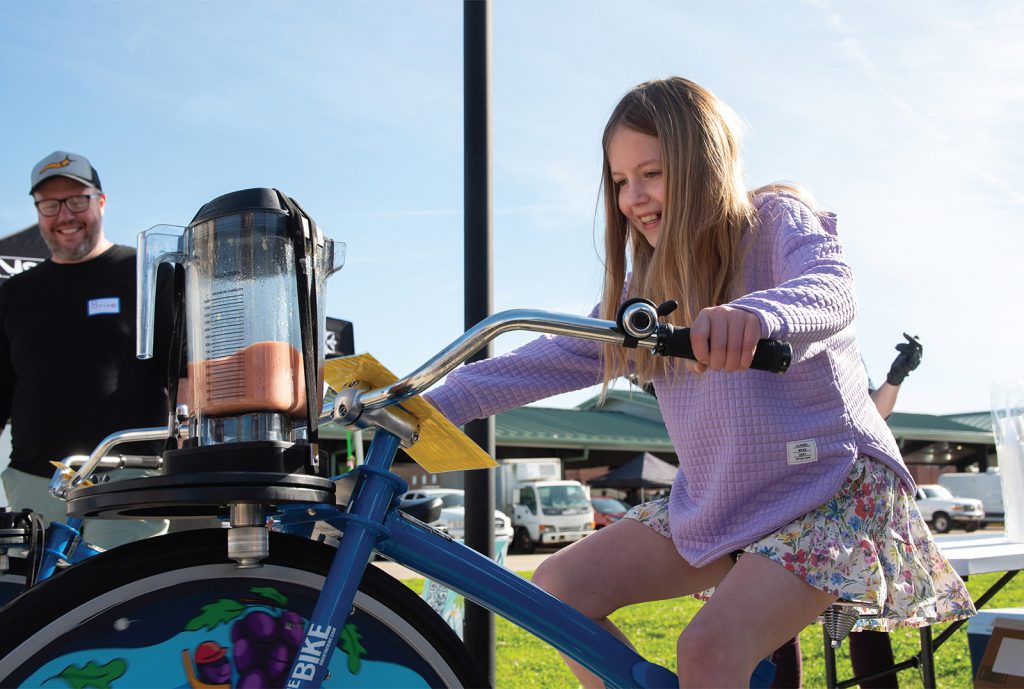
A child rides one of Local Motion’s blender bikes at the Farmers Market during Bike, Walk & Wheel Week, May 2025. The blender bikes are stationary bikes equipped with a blender attachment that spins when riders pedal.
For Local Motion, Columbia’s transportation future starts with a simple idea: Build for the people who need it most, and everyone benefits..
Getting around a city is often described in terms of moving from point A to point B. But behind the routine route to work, school, or the grocery store is something bigger: Can a person move through their community safely, independently, and on their own terms?
That question sits at the center of Local Motion’s work in Columbia and across the state. Founded in 2000 as the PedNet Coalition and rebranded in 2021, Local Motion is working toward making Columbia a more livable city for all.
“Local Motion is an active transportation advocacy organization,” said CEO Mike Burden, who has led the organization for a little over a year. “We promote policies and run programs that make Columbia safer, more connected, and more accessible for people who walk, roll, bike, and ride transit. Everything we do is guided by those things.”
As the city of Columbia works through a strategic planning process, an updated Complete Streets policy, and major infrastructure projects like the I-70 improvements and Business Loop revitalization, Local Motion leaders are seeing a rare window to shape what the next few decades can look like.
To Burden, equal transportation access unlocks a more vibrant, healthier, more connected community, created in part by the small moments of contact that happen when people share a sidewalk, a bike lane, or a bus seat instead of passing each other in separate, isolated cars.
“That grows our empathy muscles and makes us feel more connected to our neighbors,” Burden said, “which is absolutely a good thing.”
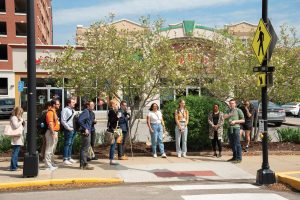
Participants at the Moving Missouri Forward Summit participate in a walk audit in downtown Columbia Missouri (April 2025)
THE CASE FOR BUILDING FOR EVERYONE
Local Motion’s philosophy for a more livable city is a simple idea: Infrastructure designed for the most vulnerable users ends up serving everyone. Chief Development Officer Josh Parshall echoes the framing that mobility isn’t a nice-to-have; it’s foundational to how well a community functions.
“When we talk about livability, we’re talking about people of all ages and abilities being able to get around easily in the way that works for them,” Parshall said. “We’re talking about people who can’t afford a car being able to get to work, being able to access healthcare and healthy food.”
A wide, welcoming pedestrian refuge island that gives an older adult enough time to cross a busy street also works better for a parent pushing a stroller. A protected bike lane meant to make a nervous new rider feel safe also makes the street calmer and more predictable for drivers. And reliable, affordable public transportation means fewer cars competing for the same lanes and the same parking spots.
“When you build with schools and kids in mind, it benefits the entire community,” Parshall explained. “When you build for disability in mind, that’s going to benefit the entire community. These things don’t need to be in competition with each other. We can live harmoniously. The good for one is the good for all.”
For Parshall, that logic extends past streets and sidewalks into nearly every issue people may care about. Access to healthcare depends on being able to get to the doctor. Physical fitness depends on people having safe places to walk or ride a bike and the ability to get to where they want to be active.
“If you look at things like food access, transportation matters. If you look at education, transportation matters. If you look at workforce, transportation matters. It connects us to where we want to go, and it connects all these issues,” Parshall said. “Whatever your issue is, transportation plays a role there. Part of the puzzle is making sure that everybody can get where they want to go.”
COMMUNITY IN MOTION
Throughout the year, Local Motion presents programming that integrates its community and awareness principles. Slow group rides like Bikes, Bites & Brews in the spring and Vélo Vino Vici in the autumn wind through downtown businesses and bars. The group’s annual Week Without Driving campaign invites people to leave their cars behind for even a single errand — such as a grocery run by bus or a commute by bike — and reflect on the experience. More recently, Local Motion has taken on mid-Missouri’s iCan Bike Camp for the first time.
Beyond their bite-sized advocacy, events are a chance for people to test out a new way of getting around and meet neighbors who share a similar interest. Former Local Motion board member Patricia Weisenfelder and her family have participated in and volunteered at the springtime Bike, Walk & Wheel Week for years, alongside other events. This year’s Mother’s Day ride at Twin Lakes offered a walk, a short ride, and a longer route, which allowed her family to split up by ability and still take part together.
“It was a quick family ride, followed by a picnic,” noted Weisenfelder. “They had different options for different capabilities.”
Afterward, everyone met back at the park for hot dogs and time on the playground. Weisenfelder said the event gave her a chance to connect with other Columbia residents who are also interested having better, safer transportation and pedestrian options for getting around Columbia.
MORE THAN BIKES
Local Motion’s optimism about Columbia’s future is grounded in its past. The organization pushed for Columbia’s first Complete Streets policy in 2004, the first such policy adopted in Missouri. In 2016, its Vision Zero policy set a goal to eliminate traffic deaths and serious injuries by 2030. Both were among the earliest such policies adopted in the country.
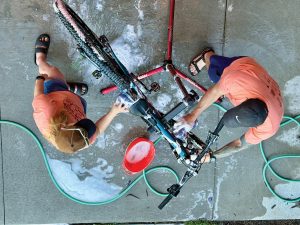
Two volunteers wash a bike mounted on a repair stand at the Wheelchair & Bike Wash at Logboat for Bike, Walk & Wheel Week 2026.
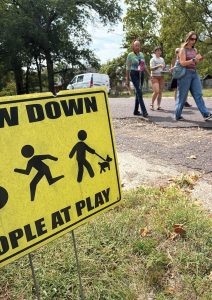
Members of Local Motion’s grassroots advocacy cohort on a walk audit in September 2025.
The National Highway Traffic Safety Administration estimates that about 40,000 people die in traffic crashes nationwide each year. In 2025, more than 15 percent of Missouri’s traffic deaths involved pedestrians, cyclists, or other non-drivers. It’s these hard facts, as much as Local Motion’s empathetic philosophy, that propel its advocacy.
Beyond Columbia’s city limits, Local Motion co-founded Missourians for Responsible Transportation in 2018 with partner organizations in Kansas City, St. Louis, and Springfield. The group extends active transportation advocacy into rural communities, where a missing crosswalk can be the one obstacle keeping a student from safely walking between two nearby schools.
For Columbia residents who mostly get around by car, Local Motion’s ask is modest: Try alternative transportation once to get into the shoes of someone who may rely on it all the time.

Local Motion
Mission: Provide walking, biking, and transit solutions to meet people’s everyday transportation needs.
Board of Directors
- Emily Piontek, President
- Jaclyn Benigno, Secretary
- Frank Schmidt, Treasurer
- Chuck Burgess
- Marlyn Whitney
- Jon Crisp
Staff
- Mike Burden, Chief Executive Officer
- Becky Reed, Chief Financial Officer
- Josh Parshall, Chief Development Officer
- McKenzie Ortiz, Advocacy Director
- Judy Steinhoff, Operations Director
Annual Events
- Bike, Walk, & Wheel Week
- Bikes & Brews
- Walk audits
- Vélo Vino Vici
- Week Without Driving
Missourians For Responsible Transportation
Missourians For Responsible Transportation is an advocacy network formed by Local Motion and partners Bike Walk KC (Kansas City), Ozark Greenways (Springfield), and Trailnet (St. Louis).
Staff
- Jackson Hotaling, Director
of Policy and Programs - Rikki Ascani, Community Engagement Director
- Cindy DeBlauw,
Program Assistant