
As fall season turns into winter, families and friends gather around tables, light candles, prepare family recipes, and return to traditions that remind them who they are and where they come from. Celebrating is just another form of love, right? We come together to honor the people who matter to us, revisit familiar memories, and make new ones.
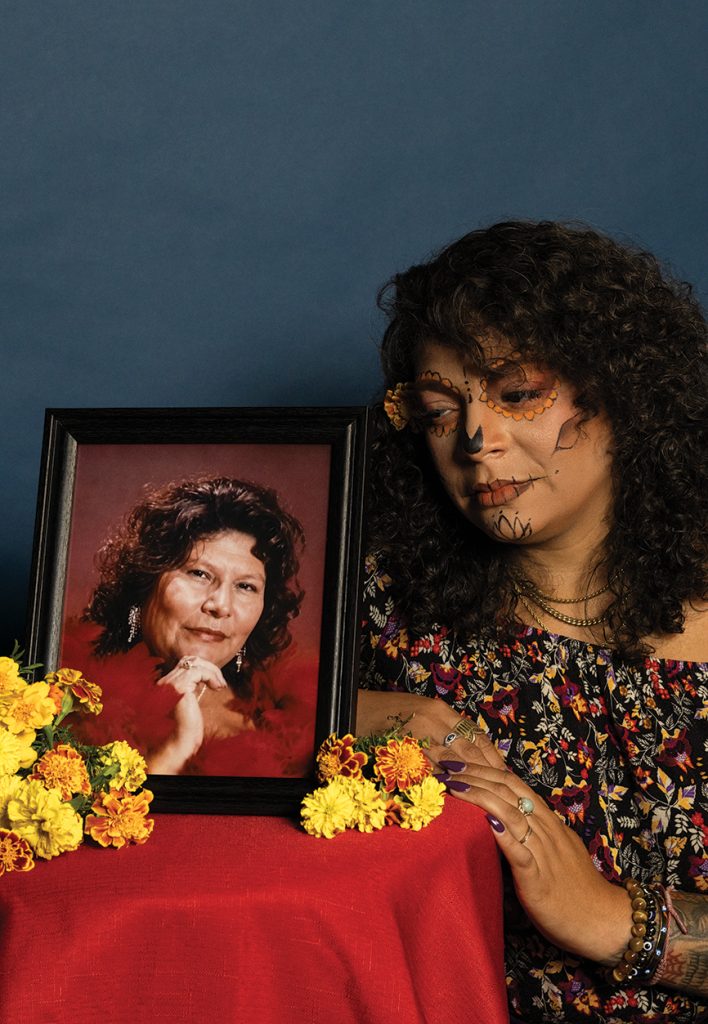
During Día de Muertos, observed November 1-2, that circle of love widens to include those who are no longer physically present. Photographs are placed on an ofrenda, or altar. Candles glow beside brilliant orange marigolds. Favorite foods and carefully chosen belongings recall a person in intimate detail: what they ate, what they treasured, and how it felt to be near them.
The imagery may be striking, but the heart of the tradition is found in the lives being remembered.
“Día de Muertos isn’t a celebration of death,” says Ashley Inez Cole, owner of La Bruja CoMo in Columbia. “It is a celebration of the lives that were lived and the love that remains.”
Rooted in Indigenous traditions in Mexico and shaped through Catholic observances, Día de Muertos varies among communities and families. Some practices pass through generations; others are rediscovered when loss makes remembrance feel more necessary.
Mariana J. Guzmán learned about Día de Muertos at school and home in Mexico City. Her family ate pan de muerto, a soft, sugar-dusted bread, and her father bought decorated sugar skulls (calaveras de azúcar), one for each family member. Although they did not build an ofrenda at home, Guzmán was fascinated by the altars she saw in public spaces.
At the time, she says, home altars were more closely associated with rural communities and states with larger Indigenous populations, including Oaxaca and Michoacán. The tradition has since become more visible in cities and around the world. Guzmán’s relationship with the custom changed, too. After her great-grandmother died, she began creating an ofrenda annually. As the years passed, she added more photographs. Choosing what to place beside each photograph gives Guzmán a gentle way to spend time with the people she misses. “Thinking of what each one would like to have is an exercise that keeps their memory alive,” she says.
Among those photographs is Guzmán’s friend Natalia, who died in an accident in 2010 at age 22 while studying to become a physician. In their last conversation, Natalia shared that she had helped deliver a baby for the first time and called it one of the loveliest experiences of her life. She wanted to help people heal, and, as Guzmán remembers, that is exactly what she did during her short life.
“It is weird to see my friend staying the same age in her picture as I grow older,” Guzmán says, “but I love to see her smile and to take some time to celebrate her short and brilliant life.” For Guzmán, the idea that loved ones return may be more metaphor than literal belief, yet the feeling of reunion is real. “Día de Muertos brings her back to me.”
A PATH HOME
The ofrenda, filled with symbols, offers a welcoming space for the past and the present to meet. Andrea Montoya describes photographs surrounded by papel picado, pan de muerto, sugar skulls, and the treasured objects of loved ones who’ve passed. “While they’re here, they can rest, listen to our stories, and wake up the memories of them that bring them back to life in our hearts,” Montoya says.
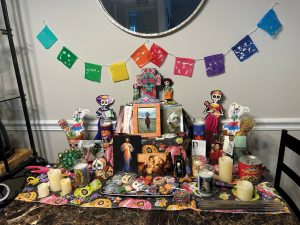
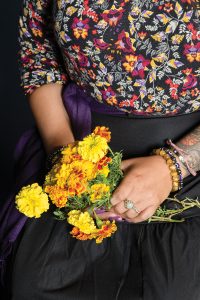
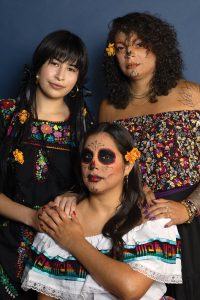
For her portrait accompanying this story, Montoya chose marigolds, festive bows, and a traditional huipil (tunic), reflecting the celebration’s Indigenous and Catholic influences. She also shared photos of an altar made by her friend and former roommate, Sofia Deatherage. Together, they create a place prepared with the care one might offer a beloved guest coming home.
Montoya’s family did not always celebrate with altars, but she hopes younger generations will preserve the practice of remembrance. Telling stories helps people know their roots and those who paved the way for their lives now. La Catrina, the elegantly dressed skeleton associated with the holiday, offers perspective: Status cannot shield anyone from death, but love and stories can remain.
In Javier Aguirre Manjarrez’s childhood memories, Día de Muertos begins with care. His family cleaned relatives’ resting places, arranged flowers and photographs, and brought favorite foods. They observed November 1 in connection with the saints and November 2 in remembrance of the dead.
Today, Manjarrez prepares his offering table during the final week of October. He arranges photographs of relatives, friends, and pets, then adds candles, flowers, and something each person enjoyed. His wife’s relatives now sit beside his, allowing the table to hold both of their histories.
At its center is his paternal grandmother, Justa Saucedo Ontiveros Aguirre, who gathered his father’s family around traditional Mexican dishes. He places her favorite fruits and candies near a prayer card and rosary she gave him, along with pan de muerto.
In Mexico, relatives cover Aguirre’s resting place with flowers, honoring her love of gardening and the animals on her farm. When visitors ask who someone is, the photograph opens a door: Manjarrez can tell them about the person beyond the frame.
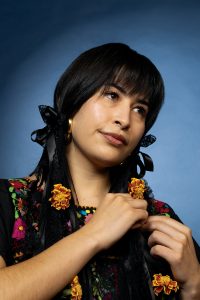
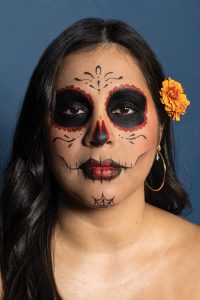
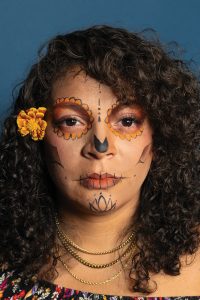
Photos by Kylie Shaw Photoshoot credits: models Andrea Montoya, Cynthia Vargas, Ashley Inez Cole. Makeup artists: Kane Kruse, Carmen Walker
A PLACE TO CARRY GRIEF TOGETHER
For Cole, Día de Muertos has also changed the way she approaches something she once feared. “I was very afraid of death as a child, and that fear stayed with me for a long time,” she says. As an adult, the celebration has helped her see that loss is not only about someone’s absence; it is also about the many ways that person continues to shape and influence us.
This year, Cole will place her mother’s photograph beside her grandmother’s for the first time. Her relationship with her mother was complicated, and she does not believe honoring someone requires pretending otherwise. The altar makes room for a fuller truth. The women before her passed down culture, stories, strength, and connection to family. They also gave Cole lessons through choices she hopes to make differently.
“I can honor my mother and grandmother while also recognizing where cycles needed to change,” she says. “I can be grateful for what they gave me while choosing to build differently where I need to.”
It is a generous understanding of legacy, not only what is inherited, but also what is learned. Placing the photographs allows Cole to say: “You were here. Your life mattered. Your story is part of mine.”
Another photograph carries a different grief. Cole, an Air Force veteran, lost a friend and fellow woman veteran to suicide. The loss divided her life into a before and an after. Día de Muertos gave her somewhere to place that grief and honor her friend’s life without allowing the way she died to become her whole story.
That experience inspired Cole to create a public Día de Muertos gathering through La Bruja CoMo at Lore Tattoo, hosted by owner Cody Finley. Transforming a tattoo shop, a space some associate with darker imagery, into one filled with food, music, culture, and welcome likewise transforms the contemplation of death into a celebration of memories, humor, and connection.
The community ofrenda is not a prop. Every photograph represents someone deeply missed. Día de Muertos invites people to bring memories and share what made that person laugh, what they loved, and what they taught others.
Topics like grief and loss are uncomfortable for most, especially in a culture that focuses on the living, but cultural celebrations offer a way into conversations many people have been taught to avoid. Friends sometimes hesitate to say the name of someone who has died because they worry they will cause more pain. From these stories, hearing a name is comforting; it means someone else remembers, too. A public altar assures people that grief does not have to remain private and that community can help carry what feels too heavy to hold alone.
Perhaps that is one of the most beautiful lessons within Día de Muertos: Grief and celebration do not cancel each other out. We can miss someone and still laugh at precious moments. We can honor an imperfect relationship without changing its truth. We can feel sorrow for the years a person did not get to live while remaining grateful for the years they did.
As participants light candles and bring familiar foods to the table, remembrance draws the past closer. It asks us to consider the people who shaped us, the parts of them we carry, and the stories we will pass forward. Love does not end simply because a life does. No matter the culture or ethnic celebration, this is the aspect woven into every human story. Sometimes it returns through a photograph, the scent of marigolds, or a favorite dish and finds a place to gather again.
Columbia’s fall and winter calendar offers many reasons to gather: to honor ancestors, welcome light, celebrate renewal, and help younger generations understand where they come from. Each tradition is distinct, yet all invite us to learn about and understand our neighbors with greater care.
For Melanie Yim, owner of Melanie Hair Studio and a volunteer at Wat Angkor Cambodian Buddist Temple in Hallsville, Pchum Ben is especially meaningful. The 15-day Cambodian Buddhist observance honors deceased ancestors, usually in late September or early October. Because it is not a U.S. holiday, Columbia’s Cambodian community gathers mainly on weekends. Families visit the temple, pray, and share foods such as num ansom and num banhchok, as classical music, chanting, and conversation mingle with the scent of incense.
Yim remembers attending the festival as a child without fully understanding the prayers. Today, English-speaking monks help younger generations learn the meaning behind each ritual. After losing her father and other relatives, Yim experiences the celebration differently: It leaves her feeling connected and at peace. She hopes more people in Columbia and the surrounding area will discover the temple and experience its welcome.
Navaratri and Diwali also bring families together during the season. Sanjeev Khanna, a University of Missouri professor and faculty adviser to the Cultural Association of India, describes Navaratri as a nine-night Hindu festival honoring the goddess Durga and the triumph of good over evil. Diwali, often called the “Festival of Lights” and celebrated by Hindus, Jains, Sikhs, and some Buddhists, celebrates light over darkness and good over evil through the lighting of diyas (oil lamps), prayers, feasts, and family gatherings.
The Cultural Association of India organizes a beautiful cultural celebration at the University of Missouri’s Jesse Hall at the end of October. The event is called India Nite, and this year marked its 34th edition. It’s a place for the public to embrace Indian culture through music, dance, storytelling, and student-created presentations. You won’t want to miss the 35th celebration next year.
The holiday season stretches toward Lunar New Year in early 2027. After that, Chinese families may welcome the Spring Festival with reunion meals, red decorations, and wishes for good fortune, while Korean families observe Seollal, the Korean Lunar New Year, with traditions such as ancestral remembrance, bows to elders, and tteokguk, a rice-cake soup. Each of these celebrations stays vibrant when its stories are practiced, explained, and generously shared.