
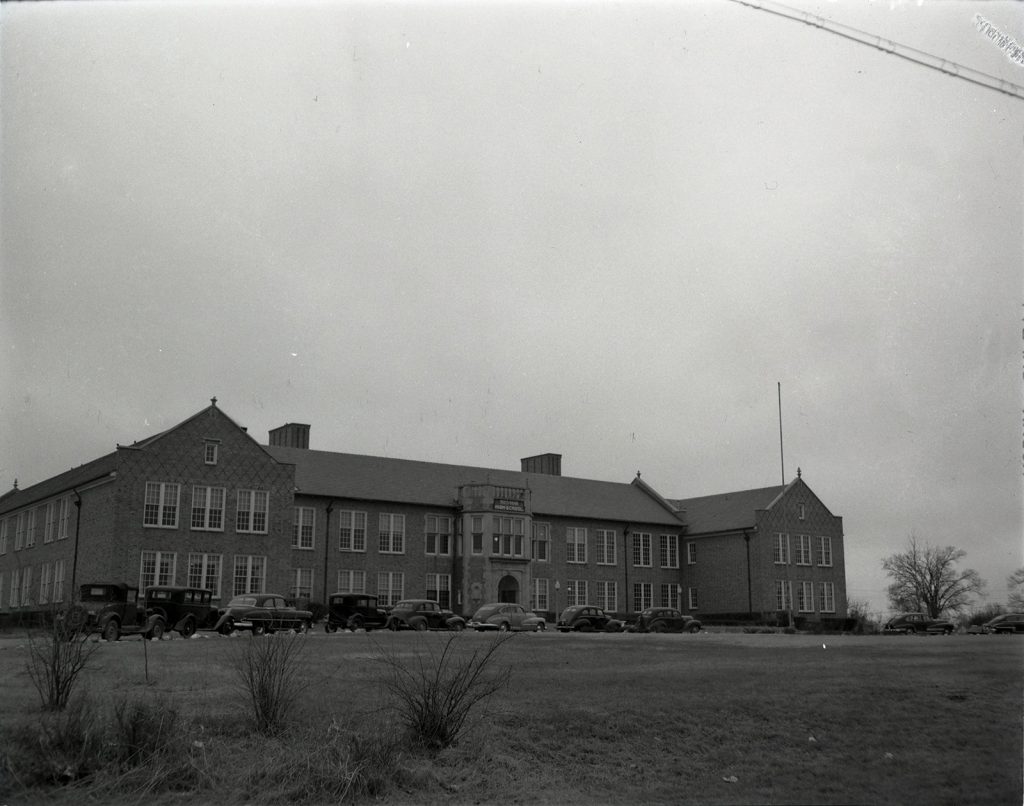
David H. Hickman High School (Burton L. McNeil
Photographs, P0025. P0025-17. The State Historical
Society of Missouri, Photograph Collection.)
Part 2: HHS works through its integration struggles and hones the “Hickman style.”
Like it or not, by 1960, all of Columbia’s Black high schoolers were now officially Kewpies. Though Hickman’s white students tended not to be outwardly racist, they weren’t very welcoming to their new Black classmates either. As John Kelly, one of the first of those classmates, would later reflect on his student days: “It was a very cold, chilly atmosphere. There weren’t really any open confrontations, but you could just tell people were tolerating you and not really welcoming you.”
With the important exception of varsity athletics, Hickman’s first Black students largely steered clear of clubs and other extracurriculars. Robert Hickem (’61), another of Hickman’s first Black students, recalled this prevailing mentality: “White folks are gonna make fun of you” for joining all-white clubs, “and the brothers are gonna ask what are you doing in there, trying to play white?” This continued social segregation within Hickman caused consternation for Battle (now a guidance counselor), a thoroughgoing believer in racial integration whose decision into a predominantly white neighborhood in the early sixties ruffled feathers both inside and outside Douglass Park.
Indeed, soft segregation persisted at Hickman for a long time afterward. As a distant minority within the student body (around 10 percent), Black Kewpies didn’t get elected to student government, get chosen as Homecoming royalty, make the cheer squad, or win any other schoolwide popularity contests. Perhaps most importantly, Black students (and their parents) lost the close bond they had with their Black teachers at Douglass; teachers who, to quote one student, “told us we could be somebody … people who shared our joy and happiness.” Hickman’s white teachers, by comparison, seemed cold and unwelcoming. (The one exception that Kelly remembers was Conrad Stawski, an English teacher whose Polish family had suffered under the Nazi yoke.)
Sensing something was amiss, Principal Kenneth Clark, Associate Principal James Ritter, and Battle encouraged the Hickman community to discuss the school’s issues in the open. They held a series of “Speak-Out” assemblies, where students were invited to speak their minds on how to make Hickman better. They met with groups of concerned Black parents at the Blind Boone Community Center. At the district level, CPS appointed former Douglass secretary Beulah Ralph to spin up a home visiting program in 1968 in an effort to improve communication with the parents of disengaged students.
By this time, Hickman and CPS were integrating in other ways, too. Bill Higdon, a white Hickman history teacher, teamed up with Muriel Battle — then, his counterpart at West Junior High — to figure out how to integrate Black history into the district’s secondary American history curriculum. Hickman even began offering a class in “Contemporary Problems.” (Using real-life issues as a teaching tool has become something of a Kewpie tradition. Current U.S. history teacher Zach Rodeman likes to teach his students about the American election process by making liberal students roleplay as real-life conservative candidates and vice versa.)
In 1968, Hickman elected its first Black Student Council officers: Tony Edwards and Donna Battle. In addition to both being exceptional students, Edwards was a Future Farmer of America and bona fide basketball star whose court exploits regularly made the papers, while Battle (daughter of Eliot and Muriel) was an all-around whiz kid whose many accomplishments were similarly publicized. If the school administration hoped that integration at the top of the class would mollify Black students’ dissatisfaction, however, others did not feel quite so blessed. As Mildred Cox (’70), argued in the pages of the Purple & Gold: “We feel that the Black male athlete is exploited, and the Black female is all but forgotten … unless, of course, she is gifted with extraordinary intelligence. What kind of opportunity does this hold for the Black student who lacks outstanding intellect, or is not capable of becoming an all star? My answer for the average Black student, Hickman holds nothing.”
In fact, the student government was suffering from something of a legitimacy crisis in the late sixties. With news of campus protests on the TV and the draft looming over them, many Kewpies wondered if their school government should be tackling issues that were more relevant to their lives. “Is Student Council to be the local candy retailer and dance fixer, and nothing more?” asked one 1969 Purple & Gold op-ed. “The decision — what should Student Council do — is up to you… CAN YOU BUILD A NEW WORLD FROM THE ASHES OF THE OLD?”
Responding to their times, Kewpies formed a number of unofficial “un-clubs” with such names as People-to-People and The Dialogue in Black and White to discuss democracy, the Vietnam War, and racial understanding. One of these groups, the Concerned Hickman Students, even tried to mobilize the school on such real-life political issues as opposing the war, supporting the city’s open housing ordinance, and lowering the voting age. Though they were unsuccessful on most fronts, they did succeed in getting Hickman to recognize MLK Day as early as 1970.
When racial tensions did boil over at Hickman, it was not due to official discrimination on part of the school. Rather, it was because Black students felt excluded from that great popularity symbol: the cheer squad. At the time, cheerleaders were chosen by student election, and in 1969, there were two Black students on the ballot. When neither of the two Black candidates made the final cut, some Black students decided they’d had enough. Around 50 of them walked out of class (“Say it loud, I’m black, and I’m proud!”) and peacefully demonstrated outside.
In response, Associate Principal Ritter suggested the protesters hash out a list of grievances, which they then presented to the school at a one-hour rally the next morning. Among their recommendations: selecting cheerleaders via a professional panel instead of popular election, a black studies class, an investigation into why no Black athletes had yet won the Joe Barnes Cup, and more soul music at school dances.
Luckily for Hickman, the administration and the aggrieved students were able to solve the crisis with tact and respectful discussion. After a few days of negotiation, Principals Clark and Ritter agreed to revamp the cheerleader selection process and expanded the cheerleading squad from six to eight girls, thereby making seventh-place Karettia Dixon the first black Kewpie cheerleader. (In eighth place? Future U.S. Senator Claire McCaskill). The students didn’t get a Black studies course (McCaskill’s opinion? “It’s expecting too much at present.”), but starting that year they could check out copies of the Autobiography of Malcolm X from the library or watch Of Black America in the school’s brand-new multimedia social studies resource center.
It is worth noting that, in other parts of the county, racial tensions in public high schools certainly did spiral out of control in that period, including an incident at Tilden High in southside Chicago that ended in tragedy when a student got shot. But that’s not the Kewpie way: After the walkout, Hickman students banded together and held “Brotherhood Week” — featuring “walk-in” raps with teachers, ministers, and local civil rights leaders — to calm things down with some peace, love, and understanding. Heads stayed cool, a compromise was made, and life carried on.
As with other public high schools, Hickman continued to grow and change in the following decades: expanding girls’ sports in the seventies, installing computer labs in the eighties, adopting a multicultural curriculum in the nineties, and so on. By the end of the twentieth century, Hickman had developed a robust Advanced Placement program and a reputation as Columbia’s diverse, downtown school. The latter came about after Rock Bridge High School opened on the far south side of town in 1973, a move that solved Hickman’s overcrowding problem for years to come.
Despite the fact that HHS now only covered half of Columbia, Hickman teachers don’t recall the school’s culture changing much after Rock Bridge opened. If anything, retired history teacher Hank Landry contends that Kewpies doubled down on their school pride after gaining a crosstown rival.
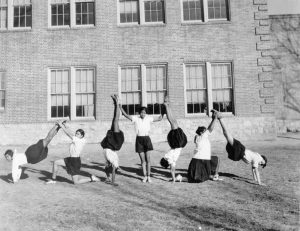
Douglass School Cheerleaders (Boone County, Missouri,
Black Archives Collection, C4057.C4057-f07-02. The State
Historical Society of Missouri, Photograph Collection.)
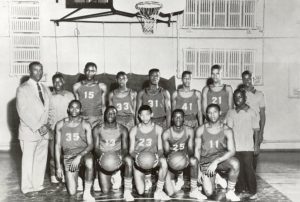
Douglass School Basketball Team (Beulah Ralph Photograph
Collection, P0516. 003157. The State Historical Society
of Missouri, Photograph Collection.)
What Makes Hickman Hickman
Listening to veteran teachers like Landry, you can make out a “Hickman style” of teaching that has contributed to its mighty academic legacy. One component of this style is teacher independence: Hickman teachers have generally always had the freedom to design their own courses. As world literature teacher Mackenzie Everett-Kennedy (’03) argues, “It’s hard to take away the voice of the Hickman teachers, we are pretty assertive compared to other schools where the principal runs the show. … We’re all fully committed because we have that.” This freedom encourages teachers to collaborate by designing shared lesson plans, team-teaching courses together, and bouncing ideas off each other.
Another factor is a faculty culture that encourages professional development: the idea that teachers need, in the words of retired world history teacher Dixie Grupe, to be “continually adding to his or her scholarship. [They need] to keep their own inner scholar alive, to model that for their own students, and to continue to become a better teacher.” A third component is a belief among Hickman’s faculty that it is a teacher’s duty to do their utmost to reach their diverse student population and to build a supportive community that will help their kids be the best scholars that they can be.
Add that all together, and you get a school culture in which teachers are willing to take risks and innovate in the classroom. A prime example of this is the World Life and Literature course, created by Grupe and Diana Rahm in the early 1990s. As Grupe explains, one of the Hickman faculty’s main preoccupations in the 1980s and ’90s “was this question of ‘When are we going to give kids a chance to synthesize something, to bring all these pieces together and make some kind of meaning that they’re going to be able to take on and use in their life?’ … Well, one of the ways you do that is by comparing and bringing together disparate silos of learning.”
Instead of teaching kids about ancient Greece in social studies class and having them read The Odyssey in literature class, Grupe and Rahm thought, why not teach them together? With support from the administration, they pair debuted a new concept in the 1992-93 school year: one writing-intensive class, two hours every day, co-taught by two teachers, that would cover world history and world literature through a multicultural lens. The class would also have an interpretative element, where students would show what they learned not just by writing essays and taking tests, but also by dressing up as a historical figure and presenting some sort of original composition during an end-of-year Extravaganza.
Despite some early skepticism (the Tribune wasn’t thrilled about Hickman students learning “the fun way”), World Life and Literature has gone on to become a Hickman institution: a sophomore-year rite of passage and most Kewpies’ first AP class. For Everett-Kennedy, who currently teaches the literature half, the course exemplifies successful Hickman community-building. Because the class meets every day, the kids have more time to get to know each other, develop a stronger rapport with their teachers, and ultimately become more successful learners. The school now also teaches AP U.S. History and U.S. Government in much the same way, and many Kewpies who go through the “block” courses regard them as formative experiences.
Beyond AP test scores and Presidential Scholars, the success of the Hickman style can also be measured by the number of Hickman teachers who are themselves alums. “The number of teachers who were graduates from Hickman is insane,” says Everett-Kennedy, “I would estimate at least 25%.”
Most of those professional Kewpies can name the Hickman teacher who inspired them to pursue a career in education: for biology teacher Shaina Van Remus (’17), it was Rodeman. For Rodeman, it was Landry. Before Everett-Kennedy became the senior World Life and Literature teacher in 2016, she was first a student of Grupe’s in the early 2000s and then her co-teacher in the early 2010s. This sort of institutional legacy, handed down from teacher to student, mentor to mentee, abounds at Hickman.
If Hickman is to thrive in its second century of education, though, it can’t just rest on its laurels. Gilzow argues that while it may be hard for some teachers, particularly those who were Kewpies, “to see that there’s any kind of slide … what we have to do is not rely on our reputation and pivot to meet students where they are, and support the ones who are not necessarily our Presidential Scholars.” Because kids sometimes do slip through the cracks. Perhaps Bob Behrens, student body president during that tumultuous 1968-69 school year, summed up the conundrum best: “Hickman High School can be a gratifying opportunity or the loneliest experience in your life. If a student wants to become involved, Hickman has much to offer. It is a little world in itself.”
He was right about that. How many other public schools have a space agency (C.A.S.A.), a literary journal (the Hickman Review), and a radio station (callsign KWPE)? But such size and diversity can be intimidating, as Behrens observed: “It’s hard to come from a small junior high school and jump into a school like Hickman with 2,100 students. These kids are scared.” One imagines that it’s even harder to come in from unsupervised Zoom classes and feel little more than a face in the crowd.
As we have seen, though, Hickman has stared down crises before and innovated its way forward. As the school looks to deal with its standardized testing problem, it has a deep well of humanistic grit to draw upon.
“The thing I like about Hickman,” says Rodeman, “is that whatever our shortcomings may be, I look around and I see people putting in long hours, and I see people giving their own time to serve students. I see people spending their own money to help their kids at school. I see people trying to hold people to account and working together with colleagues that maybe they wouldn’t always befriend outside of the building, and yet working collectively to try to do right by the kids that we have here.” And with faculty like that, this Kewpie firmly believes that grand old Hickman High will figure it out.
Now repeat after me:
Strawberry Shortcake, Gooseberry Pie
V-I-C-T-O-R-Y
Are we it? Well, I guess yes!