
‘Life of a Murder’ recounts prosecution and conviction
of a Columbia crime 34 years after the murder
Becky Doisy was wearing cut-off blue jeans, a printed blue top, and sandals as she bounded down the stairs to meet Johnny Wright for a date at 2:10 p.m. on Thursday, August 5, 1976. It was a sunny, typically hot summer day near central Columbia. Becky, who was a waitress at Ernie’s Diner, working only to meet her basic needs and to give her the freedom to write poetry and to explore her creative yen, told her roommate, “If you see my cat, put her inside the door. If not, don’t worry about it.”
Those were Becky’s last known words. The former University of Missouri student was 23.
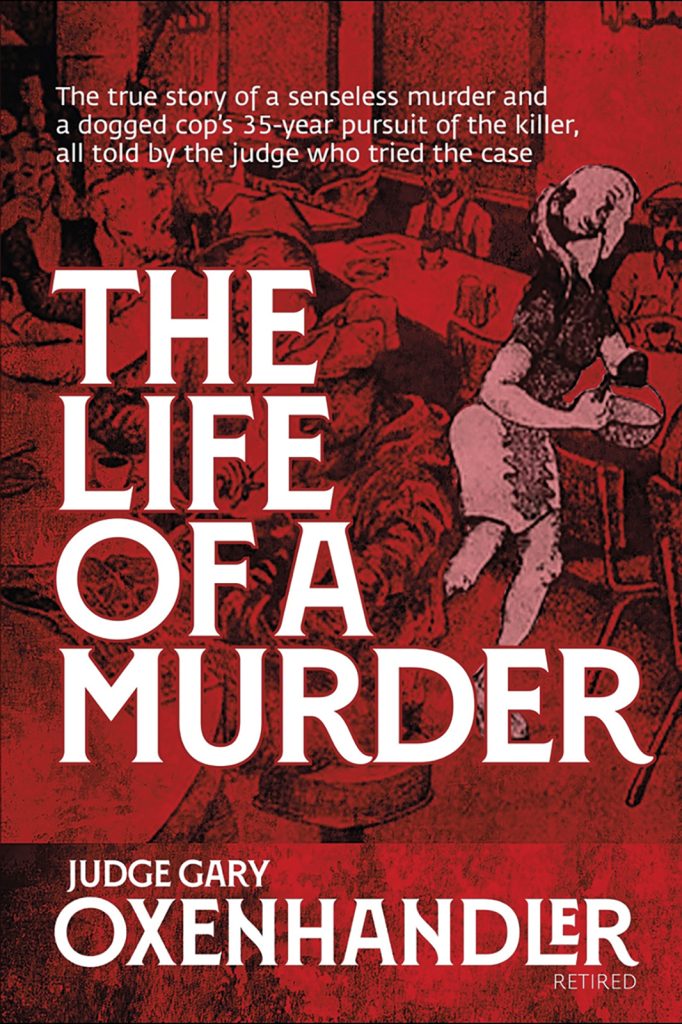
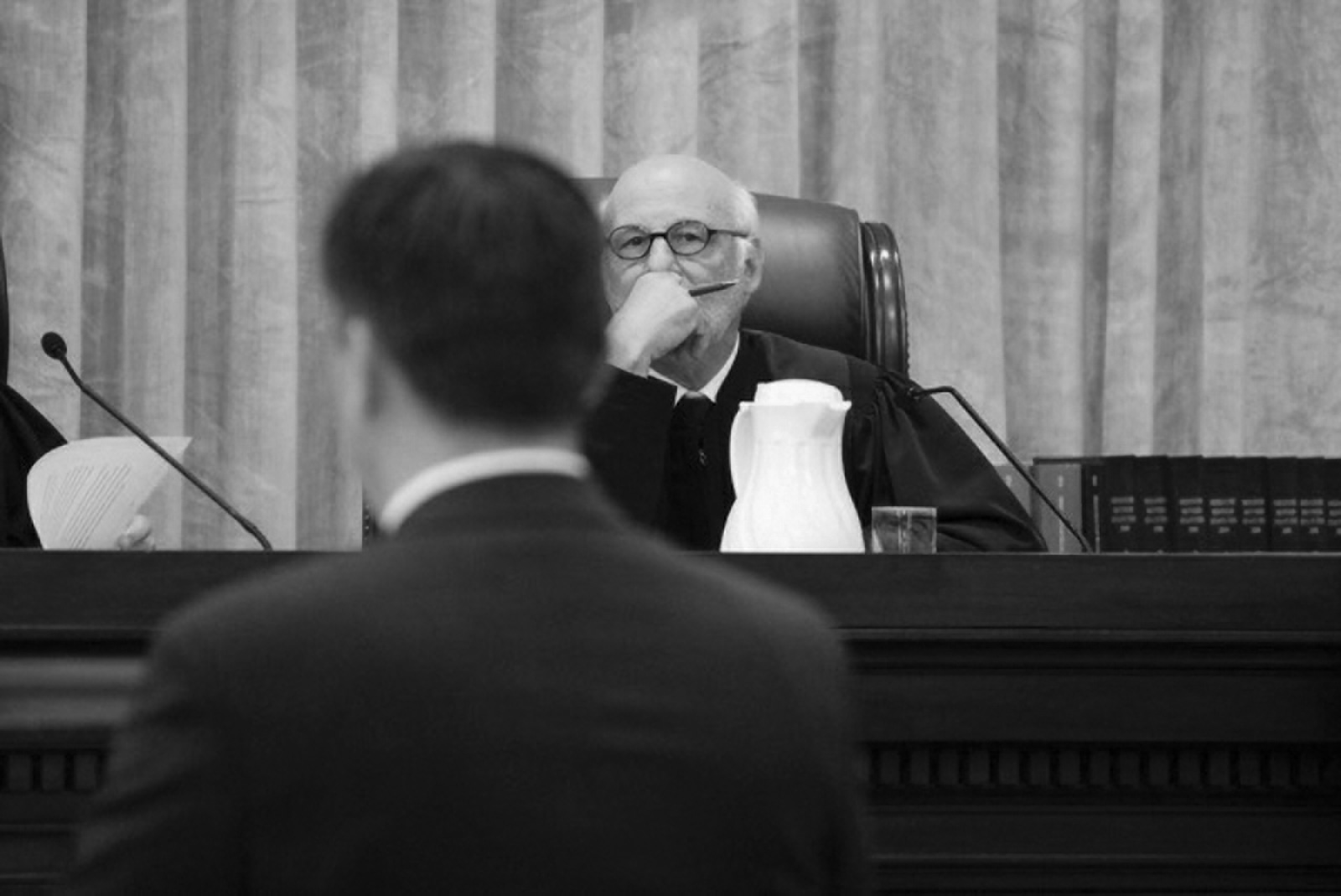
The now-retired Boone County Circuit Judge who heard the jury trial, Gary Oxenhandler, can recite those details from memory after presenting his book about the case, The Life of a Murder, to some 30 civic and professional groups – even though the verdict against and sentencing of Johnny Wright happened 15 years ago – and that was 34 years after Doisy’s murder.
From the first page to the last, the book, which was published last fall, lays out the story in remarkable documentary form, and it’s not difficult to imagine a voice-over from Dateline’s Keith Morrison or another true crime television host setting the stage, introducing the characters, and finally, encapsulating the saga in grim fashion.
“We are left with a sad irony,” Oxenhandler wrote near the book’s conclusion. “Wright’s family can visit his grave; the Doisys have no place to leave their flowers.”

‘The brief life of a talented young woman’
The book, which began as a few writings and then something longer and then a manuscript, took about 18 months to write. The original 144,000-word manuscript was trimmed to just under 90,000 words, proving that the task of deciding what to leave in was as arduous as deciding what to take out. Oxenhandler quickly admits that most of the omitted material was about him and his legal career, and how a lifetime of seemingly disparate connections came together for a four-day trial, a verdict, and the sentencing of Johnny Wright in 2011. Coming up with a title was also challenging, especially when a catchy phrase – “He paid 15 bucks to get busted for murder” – seemed to be the frontrunner at first.
“I want the reader to be part of what was going on in the minds of the investigators, counsel, and judge,” Oxenhander wrote in the introduction. “At the same time, not to be forgotten, the events depicted, front to back, tell the story of a tragedy: the brief life of a talented young woman who has now lived twice as long in her death than she did in her life. And, in the end, I want to tell the story of the Life of a Murder.”
While Life of a Murder keeps Becky Doisy and a cast of fascinating characters alive, so to speak, there’s also a bittersweet piece of art at Ernie’s that keeps Becky busy waiting table. In the book’s foreword, noted investigative journalist and author Jake Adelstein explains that when Becky disappeared, local artist Art Koch captured her spirit in a print that hangs on the east side of the diner. “In the scene, Becky is the waitress in the right foreground, forever moving through a busy Saturday morning – likely the kind of Saturday when the news of her disappearance began to ripple through the town.”
Write a book? ‘Can you do that?’
Former Gov. Bob Holden appointed Oxenhandler to fill the spot that was left vacant when longtime presiding Boone County Circuit Judge Frank Conley retired in 2002. When Oxenhandler retired after reaching the mandatory retirement age of 70 in April 2016, it ended a 43-year legal career that included a stint as a law partner with his son, Josh, a partnership that “Judge O,” as he is sometimes called, said was a highlight of his professional life.
When he was sworn in and took his seat on the bench, Oxenhandler automatically inherited about 800 cases. He says, “They were dropped in my lap.” One of those cases was a capital murder case against Michael Tisius, the only defendant he ever sentenced to death. Another case that fell into his lap was the 1976 disappearance of Becky Doisy, which had led to a murder warrant issued for Johnny Wright in 1985. The case was old and most investigators and prosecutors believed Wright was probably dead.
Until Wright, living under the name Errol Rodney Edwards in Georgia, applied for a job with the city of Lawrenceville, Georgia, using his real name, birthdate, and social security number. The $15 background check was supposed to scan only state of Georgia records, but a clerk – for some unknown reason – also ran Wright’s information against the National Crime Information Center (NCIC) database. Bingo. There was a 1985 warrant from Boone County, Missouri, charging Wright with murder.
“He paid 15 bucks to get busted for murder,” Oxenhandler wrote.
Wright was tried, convicted, and sentenced in 2011. He died in prison of natural causes in 2014. And it was a few years before Oxenhandler contemplated writing a book about the case.
“The first question I had was, ‘Can I do this?’,” he said. “The defendant was dead. The case was over. And I was retired.” He checked with the judicial discipline and review board and consulted others.
“I did my due diligence. If they had said ‘no,’ it would have stopped me right there,” he explained. As long as he made it clear that he was no longer on the bench – that he was retired – there were no objections.
The F-bomb lady
Oxenhandler pored through trial transcripts, investigative notes, and other background that he personally researched in amassing the material for the book. Life of a Murder also prominently features co-prosecutors Richard Hicks and Cecily Daller and retired Columbia police investigator Chris “Big Bird” Egbert, as well as others involved with the case. It was Daller’s opening statement to the jury that set the tone for the prosecution’s case, and the wording was immediately jarring.
“Things got f—ed up, and I had to croak the bitch.” As Daller spoke, she pointed at defendant Johnny Wright, explaining to the jury that those were Wright’s words to his roommate, Harry Moore, the night of August 5, 1976, when Moore looked into the back seat of Wright’s car and saw the lifeless body of Becky Doisy, whose throat had been slashed.
In the book, Oxenhandler gives a voice to an individual known only as Juror 53, who recounted that moment and the impact it had. Juror 53 noted, “I didn’t know you could do that in a trial. She didn’t give the appearance of being an ‘F’ bomber. It got me listening.”
Each individual presented in the book – even the worst of the worst – is not hidden in legalese and jargon. Life of a Murder seems to humanize all of them.
“It was not my intention to be anything but respectful to everybody in the book,” Oxenhandler said. “Even Johnny Wright. Even if I thought he was a monster and a killer. Nonetheless, he grew up in a way that none of us want to grow up. The poorest of the poor, in a terrible neighborhood … But I can’t tell you that it was a goal of mine to humanize anybody. It’s just their own story – and it turned out that way.”
There’s no body
Whether the case had been tried in 1976, 1985, or anytime between then and Wright’s arrest in 2011, it was, at best, a weak case. Prosecutor Richard Hicks said as much in his portion of Oxenhandler’s book. By the time the case got to him, and he selected Daller as his “second” for the prosecution, some evidence was no longer available. The two primary witnesses – Harry Moore saying he saw Becky’s lifeless body in the back of Wright’s car – and heroin addict William Simmons, who met Wright at a St. Louis methadone clinic – were admitted, lifelong liars with their own legal entanglements.
More than anything, though, there was no body. No evidence, other than Wright’s statements to Moore and Simmons, to show that Becky Doisy was actually dead. What investigators and prosecutors had discovered, however, was a burglary where Wright allegedly stole a shovel and a hoe. Hicks insisted that he needed the “burglary tools” entered into evidence. Other than coincidence, there was no evidence to pinpoint when the shovel and hoe were taken or that he used them to bury a body. The arguments for allowing and excluding that evidence are chronicled in detail in the book. Oxenhandler ruled against the prosecution, and the evidence was not allowed.
It’s still an occasional point of contention. At a July presentation to the Boone County Bar Association at the Columbia Country Club, with Daller, Hicks, and Egbert seated to his right, Judge O explained the ruling. Egbert interrupted to ask the room full of attorneys and judges to raise their hands if they thought the shovel and hoe should have been entered into evidence. The crowd erupted in laughter. While the group’s unofficial verdict was not unanimous, most hands were raised.
Incidentally, on May 20, 2016, Richard and Cecily married. The ceremony took place in Kathy Doisy’s backyard in Columbia. Oxenhandler now considers them “dear friends,” even with the good-natured ribbing over the evidence that the esteemed judge ruled out in 2011.
Upon further review?
Judge O’s copy of his book is always close by. It has pink, yellow, and pale green Post-it notes sticking out from the margins. Some of the scribbled notes say, “Knuckle dragger.” “Hicks.” “Juror 53.” The book, and the story – and the things he still wrestles with, from how much a victim impact statement should influence sentencing to understanding that sentencing a defendant is not a science – remain with him.
“I said I would listen, be respectful, and be fair and impartial,” he explained, referring to his 2002 swearing in. “I did the best that I could do.”
The shovel-and-hoe scenario might still come up in his interactions with those involved in the trial, and Oxenhandler welcomes the conversation, adding, “It’s really a fascinating issue of law.”
There’s also Wright’s failed polygraph test, which could not be admitted into evidence – though it almost happened. One of the police investigators who took the stand mentioned the polygraph, and Wright’s attorney immediately asked for a mistrial. Instead, Oxenhandler, noting that judges “always sanitize stuff for the jury,” explained to the defense and prosecutors that he would tell the jury, “There was no polygraph.”
Did he lie to the jury? “I lied to the jury,” he said, repeating that he was following the practice of “sanitizing” material for the jury, and that “it worked out perfectly.”
The alleged burglary of a shovel and hoe, the polygraph information, and even other women who Wright had been accused of sexually assaulting were not presented as evidence during the trial. And that left Judge O’s neighbor, Patricia Cole, struggling with her own, unofficial verdict. Cole wrote in the book’s post-trial chapter, “If I was sitting [on the jury] I don’t know that I could find this person guilty.”
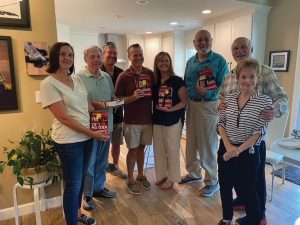
Gary and Janet Oxenhandler (right) hosted the main “players” from the book for breakfast in their home. From left, Patti Cole, Marvin Tofle, Ben White, Richard Hicks, Cecily (Daller) Hicks, and Chris Egbert.
‘They’re going to find her’
Egbert, who is now 80, is mentioned in Life of a Murder almost more than anyone else. He was filling in for another Columbia Police officer on Saturday, August 7, 1976, when a woman named Kathy Doisy dropped in to tell him that her sister, Becky, was missing. Becky’s co-workers were also worried that she had not shown up for her morning shift at Ernie’s. And so began Egbert’s lifelong pursuit of Becky’s killer and his association with the Doisy family.
He had been retired more than 15 years when Wright was finally arrested. But he had remained in touch with the new investigative team and stayed in contact with Kathy Doisy and her parents.
During his investigation, he consulted two psychics who had gained notoriety by helping police in other jurisdictions solve crimes. Both psychics marked an X on a map of Columbia, and both marks were “just about on top of the city landfill,” he said.
“You take that, for whatever it’s worth, and you couple that with the fact that [Wright] worked for the city street department. He would have had access to the city dump,” Egbert said following the presentation where he asked the audience to “rule” on Oxenhandler’s ruling. “But where she is? I don’t know,” he added.
Egbert said there is some satisfaction knowing that investigators took DNA samples from Becky’s sister.
“Someday, somebody is going to be putting in a subdivision, digging a hole. And they’re going to find her. They’ll find her,” he said. “And when they do, I’ll probably be dead and gone. But I want to be able to connect that DNA. At least they have a connection so we’ll know whose body that is.”