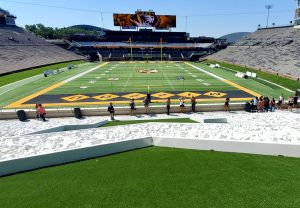

As autumn sets mid-Missouri ablaze beneath crystal-blue skies, wisps of cirrus clouds float by, and savory smoke plumes from tailgate grills, few would dispute that it’s the region’s truest time of year.
It’s a cornucopia for the senses during peak football season — especially when the University of Missouri is enjoying gridiron success. Marching Mizzou fills Memorial Stadium with the strains of “Fight Tiger/Every True Son.” Echoes of “M-I-Z, Z-O-U!” rattle the bleachers. Cannon explosions punctuate each black-and-gold touchdown.
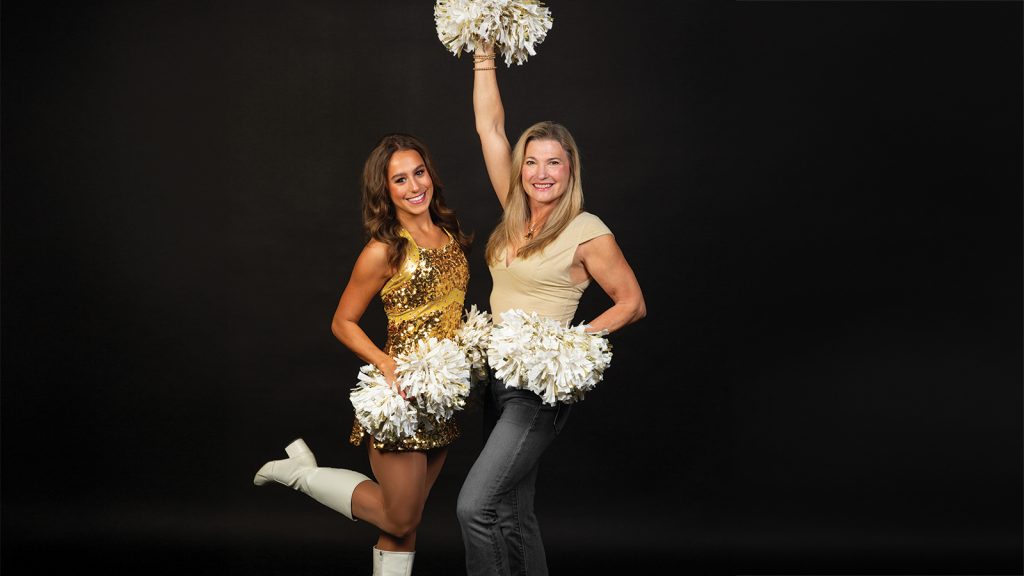
For six decades, the Golden Girls — whose sequined uniforms shine almost as brightly as their thousand-kilowatt smiles — have twirled, kicked, and pom-pommed at the center of it all. And although the iconic squad might seem as synonymous with Ol’ Mizzou as the ionic Columns on Francis Quadrangle, there was a time when the concept was novel.
The 1960s were a golden era for Mizzou football, when Coach Dan Devine led the Tigers to seventy-seven wins and five bowl games. MU bands director Charles Emmons, ever the mastermind, knew only innovation would keep his musical marchers in championship form.
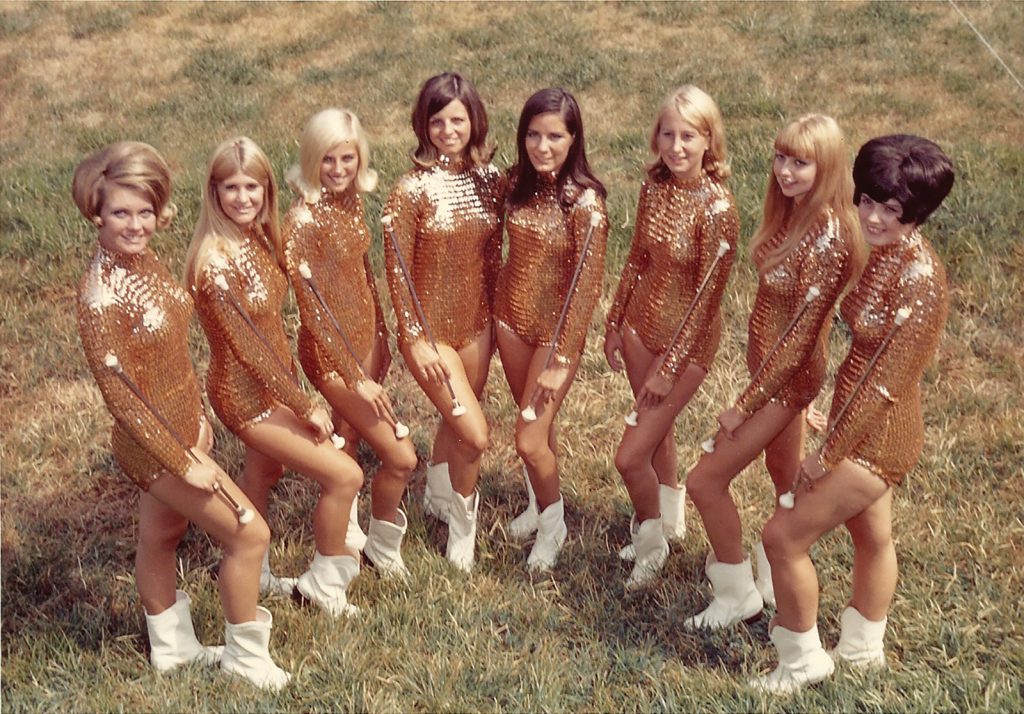
The moment of inspiration arrived via Sandy Davidson, a now retired professor from the MU School of Journalism, who in 1964 was a baton-twirling majorette wearing a silver-sequined leotard to band tryouts.
“He said, ‘I’d like to see that in gold,’” Patty Kespohl, former Golden Girls coach for thirty-three years, told MIZZOU alumni magazine in 2015. “We weren’t officially announced as the Golden Girls — maybe a reporter gave us that name — but we were always looking for twirlers until [Emmons’ successor Alex] Pickard got tired of watching the girls pick up dropped batons.”
Pickard and Kespohl eventually phased out the batons, transitioning to more elaborate halftime dance routines and attracting more experienced dancers. Early choreography included the Charleston and a performance set to the song “Kids” from the musical Bye Bye Birdie.
“The Golden Girls were still just newbies when I tried out in 1969, but a lot of them had dancing experience being from big cities, so I had to work extra hard,” said Linda Russell, squad member from 1969 to 1971. “Tryouts were in the basement of Jesse Hall, and I practiced for hours in front of a mirror at my sorority. By golly, I was determined to be good.”
The troupe was virtually an overnight success, leading the Homecoming parade and catching the eye of executives at the NFL’s St. Louis Cardinals. Kespohl and crew were bused to the Gateway City for five seasons in the 1970s, trading Saturday gold for Sunday red and white and sashaying on the Busch Stadium turf as part of “The Big Red Line.” But the gig proved too much to ask of college students, whose grades suffered, and leadership eventually abandoned the side hustle.
In 1987, former MU Director of Athletics Joe Castiglione invited the Golden Girls to perform during halftime and timeouts of men’s basketball games. The thirty-girl team was trimmed to fourteen dancers to accommodate the sport’s smaller environs, which inadvertently tightened the routines and might have led to the squad’s back-to-back championships (1990 and 1991) at the National Cheerleaders Association competition in Dallas. (The Golden Girls also won the 2003 United Spirit Association Collegiate Nationals competition in Las Vegas.)
“Mizzou basketball was really good in the ’90s, and the Hearnes Center was rocking,” said Chrissy Meyer. “After we won the dance championship, we got to go to Japan and cheer during NBA exhibition games.”
These days, it’s no exaggeration to say the Golden Girls are internationally known. In addition to the exposure that accompanies Mizzou athletics’ prominence, the squad has performed with Marching Mizzou during the St. Patrick’s Day Parade in Dublin, Ireland; has appeared in the Macy’s Thanksgiving Day Parade in New York; and is slated to attend London Band Week in June 2026.
The Golden Girls also participate in countless annual events supporting a variety of causes, including ALS Walk, Big Brothers Big Sisters, Lizzy’s Walk of Faith, Playing 4 Hope, and the SuperFinn Autism Foundation.
“Being a Golden Girl is about so much more than wearing the gold sequins and white boots,” said Cayla Timberlake, a Golden Girl from 2008 to 2012 and current head coach. “It’s about being the face of the University of Missouri and being ambassadors, not only for this community but for the state of Missouri.”
Read on as Golden Girls alumnae share their experiences from the past sixty years.
 Linda Russell
1969-72, BS Ed ’72, M Ed ’87
Growing up in tiny Craig, Missouri, Linda Russell learned early that stepping outside one’s comfort zone meant growth — especially when you’re 5-foot-3.
“I did a variety of things I never would have tried because everyone had to participate,” Russell said. “It didn’t matter if you were any good, so I joined the basketball team.”
The trend continued when Russell followed her older brother to Mizzou in 1969 and a friend suggested she try out for the Golden Girls. The fearless freshman’s tenacity and work ethic landed her a spot.
“I remember collapsing from heat exhaustion during practice one hot August day,” Russell said. “They gave us salt pills back then because they thought they helped, and the next day I was right back out there.”
Russell’s highlight as a Golden Girl was performing in the 1970 Orange Bowl in Miami, where Mizzou lost to Penn State 10-3. She earned bachelor’s and master’s degrees in education and taught social studies for thirty-one years at Columbia Public Schools.
“I’ve always been comfortable being in front of lots of people in all kinds of situations, and I attribute that to being a Golden Girl,” Russell said. “The experience opened up so many doors for me.”
 Julie Yoakum Durham
2000-04, BA ’04
Julie Yoakum Durham’s career highlight as a Golden Girl occurred 1,400 miles west of Faurot Field, in Las Vegas, where she and her teammates competed in the 2003 United Spirit Association Collegiate Nationals.
As the ten squads were announced in reverse order, from last place to first, the excitement among the Mizzou girls grew with each revealed name.
“Talk about a build-up,” Durham said. “Announcing ten teams takes a while, and the celebration basically starts when they announce second place — because then you know you’ve won. I’ve never seen so much instant shock and joy in my life.”
Former coach Shannon Fry spotted Durham’s leadership potential early and made her a squad captain as a sophomore. She held the spot for three years and continued to handle choreography after graduating.
“They couldn’t get rid of me,” said Durham, laughing. “It takes a lot of patience to lead a dance group, from reading band charts to choreographing for a football field, basketball court, or stage.”
These days Durham is the real-world learning coordinator for Lindbergh Schools in St. Louis, where she facilitates mentorships and programming that connects students to various career paths.
“Anything besides an influencer or professional athlete,” Durham said. “Not that those aren’t great careers, but many kids think that’s all there is. I help them with internships, apprenticeships, and job-shadow experiences to figure out what they want to be when they grow up.”
 Amy Trader Bradley
2009-13, BS ’13
The list of sports dance teams with a more prominent profile than the Golden Girls isn’t long, but the Dallas Cowboys Cheerleaders certainly top it.
A trailblazer in more ways than one, Amy Trader Bradley joined the group after the grueling tryout process — and the corresponding CMT show Dallas Cowboys Cheerleaders: Making the Team — in 2015 to become the first Mizzou alumna on the famed NFL troupe.
“On a whim, I went down to Dallas and didn’t tell anyone because I thought there was no way I would make the team,” Bradley said. “I had nothing to lose, so I decided I was just going to have fun with it.”
Another thing that might have helped was her previous experience on the New York Knicks dance team, where Bradley performed under the bright lights of Madison Square Garden.
A biomedical engineering major with a minor in computational neuroscience, Bradley was on a team of students that developed a patented, minimally invasive spinal implant for herniated disc repair. She also recently welcomed a baby boy to her family.
“Being a Golden Girl helped me make those other dance teams because of the standard of excellence we were held to,” Bradley said. “Nothing surprised me or intimidated me thanks to my experience at Mizzou.”
 Tina Keller Budzinski
1997-2000, BS ’02
Tina Keller Budzinski was fortunate to experience Mizzou football’s reemergence when the Tigers traveled to San Diego for the 1997 Holiday Bowl — the program’s first bowl game in fourteen years at the time. She was also there for another moment that lives in Mizzou infamy: the “Kicked Ball” game, in which Nebraska scored a last-second touchdown to tie Missouri after a deflected pass was booted into the air and caught.
But her favorite moment happened every Saturday — win or lose — standing midfield at Faurot, bedazzled in gold sequins and bathed in sunlight during the national anthem.
“There are so many things that you get to do and experience as a Golden Girl, but that’s right at the top for me,” said Budzinski, who coached dance at William Jewell College and now serves as varsity head coach of the dance team at Pembroke Hill School in Kansas City, Missouri. “I tell all of my dance students, ‘Find your moment like that and make it last a lifetime.’”
Livie Causey
2022-present, health sciences major
For current squad member Livie Causey, the memory of making the cut is still vivid.
Her mom, a Mizzou alum (as is her dad), joined her on the long drive from Dallas to Columbia. Before entering Mizzou Arena — packed with hundreds of hopefuls — they paused to pray.
“After making it through the first day, I thought, ‘OK, it’s getting real now,’” said Causey, who has danced competitively since age 5. “They posted the results on Instagram, and I was shaking. My mom and I counted to three and opened it. I just remember screaming, crying — and then Facetiming my dad. He was crying, too.”
Now a veteran Golden Girl, Causey treasures the team’s trips to The Big Apple and The Emerald Isle.
“Waking up at 2 a.m. to rehearse on the New York streets made for a crazy long day, but it was the experience of a lifetime,” she said. “When we travel, we get so silly and goofy — the laughs are the best. We’re a sisterhood, and it’s really shaped who I am today.”
Chrissy Stanard Meyer
1989-93, BS ’93
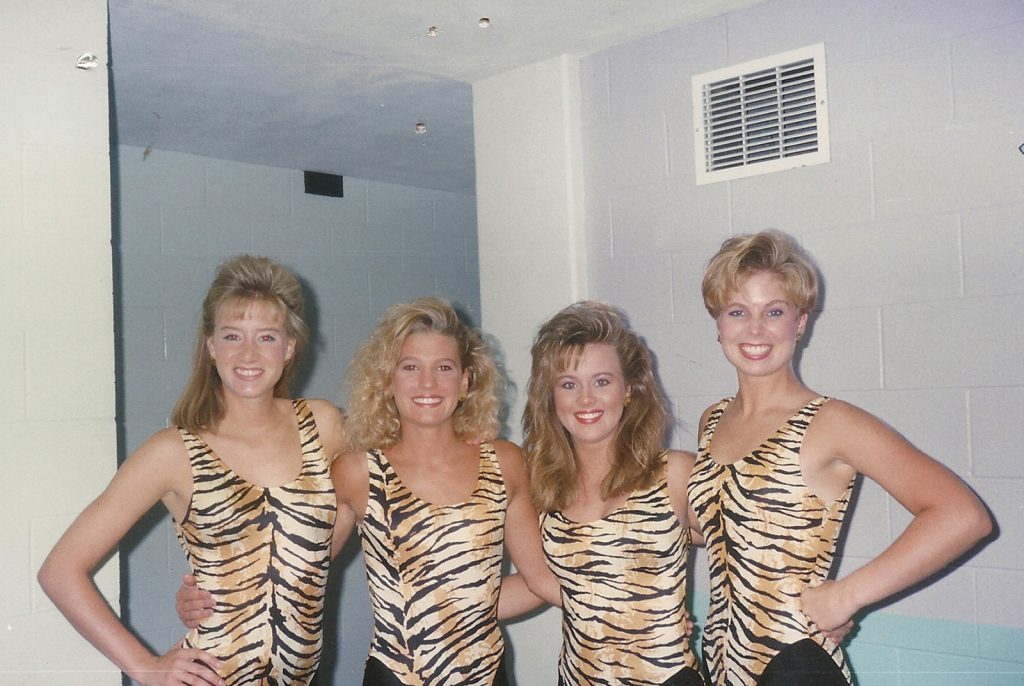
Although she didn’t realize it at the time, Chrissy Meyer came to Mizzou as a throwback to a bygone era — an enthusiastic baton twirler hoping to lead the band.
“I sent in my video and application, and they told me they weren’t holding tryouts, but they sent me an application for the Golden Girls,” Meyer said. “I absolutely fell in love with it — and I ended up twirling at some of the football and basketball games as well.”
Meyer’s tenure overlapped with some lean years for Mizzou football, but she was there for the infamous Fifth Down Game — when referees lost track of the downs, allowing the eventual NCAA champion Colorado Buffaloes an extra play as time expired to defeat the Tigers 33-31.
“I highly recommend dance classes, no matter where life takes you,” said Meyer, who is a pharmaceutical auditor and an Orangetheory instructor. “It teaches you dedication, coordination, and body control, valuable tools regardless of your path.”