
Every family leaves a legacy, whether through heirlooms, land, or the values passed on to children. The Community Foundation of Central Missouri exists to make sure part of that legacy can also strengthen local nonprofits and communities.
As billions of dollars shift from one generation to the next, the foundation is working to ensure more of that wealth stays local and that every gift, big or small, has the power to make a lasting difference.
CFCM is one of eight community foundations in the state, and it serves a ten-county region, not just Columbia. Its role is to connect local generosity with local needs and steward those dollars so they make a difference for years to come. That can mean a grant to a food pantry, a scholarship for a first-generation student, or an endowment that reliably supports an arts program every year.
CFCM serves as a transitional steward, helping donors create meaningful community support from their assets. That might mean cash, stocks, real estate, or more unusual contributions.
“If it’s legal, we’ll take it,” says Executive Director Eric Sappington.
He jokes that if someone wanted to donate an elephant, CFCM would find a way to make it work. In reality, most non-cash gifts are liquidated so their value can flow to a nonprofit cause. The point, Sappington says, is that the foundation’s role is to ensure donations are handled properly, donor intent is respected, and the end result is charitable dollars at work in mid-Missouri.
“We’re the gatekeepers,” he says. “We make sure the process is followed, and the money goes where it’s supposed to.”
That process is designed to be straightforward for donors and airtight behind the scenes. A typical pathway starts when a family reaches out with a question regarding anything from stock to rental property. CFCM talks through goals, timing, and beneficiaries, then coordinates with the donor’s attorney or tax professional. Assets are reviewed, appraised when needed, and, if accepted, converted into charitable dollars that flow to the nonprofit the donor designates or into a fund for ongoing support. The family gets the tax documentation they need, and the community gets the benefit.
Show-Me State the Money
America is in the midst of the largest wealth transfer in history, as Baby Boomers and older generations pass on trillions in assets. In Missouri, a study commissioned by the Alliance of Missouri Community Foundations projects a $153 billion transfer over the next ten years. Central Missouri’s share is estimated at $8.29 billion by 2032. If just 5 percent of that were directed to philanthropy, the region could generate more than $414 million for local causes, producing about $20 million annually if endowed.
“This is really about making sure those dollars stay here,” Sappington says. “We don’t want to see wealth leave Missouri when families move, or children inherit and take it elsewhere. Our job is to keep as much of it as possible in Central Missouri to benefit the community at large.”
Most mid-Missourians know CFCM through CoMoGives, the high-profile online campaign each December that raised nearly $2 million in 2024 alone. It remains the foundation’s “largest and loudest” effort, Sappington says, but it does not tell the whole story.
While CoMoGives can feel Columbia-centered, part of Sappington’s role is to remind donors and nonprofits across the region that they are just as central to the foundation’s mission.
And the year-end campaign is only one piece of CFCM’s work. Year-round, the organization offers tools that help families and businesses give in ways that fit their lives.
A Giving Vehicle for Every Donor
Donor-advised funds, sometimes described as philanthropic checking accounts, let people contribute when it makes sense, take an immediate tax deduction, and recommend grants over time.
Endowment funds are built for the long haul, providing nonprofits with reliable income year after year. One prominent example is the Columbia Arts Fund, a permanent endowment created in partnership with the city’s Office of Cultural Affairs to provide long-term support for local arts.
Each year, it underwrites projects from festivals and concerts to visual art exhibitions and educational programming. In September, the city highlighted several local artists whose work had been supported through Columbia Arts Fund grants, underscoring how a single endowed fund can ripple outward, nurturing creativity, building community identity, and giving residents more opportunities to connect through the arts.
Scholarship funds let donors name a fund and direct it to the school of their choice in honor of a loved one, often giving families more flexibility than a college or university can offer. At the University of Missouri, for example, creating a named scholarship requires either a $5,000 annual contribution or a $50,000 endowed fund, and any naming opportunities must be approved by the university. By contrast, CFCM can start a scholarship with any amount, making the idea of a family scholarship realistic instead of out of reach.
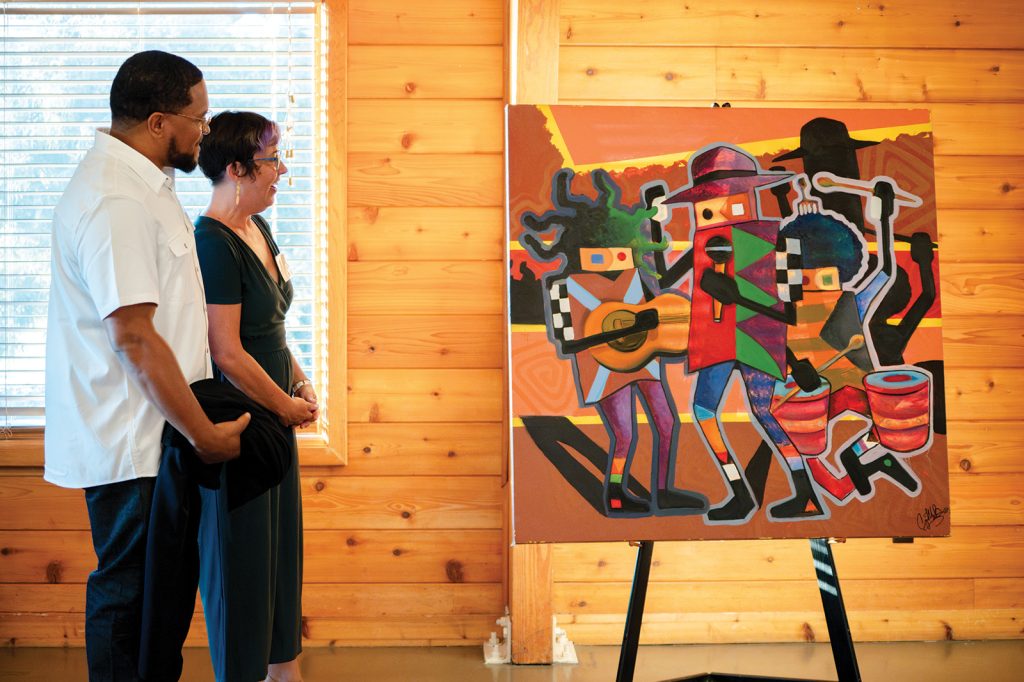
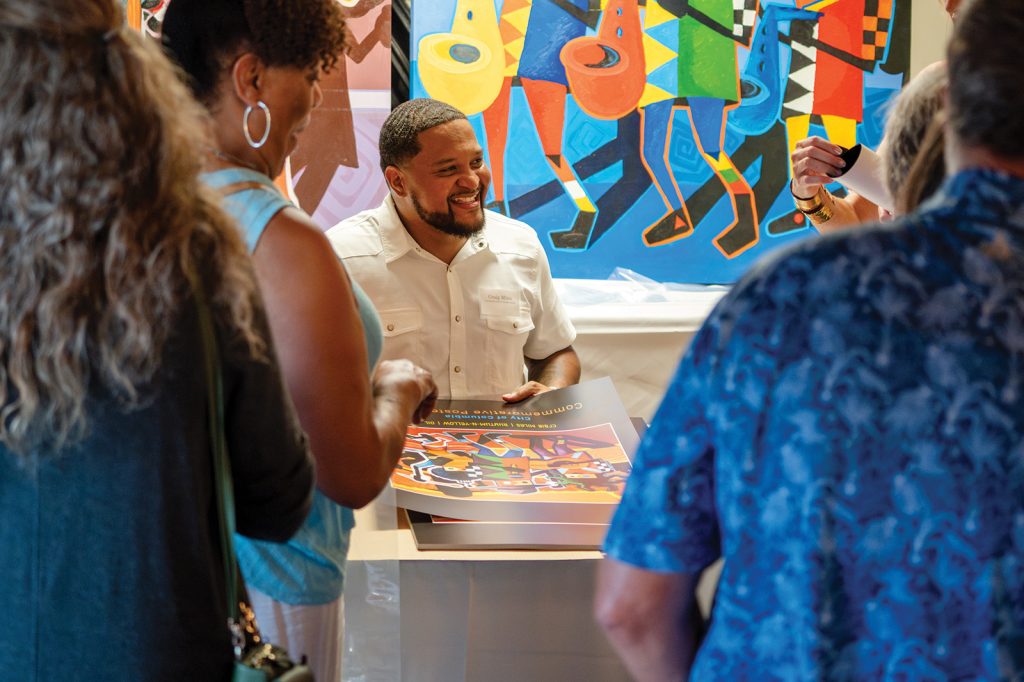
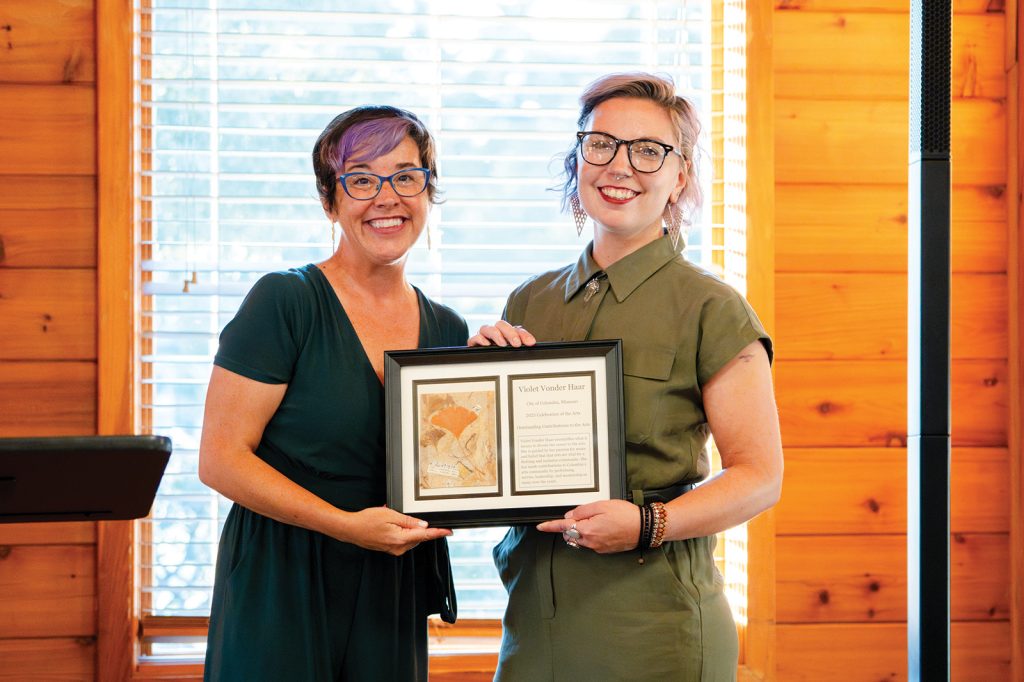
The Community Foundation of Central Missouri helps fund — through donations — the Columbia Arts Fund, which recently gave an award to Violet VonderHaar and unveiled the 2025 commemorative poster. The winning poster is Craig Miles’ oil painting Rhythm-N-Yellow.
Modest Gifts Can Multiply
If foundation giving still sounds like something reserved for the wealthy, Sappington is quick to push back.
“There’s no minimum,” he says. “This isn’t just for millionaires. Anyone can open a fund here.”
In practice, that might mean a teacher who wants to remember a parent with a modest memorial scholarship, a small business that wants to give back each year as it grows, or a family who donates part of the proceeds when they sell a piece of land.
Whatever the size or source, the foundation’s role is to ensure those gifts are handled responsibly. Donors want to know their gifts are managed with professionalism and transparency. Nonprofits rely on the consistency that comes with a partner focused on long-term stewardship. Communities benefit from the multiplier effect that happens when even modest gifts are pooled and invested carefully, then granted out to address local priorities. In rural counties where population is flat or declining, that kind of reliable philanthropy can be the difference between scaling a program and shuttering it.
The 5 percent idea puts the opportunity in plain view. If every family in Central Missouri left just 5 percent of their estate to local philanthropy, the impact would be permanent. Accomplishing this does not require a complicated estate plan. It can start with a single conversation and a simple fund.
As Sappington puts it, “The donor gets the tax break, the nonprofits get funding, and the community benefits long-term.”
That “win all around” mentality is the foundation’s North Star. It is also why CFCM keeps saying yes: to the routine gifts and the unusual ones, to the check mailed in December and the appreciated stock transferred in April, to the family farm set aside for a future sale and the modest scholarship in honor of a grandfather who taught his grandkids to read.
Whatever the size or class of a donated asset, the Community Foundation of Central Missouri exists to ensure that the transfer of wealth strengthens the region for decades to come.
And if a legacy idea happens to be a little unconventional, they are ready for that too — as long as it helps neighbors and keeps more of our shared future right here at home.