
For 35 years, Coyote Hill has been helping to
change future generations one child at a time.
For 35 years, Coyote Hill Foster Care Ministries has been helping children in foster care feel more safe and secure. Over 1,000 children have had their lives changed for the better thanks to the services Coyote Hill provides at its locations in Columbia, Jefferson City, Moberly, and Hannibal. The organization believes that every child deserves “a safe place to be a child,” as its tagline says. “We are here to change the lives of generations to come,” said Bill Atherton, Coyote Hill’s CEO.
A critical part of this message is understanding that stability is the most important thing for children in foster care. Having a solid, reliable home atmosphere frees children from worry and allows them to just be kids.
“If you have healthy relationships in children’s lives, then you can help them have stability,” Atherton explained. “Without stability and healthy relationships, I do think that the generational cycle of unhealthy living can just continue for families.”
From Vision to Reality
Breaking that unhealthy cycle was the vision of Larry and Cathy McDaniel, who founded Coyote Hill Christian Children’s Home in 1991, in their own house, by becoming foster parents themselves. The fostering experience made them realize, however, that there was a much greater need than they could meet as a single family.
Together, around their kitchen table, they dreamed of creating a place that offered professional services while keeping the family unit at the core. The next 35 years brought their dream to life.
In 1995, Mark and Laurene Zimmer donated a section of their land to the ministry to help it grow its resources. Coyote Hill’s first home was built and dedicated on this land in 1997. It was named “Cathy’s Home” to honor McDaniel and carry on her legacy after she passed away from cancer. As the need for foster homes grew over the years, so did the resources Coyote Hill was able to marshal. More care homes were built, which meant more children could be helped through the ministries’ programs.
Bill and his wife, Tammy, joined the staff in 1995 as the third home parents ever at Coyote Hill. In the nine years that the Athertons served as home parents, they worked with around 35 children, six of whom stayed with them for the majority of that time. Many of these children still have great relationships with the couple.
“If you can create stability for children and have healthier relationships with them, then they’re yours for life, and you become theirs for life,” Atherton said. “The children that you have time with, those are the ones that you really impact the most.”
Even though the Athertons never adopted any of the children in their care, per fostering policy, they still consider the children whose lives they touched to be their own. “We did choose to be lifelong grandparents and parents to children, and it’s been a joy and a privilege to be a part of,” Atherton said.
To this day, Atherton tells stories of the kids they fostered years ago, who are now adults and live all over the country. Most are married, and some have children of their own. Many of them have successful careers, and all live independent lives, yet they still call Atherton to catch up or ask for advice.
“You get the privilege of being a part of those types of things, because they don’t have those people in their lives,” Atherton said. “You will have a turn in this generational cycle for the better.”
Constant Mission, Changing Methods
While Coyote Hill’s mission of bettering children’s lives remains constant, the ways it does so have had to adapt. When the federal government passed the Family First Prevention Services Act in 2018, it changed the child welfare system — and the way that Coyote Hill operates. Since the law pushed children to be in family-focused homes rather than residential and group home placements, the organization had to rethink its operations.
“[That] opened this door on a dream that we kind of thought we’d never get around to, which was supporting foster families in their own homes and helping equip them the same way,” said Kari Hopkins, Coyote Hill’s chief operating officer.
At the start of 2020, it launched the Foster Care Services program, which supports individual foster families. The program’s goal was to recruit more families and retain these families as foster parents, since on average, 50 percent of families quit within the first year of fostering.
“Our kids are nearly twice as likely to be in a more stable home than other foster families,” Hopkins stated. “They’re averaging a good year with one family as opposed to moving every six months, which is more typical of what the state reports on averages for families.”
Coyote Hill’s recruitment process begins with identifying families and helping them recognize that they have the capability to serve as a foster family. Families are then trained so they can navigate the challenges of foster care. This training equips new foster parents to deal with everything they might encounter while working in the foster care system so they can better create stability for the kids in their care and enable them to have a normal childhood.
“If you allow children to not bounce from home to home, that means there’s a better shot at actually reunifying with parents or finding an adoptive home.”
Hopkins explained, “If you allow children to not bounce from home to home, that means there’s a better shot at actually reunifying with parents or finding an adoptive home.”

To make sure its families feel supported, Coyote Hill does acts of kindness for them, such as providing gift cards or sporting event tickets sent in by donors. Often, these gifted experiences are ones that children in foster care have never had the chance to enjoy before. These unique experiences help them create a closer connection with their foster families.
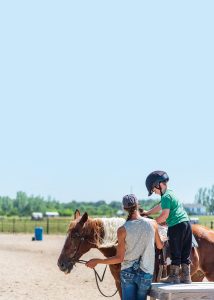
Speaking of unique experiences, the organization’s Equine Program partners each participating Coyote Hill kid with a horse and teaches them to ride and groom, tack, and care for their animal. When this program started at the Harrisburg location, only children on the property were allowed to participate. However, in the last few years, Coyote Hill has opened the program to serve any child who has been impacted by the foster care system, even if they have since been adopted. Once available only during the summer, the program now offers children the opportunity to ride horses all year round.
The Equine Program area is beautiful, with both indoor and outdoor riding areas, barns, sparkling lakes, and lovely homes. “It really is a special place if you haven’t visited,” Hopkins said. “It’s not what you expect; it is so much more than that.”
The Equine Program helps children develop confidence in themselves as they learn a unique skill. “We find that it builds a character in children that’s unique to them, and it does give them the confidence to go out into the world and to challenge themselves to do more things,” Atherton said.
Meeting Parents Where They Are
In the last few years, Coyote Hill saw a need to help children get on track to return home to biological families who are working toward the goal of reunification. It therefore created a visitation resource called the Family Connections program, with locations in Columbia and Jefferson City, whose purpose is to help children reunite with their biological parents. Family Connections volunteers are trained to supervise weekly visitations so that reconnecting parents with their children is more feasible than it would be with a caseworker. Reunifying families helps build the child’s support system and helps reduce trauma.
“We throw parties for these families because they need to be celebrated,” Atherton said. “It’s hard to do all the things that these parents have to do to reunify with their children, and it’s worth celebrating,”
This year, Coyote Hill opened a shelter home that it calls the Still Waters program; its first placements occurred in mid-June. Still Waters is a short-term care center where children can go if there is no other safe place for them. The program enables children to stay out of the foster care system while their parents take time to stabilize. Even though Still Waters currently consists of only one shelter home, Coyote Hill plans to grow the program into more homes in multiple locations in the future.
Doing the Work
Coyote Hill is a nonprofit that receives 85 percent of its funding from the community. “We don’t have large government contracts that are fully funding us to do this work,” Hopkins explained. “It really is people, families, churches, and businesses who say, ‘I care about this work, and I think these are children we should support.’”
Each year, over 50 families are licensed to foster through Coyote Hill, and as time goes on, even more families are saying “yes” to becoming foster parents. Last spring, Coyote Hill licensed its 300th family, and the retention rate of its families typically stays around 85 percent.
Still, the organization recognizes that there is a need for more foster homes in central and northeast Missouri, and to that end, it is hosting a foster parent class in the fall. “We’d love to have more families who are interested come forward and have a conversation with us about what it might look like to welcome a child into your home,” Hopkins said.
Children who come into care need one-on-one relationships to really feel stable and secure. To achieve this, more foster homes and foster families that can serve these children are needed. Those homes and families are what Coyote Hill strives to provide.
“In Missouri, there’s about 13,000 foster children in care right now,” Atherton explained. “We only have about a third of that in the way of active foster homes to care for children. We need to have more homes who can serve children.”
Being a foster parent is not for everyone: It’s a challenging job … but it’s also rewarding. Fortunately, there are ways to help within the system even without becoming a foster parent. Atherton believes that any adult can still be involved by serving as a mentor, tutor, or volunteer.
“I think we all can step in, even if it’s not in this world of foster care, but we need to reach out to our neighbors or those in need around us,” Atherton concluded. “These children will become our neighbors or our kids’ neighbors. They will become our employees or our bosses, and we need, and are required to have, a duty to help our neighbors be OK.”